



Mississippi Disclosure Statement Overview
Mississippi's seller disclosure statute, found at Sections 89-1-501 through 89-1-527 of the Mississippi Code Annotated, requires sellers of residential property to give buyers a written disclosure of known defects before any contract is signed. The law is straightforward in its purpose: buyers deserve to know what they are buying before they commit. Sellers who take the disclosure requirement seriously protect themselves from the kind of post-closing disputes that have defined too many Mississippi real estate transactions.
Termite and pest issues deserve special attention in Mississippi. The state's climate is ideal for subterranean termite colonies, and damage from wood-destroying insects is a leading cause of undisclosed defect claims. Most lenders require a Wood Destroying Insect report as a condition of financing, but sellers should not wait for the buyer's inspector to uncover termite history they already know about. Proactive disclosure of prior treatment or damage, along with documentation of any repairs, is the most defensible approach.
$25
Recording fee
None
Transfer tax
Required
Notarization
0
Witnesses required
Mississippi Requirements
Mississippi's disclosure statute applies to most residential property sales and requires the seller to complete a comprehensive written disclosure form covering the major categories of property condition. Here is what the statute requires sellers to address.
Mississippi Specific Note
Termite and pest disclosure is particularly critical in Mississippi. Subterranean termites are endemic to much of the state, and buyers and their lenders routinely require WDI reports. Sellers who know about prior termite damage or treatment and fail to disclose it face significant litigation exposure. Include all known history of infestations, treatments, and structural repairs on the disclosure form.
What Mississippi Sellers Must Disclose
- Structural Conditions: Foundation, roof, basement, crawl space, and walls, including any known settling, cracking, or prior structural repairs
- Pest and Termite History: Known prior or active infestations of wood-destroying insects, rodents, or other pests, plus any treatment history and repair records
- Water and Drainage: Any known flooding, water intrusion, drainage problems, or moisture issues in the home or on the land
- Mechanical Systems: Known defects in heating, cooling, plumbing, electrical, and any included appliances
- Environmental Hazards: Lead paint for pre-1978 homes, asbestos, mold, or other known environmental conditions
How to File in Mississippi
The Mississippi property disclosure form is delivered to the buyer, not filed with any government office. The steps below walk through how to handle the disclosure correctly in a Mississippi residential sale.
Complete the Disclosure Form Before Accepting an Offer
Fill out the form based on your actual knowledge of the property. Address every section, including structural, mechanical, pest, and environmental questions. Pulling together any past inspection reports, pest treatment records, or repair receipts before you start will make the process faster and more accurate.
Deliver to the Buyer Before Contract Signing
Mississippi law requires delivery before the purchase contract is signed. Hand the form to the buyer or transmit it through your agent before the buyer makes any offer. This avoids triggering the 3-business-day rescission window that applies when the form arrives late.
Get a Written Acknowledgment of Receipt
Have the buyer sign and date a receipt confirming they got the form. Keep a copy of both the completed disclosure form and the signed acknowledgment. These records are your best protection if a buyer later claims they were not informed of a condition.
Provide Lead Paint Disclosure Separately if Applicable
If the home was built before 1978, complete the federal lead-based paint disclosure form and provide the EPA pamphlet. This is required separately from the Mississippi statutory form and carries its own federal penalties for non-compliance.
Coordinate the WDI Report with the Transaction Timeline
While the Wood Destroying Insect inspection is typically ordered by the buyer, make sure the transaction timeline provides adequate time for it. If you already have a recent WDI report, share it with your agent so buyers are aware of its status upfront.
Mississippi Fees & Costs
Typical costs for filing in Mississippi. Actual fees may vary by county.
| Fee / Tax | Amount |
|---|---|
| Recording Fee | $25 |
| Transfer Tax | None |
| Notarization | $5 - $25 per signature |
| Certified Copy | $1 - $10 per page |
| Attorney Review (optional) | $150 - $500 |
Seller Liability for Non-Disclosure in Mississippi
Mississippi sellers who conceal known defects face liability under both the statutory disclosure law and the common law. Fraudulent misrepresentation claims require proof that the seller knowingly made a false statement that the buyer relied upon to their detriment. Negligent misrepresentation claims are broader and can succeed even without proof of intent to deceive, if the seller made a material statement without a reasonable basis for believing it was true.
Termite concealment is one of the most litigated areas in Mississippi real estate law. Sellers who have had treatment records, repair records, or prior inspection reports showing termite damage and who answered the disclosure form's pest section as if no issues existed have consistently lost in court. Mississippi judges and juries take a dim view of sellers who rely on the buyer's own pest inspection to surface problems the seller already knew about.
Flooding is another recurring issue. Properties in the Mississippi Delta, Gulf Coast areas, and flood-prone river corridors are well known to sellers who have lived through flood events. A seller who checks "no known flooding" for a property that has flooded in prior storms is taking on serious legal exposure, particularly now that buyers' lenders and insurers are scrutinizing flood history more carefully than ever before.
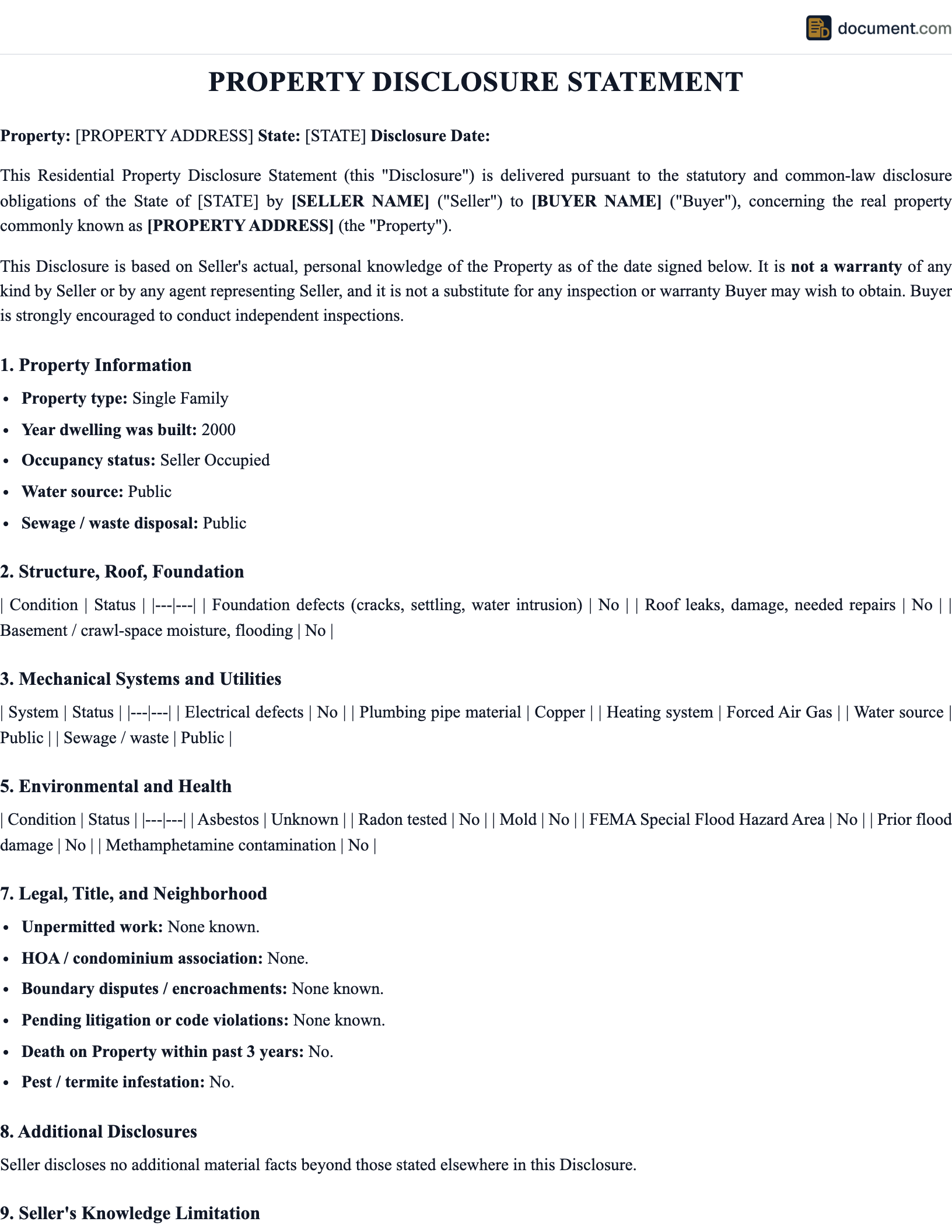
Sample Mississippi Disclosure Statement
Preview of our Mississippi-specific template. Your document will include all fields required for recording in any Mississippi county.
PROPERTY DISCLOSURE STATEMENT
STATE OF MISSISSIPPI
Legal Document
PARTY INFORMATION
Name: [Full Legal Name]
Address: [Mississippi Address]
County: [County]
PROPERTY DESCRIPTION
County: [County] State: Mississippi
Legal Description: [Per Recorded Plat]
Parcel No.: [APN]
Mississippi Disclosure Statement FAQ
Common questions about filing in Mississippi, including requirements, fees, and tax implications.
Official Mississippi Resources
Official state resources for verifying requirements and finding your local recording office.
Important Considerations for Mississippi Sellers
Pest and termite history is the single most important disclosure item for most Mississippi sellers. If you have any records of prior inspections, treatment contracts, or structural repairs related to wood-destroying insects, gather them before completing the disclosure form. Disclosing past termite treatment along with documentation of the work done is far less damaging to a sale than having a buyer discover it through a WDI report after the contract is signed.
Water intrusion and flooding history require honest answers. Mississippi buyers who take out federally backed mortgages are required to purchase flood insurance if the property is in a FEMA Special Flood Hazard Area, and their lenders often require flood zone determination reports as part of underwriting. A seller who discloses flood history is giving the buyer information they will likely discover anyway. A seller who conceals it is inviting a post-closing lawsuit.
The disclosure form should reflect what you actually know, not what you wish you knew. If a system has had intermittent problems, note that. If a roof has had minor leaks, note that. Many post-closing disputes arise not because sellers lied outright, but because they answered questions in the most favorable light possible rather than the most accurate light. Courts read disclosure forms carefully and look for answers that are technically true but designed to mislead.
Keep copies of the completed disclosure form, the buyer's signed acknowledgment, and any supporting documentation such as repair receipts or inspection reports that you referenced when completing the form. Store these records for several years after closing.
Seller Tip
If the property has had a prior pest treatment bond or warranty, contact the pest control company to confirm whether the warranty is transferable to the new owner. A transferable termite bond is a genuine selling point in Mississippi. Make sure it is disclosed prominently and that the transfer paperwork is handled at or before closing.
Related Documents
Depending on your situation, you may need additional documents alongside this one. Below are commonly related documents that are frequently used together in real estate transactions.
Important Considerations for Mississippi Sellers
Pest and termite history is the single most important disclosure item for most Mississippi sellers. If you have any records of prior inspections, treatment contracts, or structural repairs related to wood-destroying insects, gather them before completing the disclosure form. Disclosing past termite treatment along with documentation of the work done is far less damaging to a sale than having a buyer discover it through a WDI report after the contract is signed.
Water intrusion and flooding history require honest answers. Mississippi buyers who take out federally backed mortgages are required to purchase flood insurance if the property is in a FEMA Special Flood Hazard Area, and their lenders often require flood zone determination reports as part of underwriting. A seller who discloses flood history is giving the buyer information they will likely discover anyway. A seller who conceals it is inviting a post-closing lawsuit.
The disclosure form should reflect what you actually know, not what you wish you knew. If a system has had intermittent problems, note that. If a roof has had minor leaks, note that. Many post-closing disputes arise not because sellers lied outright, but because they answered questions in the most favorable light possible rather than the most accurate light. Courts read disclosure forms carefully and look for answers that are technically true but designed to mislead.
Keep copies of the completed disclosure form, the buyer's signed acknowledgment, and any supporting documentation such as repair receipts or inspection reports that you referenced when completing the form. Store these records for several years after closing.
Seller Tip
If the property has had a prior pest treatment bond or warranty, contact the pest control company to confirm whether the warranty is transferable to the new owner. A transferable termite bond is a genuine selling point in Mississippi. Make sure it is disclosed prominently and that the transfer paperwork is handled at or before closing.
Related Documents
Depending on your situation, you may need additional documents alongside this one. Below are commonly related documents that are frequently used together in real estate transactions.
Create your Mississippi Property Disclosure Statement in under 5 minutes.
Answer a few questions and download a Mississippi-compliant document, ready for the state agency.