
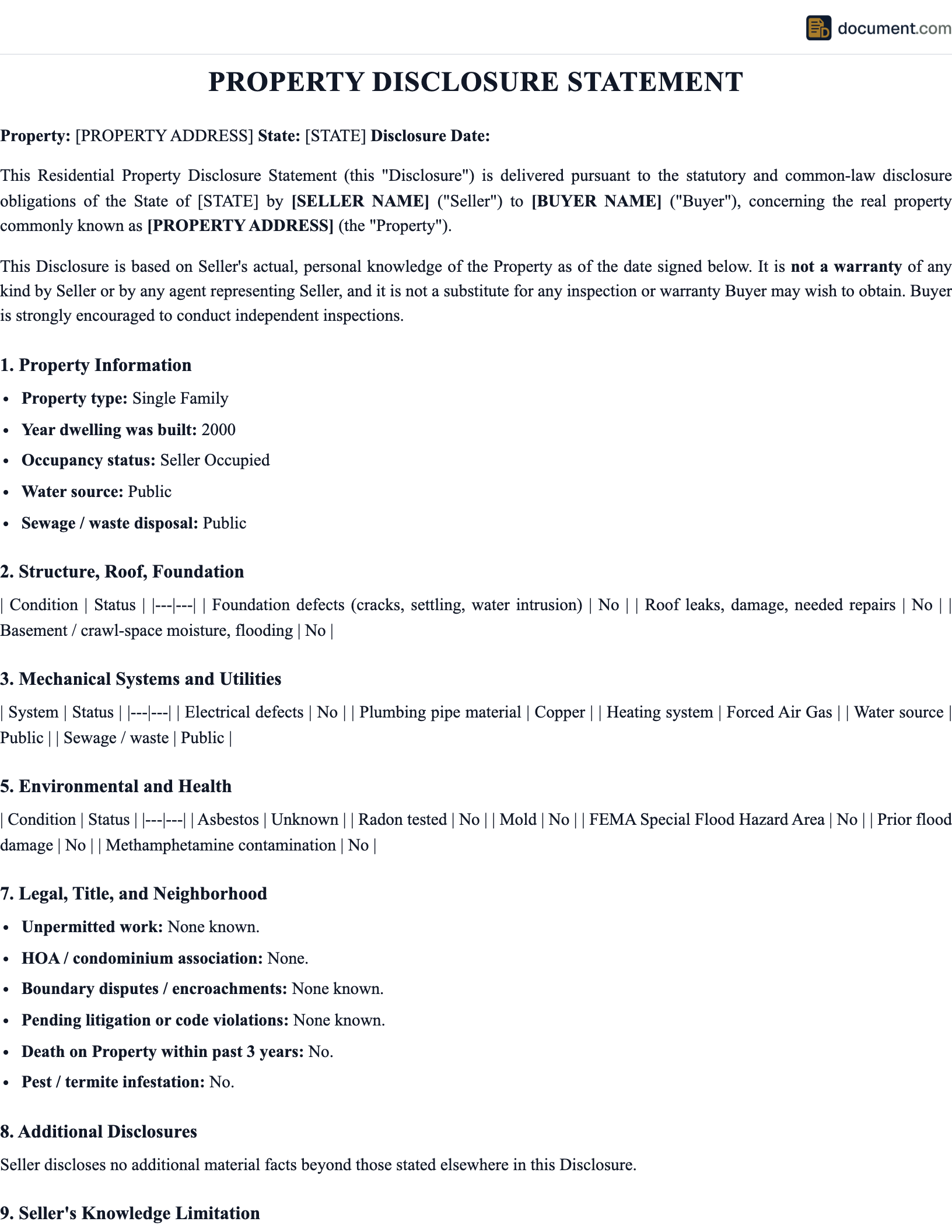



Minnesota Disclosure Statement Overview
Minnesota's seller disclosure law stands out for the breadth of what it requires sellers to share. Unlike states that limit disclosure to specific defect categories, Minnesota Statutes 513.55 requires sellers to disclose "all material facts of which the seller is aware that could adversely affect the buyer's use and enjoyment of the property or any intended use of the property of which the seller is aware." That's a broad mandate that goes beyond a checkbox form.
The 10-business-day rescission period is one of the longest in the country, and it serves an important function: it gives buyers real time to review the disclosure, ask follow-up questions, and make informed decisions before they are committed to the purchase. Sellers who try to deliver the disclosure at the last minute or after the purchase agreement is signed are inviting a rescission. The practical lesson is to have the disclosure form ready before the property goes on the market.
$46
Recording fee
$1.65 per $500
Transfer tax
Required
Notarization
0
Witnesses required
Minnesota Requirements
Minnesota's disclosure statute imposes specific obligations on sellers that go beyond a simple checklist. The following requirements apply to most residential sales in the state.
Minnesota Specific Note
Minnesota's 10-business-day rescission window is one of the longest in the country. If the seller delivers the disclosure form after the purchase agreement is signed, the buyer has 10 business days to walk away without penalty. Sellers should prepare and deliver the form before listing the property to avoid giving buyers this out after a deal has been reached.
What Minnesota Sellers Must Disclose
- Material Facts: Any known condition that could adversely affect the buyer's use and enjoyment of the property, whether or not it appears on a standard form
- Radon: Known radon test results and relevant radon risk information; Minnesota's geology produces elevated radon levels in many counties
- Wells and Septic: Location, status, and condition of all wells including abandoned wells, plus private septic system information and any available inspection records
- Unpermitted Work: Any additions, alterations, or improvements made without required building permits, including finished spaces, structural changes, or system upgrades
- Environmental Conditions: Known contamination, underground storage tanks, or other environmental hazards affecting the property
How to File in Minnesota
The Minnesota seller's disclosure form is delivered to the buyer, not filed with any government office. The key is timing: get it in the buyer's hands before the purchase agreement is signed to avoid triggering the 10-business-day rescission window.
Prepare the Disclosure Form Before Listing
Ideally, complete the Minnesota disclosure form before the property goes on the market. This allows you to provide it to prospective buyers as part of the showing process, before any offer is made.
Include Radon Test Results if Available
Gather any radon test results you have. If you have never tested, note that on the form. If tests showed elevated levels and mitigation was done, include both the original results and the post-mitigation results.
Deliver to the Buyer and Obtain Signed Acknowledgment
Provide the form to the buyer before or at the time the purchase agreement is executed. Have the buyer sign an acknowledgment confirming receipt and the date. Keep this documentation.
Provide Updated Disclosures if Conditions Change
If you discover a new material fact after the initial disclosure but before closing, Minnesota requires you to update the form. Note that an updated disclosure restarts the buyer's 10-business-day rescission window.
Provide the Separate Lead Paint Disclosure for Pre-1978 Homes
For homes built before 1978, the federal lead paint disclosure and EPA pamphlet are required separately from the Minnesota disclosure form. Both must be completed and provided to the buyer before the purchase agreement is signed.
Minnesota Fees & Costs
Typical costs for filing in Minnesota. Actual fees may vary by county.
| Fee / Tax | Amount |
|---|---|
| Recording Fee | $46 |
| Transfer Tax | $1.65 per $500 |
| Notarization | $5 - $25 per signature |
| Certified Copy | $1 - $10 per page |
| Attorney Review (optional) | $150 - $500 |
Seller Liability for Non-Disclosure in Minnesota
Minnesota's disclosure statute creates direct liability for sellers who fail to disclose material facts they know about. A buyer who discovers an undisclosed condition after closing can bring a statutory claim, as well as common law claims for misrepresentation. The 10-business-day rescission period represents the legislature's judgment that buyers deserve a meaningful opportunity to evaluate what they're being told before they commit.
Courts in Minnesota have found seller liability in cases involving undisclosed water intrusion, undisclosed structural problems, and failure to reveal the results of prior inspections the seller had commissioned. The seller's actual knowledge is what matters. Minnesota law does not require sellers to investigate conditions they are unaware of, but it does require honest disclosure of what they know.
Sellers should pay particular attention to the unpermitted work question. If you know that a prior owner added a room, finished a basement, or modified the electrical without permits, that is a material fact you are obligated to disclose. This is an area where sellers sometimes believe they don't need to report conditions they didn't personally create, but Minnesota's statute does not limit the duty to conditions the current seller caused.
Sample Minnesota Disclosure Statement
Preview of our Minnesota-specific template. Your document will include all fields required for recording in any Minnesota county.
PROPERTY DISCLOSURE STATEMENT
STATE OF MINNESOTA
Legal Document
PARTY INFORMATION
Name: [Full Legal Name]
Address: [Minnesota Address]
County: [County]
PROPERTY DESCRIPTION
County: [County] State: Minnesota
Legal Description: [Per Recorded Plat]
Parcel No.: [APN]
Minnesota Disclosure Statement FAQ
Common questions about filing in Minnesota, including requirements, fees, and tax implications.
Official Minnesota Resources
Official state resources for verifying requirements and finding your local recording office.
Important Considerations for Minnesota Sellers
Radon is the Minnesota-specific issue that sellers most commonly overlook. Much of the state sits over granite and other radon-producing geology, and elevated radon levels are found in homes across the Twin Cities metro, southern Minnesota, and the northwest. If you have never tested for radon, consider doing so before listing. A negative test result is a selling point. A positive result with a documented mitigation system in place is much better to disclose proactively than to have a buyer discover it through their own testing.
The well disclosure requirement catches sellers off guard when they don't know about an abandoned well on the property. In rural Minnesota especially, properties may have old agricultural or domestic wells that were never properly sealed. The state's county well index can help identify known wells. If there is an unsealed abandoned well, it needs to be disclosed and should be properly sealed before or as part of the sale.
Minnesota's broad "material facts" standard means sellers cannot rely on a checklist form alone. If there is something about the property that a reasonable buyer would want to know before purchasing, the seller is likely obligated to disclose it. When in doubt about whether something qualifies as a material fact, the answer from a liability standpoint is usually to disclose it.
Remember that the 10-business-day clock can restart if you provide an updated disclosure. If new information comes to light between signing and closing, updating the disclosure is the right thing to do legally, even though it gives the buyer another rescission window. Concealing newly discovered information after the initial disclosure is a separate ground for liability.
Seller Tip
Have the disclosure form reviewed by a Minnesota real estate attorney before you deliver it to a buyer. The cost is modest compared to the potential liability for a disclosure that is incomplete or ambiguous. Minnesota's broad material facts standard makes professional review particularly worthwhile.
Related Documents
Depending on your situation, you may need additional documents alongside this one. Below are commonly related documents that are frequently used together in real estate transactions.
Important Considerations for Minnesota Sellers
Radon is the Minnesota-specific issue that sellers most commonly overlook. Much of the state sits over granite and other radon-producing geology, and elevated radon levels are found in homes across the Twin Cities metro, southern Minnesota, and the northwest. If you have never tested for radon, consider doing so before listing. A negative test result is a selling point. A positive result with a documented mitigation system in place is much better to disclose proactively than to have a buyer discover it through their own testing.
The well disclosure requirement catches sellers off guard when they don't know about an abandoned well on the property. In rural Minnesota especially, properties may have old agricultural or domestic wells that were never properly sealed. The state's county well index can help identify known wells. If there is an unsealed abandoned well, it needs to be disclosed and should be properly sealed before or as part of the sale.
Minnesota's broad "material facts" standard means sellers cannot rely on a checklist form alone. If there is something about the property that a reasonable buyer would want to know before purchasing, the seller is likely obligated to disclose it. When in doubt about whether something qualifies as a material fact, the answer from a liability standpoint is usually to disclose it.
Remember that the 10-business-day clock can restart if you provide an updated disclosure. If new information comes to light between signing and closing, updating the disclosure is the right thing to do legally, even though it gives the buyer another rescission window. Concealing newly discovered information after the initial disclosure is a separate ground for liability.
Seller Tip
Have the disclosure form reviewed by a Minnesota real estate attorney before you deliver it to a buyer. The cost is modest compared to the potential liability for a disclosure that is incomplete or ambiguous. Minnesota's broad material facts standard makes professional review particularly worthwhile.
Related Documents
Depending on your situation, you may need additional documents alongside this one. Below are commonly related documents that are frequently used together in real estate transactions.
Create your Minnesota Property Disclosure Statement in under 5 minutes.
Answer a few questions and download a Minnesota-compliant document, ready for the state agency.