
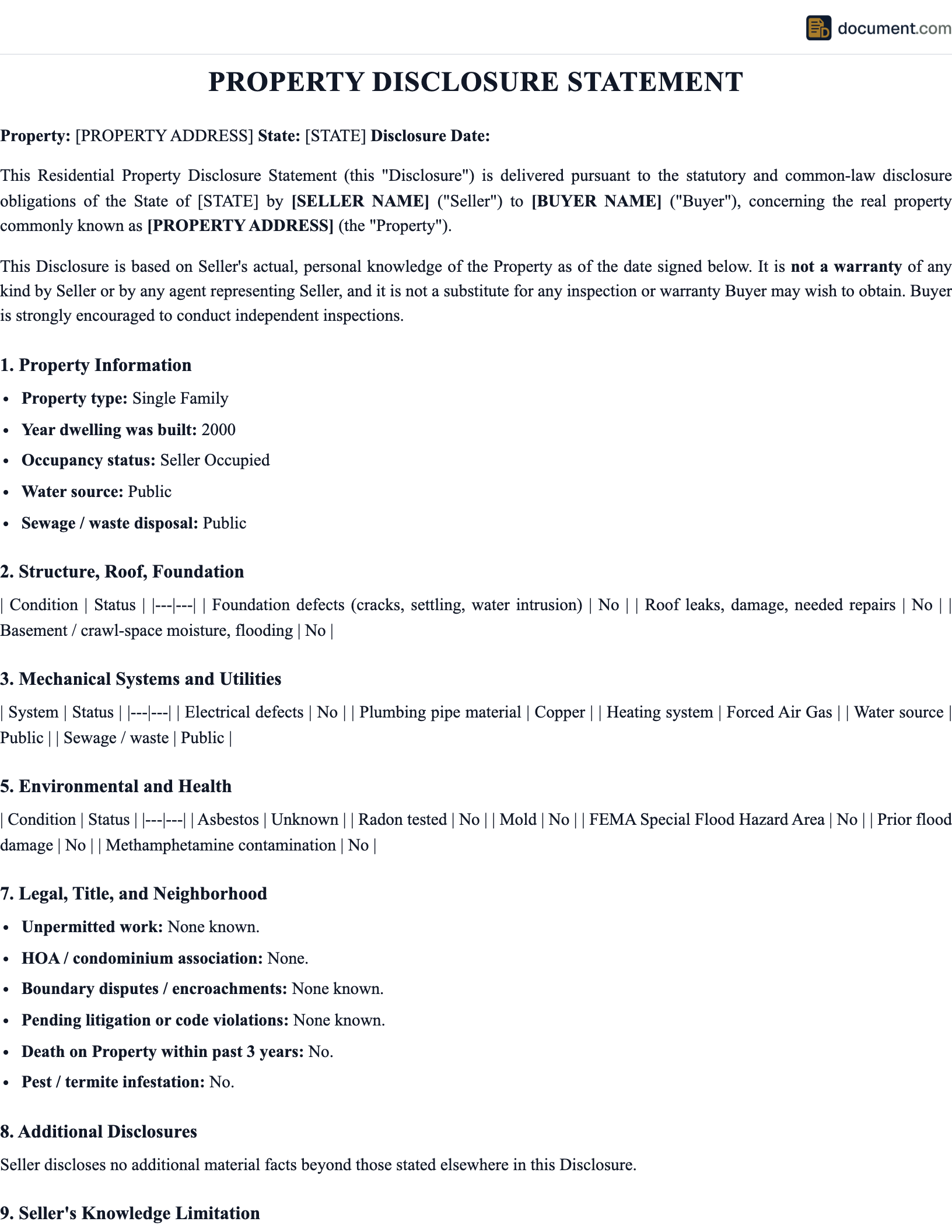



Michigan Disclosure Statement Overview
Michigan has one of the more comprehensive mandatory seller disclosure frameworks in the Midwest. The Seller Disclosure Act, MCL 565.951, requires sellers of residential property to provide a written disclosure of known conditions before the buyer signs a purchase agreement. The form itself is detailed, covering everything from the roof and foundation down to environmental hazards and flood zone status. Sellers who skip the form or fill it out sloppily take on meaningful legal risk.
The 3-day rescission right is one of Michigan's most buyer-friendly provisions. If the seller hands over the disclosure form after the buyer has already signed the agreement, the buyer can walk away clean within three business days. This creates a strong incentive for sellers to get the form completed and delivered before the offer stage, not as an afterthought once the deal is already signed.
$15
Recording fee
$3.75 per $500
Transfer tax
Required
Notarization
0
Witnesses required
Michigan Requirements
Michigan's Seller Disclosure Act sets out specific obligations that apply to most residential sales. Sellers should understand what the form covers, when it must be delivered, and what happens if they get it wrong.
Michigan Specific Note
Michigan's 3-day buyer rescission right applies when the disclosure is delivered after the purchase agreement is signed. To avoid giving buyers this window, sellers should complete and deliver the disclosure form before the buyer signs anything. Late delivery is one of the most common and avoidable compliance mistakes in Michigan residential transactions.
What the Michigan Form Must Cover
- Structural Conditions: Roof, foundation, basement, walls, and any known settlement, leaks, or prior repairs
- Mechanical Systems: Heating, cooling, electrical panel, and plumbing including any known deficiencies or recent replacements
- Environmental Hazards: Lead paint, asbestos, radon, mold, and underground storage tanks, both active and abandoned
- Flood Zone Status: Whether the property is in a FEMA-designated flood zone, which affects insurance costs for the buyer
- Water and Sewage: Well and septic system conditions, potability issues, and any prior water quality test results the seller is aware of
How to File in Michigan
The Michigan disclosure form is delivered directly to the buyer, not filed with any government office. Getting the process right comes down to timing and completeness.
Complete the Michigan Disclosure Form Thoroughly
Work through every section of the form. Answer each question based on your actual knowledge. If you don't know the answer, mark it as unknown rather than leaving it blank or guessing. Partial answers create ambiguity that tends to favor the buyer in disputes.
Deliver Before the Buyer Signs the Purchase Agreement
Give the completed form to the buyer before they sign anything. This eliminates the 3-day rescission window and puts both parties on equal footing from the start. Your agent can coordinate this as part of the listing process.
Get a Signed Acknowledgment from the Buyer
Have the buyer sign and date an acknowledgment confirming they received the disclosure form. Keep this record. It documents the timing and protects the seller if a dispute arises later over whether and when the form was provided.
Provide the Separate Lead Paint Disclosure if Applicable
If the home was built before 1978, complete the federal lead paint disclosure form in addition to the Michigan form. These are two separate documents with different legal requirements, and both must be provided to avoid federal penalties.
Update the Disclosure if Conditions Change Before Closing
If you discover a new material defect after delivering the form but before closing, you should update the disclosure. Failing to report newly discovered conditions exposes you to the same liability as failing to disclose them in the first place.
Michigan Fees & Costs
Typical costs for filing in Michigan. Actual fees may vary by county.
| Fee / Tax | Amount |
|---|---|
| Recording Fee | $15 |
| Transfer Tax | $3.75 per $500 |
| Notarization | $5 - $25 per signature |
| Certified Copy | $1 - $10 per page |
| Attorney Review (optional) | $150 - $500 |
Seller Liability for Non-Disclosure in Michigan
Michigan's Seller Disclosure Act creates a clear legal framework for what sellers owe buyers. When a seller provides a disclosure form with knowingly false information, they open themselves to claims for fraud and misrepresentation. Courts in Michigan have found liability where sellers checked "no" on disclosure questions they knew should have been answered "yes," even when the defect was later discovered during a buyer's inspection.
The remedies available to Michigan buyers include rescission of the transaction, money damages for repair costs, and in cases of deliberate fraud, punitive damages. Sellers should also be aware that their listing agent can face consequences if the agent had independent knowledge of the concealed condition. Michigan's licensing authority takes undisclosed defect complaints seriously.
One area where Michigan sellers frequently run into trouble is underground storage tanks. A buried heating oil tank that a seller didn't mention, even if they believed it was empty, can result in significant cleanup liability if contamination is found after closing. Disclosure is always the safer path, even when the seller believes a past issue has been resolved.
Sample Michigan Disclosure Statement
Preview of our Michigan-specific template. Your document will include all fields required for recording in any Michigan county.
PROPERTY DISCLOSURE STATEMENT
STATE OF MICHIGAN
Legal Document
PARTY INFORMATION
Name: [Full Legal Name]
Address: [Michigan Address]
County: [County]
PROPERTY DESCRIPTION
County: [County] State: Michigan
Legal Description: [Per Recorded Plat]
Parcel No.: [APN]
Michigan Disclosure Statement FAQ
Common questions about filing in Michigan, including requirements, fees, and tax implications.
Official Michigan Resources
Official state resources for verifying requirements and finding your local recording office.
Important Considerations for Michigan Sellers
The single most important practical step Michigan sellers can take is delivering the completed disclosure form before the buyer signs the purchase agreement. This is not just about compliance; it eliminates the statutory rescission window and prevents a scenario where a buyer backs out of a signed deal because of late delivery.
Sellers with older properties should pay particular attention to the environmental section of the Michigan form. Homes with oil heat history may have abandoned underground storage tanks. Homes in certain parts of Michigan near industrial areas may have groundwater or soil contamination concerns. If you have had any environmental testing done, keep those records and disclose the results.
The flood zone question deserves careful attention. If your property is in a FEMA-designated Special Flood Hazard Area, buyers will be required to purchase flood insurance, which adds to their monthly costs. Buyers who find out about flood zone status after closing sometimes claim they were not told, even when the information was available publicly. Disclosing it directly on the form removes any ambiguity.
Keep copies of the completed disclosure form and the buyer's signed acknowledgment for at least several years after closing. Statutes of limitations for fraud claims in Michigan can extend well beyond the closing date, and having documentation of what you disclosed and when is your best protection.
Seller Tip
If you are selling a home that has had prior water intrusion, foundation repairs, or mold treatment, document those repairs thoroughly on the disclosure form. A well-documented repair history does not decrease buyer confidence; it actually gives buyers more confidence than vague assurances that everything is fine.
Related Documents
Depending on your situation, you may need additional documents alongside this one. Below are commonly related documents that are frequently used together in real estate transactions.
Important Considerations for Michigan Sellers
The single most important practical step Michigan sellers can take is delivering the completed disclosure form before the buyer signs the purchase agreement. This is not just about compliance; it eliminates the statutory rescission window and prevents a scenario where a buyer backs out of a signed deal because of late delivery.
Sellers with older properties should pay particular attention to the environmental section of the Michigan form. Homes with oil heat history may have abandoned underground storage tanks. Homes in certain parts of Michigan near industrial areas may have groundwater or soil contamination concerns. If you have had any environmental testing done, keep those records and disclose the results.
The flood zone question deserves careful attention. If your property is in a FEMA-designated Special Flood Hazard Area, buyers will be required to purchase flood insurance, which adds to their monthly costs. Buyers who find out about flood zone status after closing sometimes claim they were not told, even when the information was available publicly. Disclosing it directly on the form removes any ambiguity.
Keep copies of the completed disclosure form and the buyer's signed acknowledgment for at least several years after closing. Statutes of limitations for fraud claims in Michigan can extend well beyond the closing date, and having documentation of what you disclosed and when is your best protection.
Seller Tip
If you are selling a home that has had prior water intrusion, foundation repairs, or mold treatment, document those repairs thoroughly on the disclosure form. A well-documented repair history does not decrease buyer confidence; it actually gives buyers more confidence than vague assurances that everything is fine.
Related Documents
Depending on your situation, you may need additional documents alongside this one. Below are commonly related documents that are frequently used together in real estate transactions.
Create your Michigan Property Disclosure Statement in under 5 minutes.
Answer a few questions and download a Michigan-compliant document, ready for the state agency.