



Maryland Disclosure Statement Overview
Maryland stands apart from most states in an important way: sellers here have a choice. Under Maryland Code Real Property Article 10-702, a residential seller can either complete a full property disclosure statement listing all known defects and material conditions, or file a disclaimer statement that makes no representations about the property's condition. Most states require disclosure; Maryland is one of the few that allows sellers to legally disclaim. The choice has real consequences for both pricing and liability, and it should be made deliberately rather than by default.
Regardless of which option a seller chooses, the form is delivered directly to the buyer. It does not go to a government recording office and is not notarized as part of this process. Maryland also requires additional disclosure documents for properties subject to HOA or condominium governance, and sellers of older Baltimore City properties may need to address ground rent when the land is held under a leasehold rather than in fee simple ownership.
$60
Recording fee
0.5%-1.5%
Transfer tax
Required
Notarization
0
Witnesses required
Maryland Requirements
Maryland Real Property Article 10-702 requires sellers to deliver either a completed disclosure statement or a disclaimer statement to the buyer before a contract of sale is executed. The buyer then has 5 days to rescind after receipt. Sellers who choose disclosure must complete all required sections honestly and completely. Sellers who choose disclaimer must understand they are not protected from fraud claims if they actively conceal known defects.
Maryland Specific Note
Maryland is unique in offering sellers the disclosure or disclaimer choice. Additionally, sellers of HOA and condominium properties must provide a separate resale package with governing documents and financial disclosures. Sellers of older Baltimore City rowhouses and certain surrounding properties must address ground rent if the property is held under a leasehold. Both HOA and ground rent disclosures carry their own rescission rights for buyers.
What Maryland Disclosures Must Cover
- Structural and systems: Foundation, roof, walls, HVAC, plumbing, and electrical condition as known to the seller
- Environmental: Lead paint in pre-1978 homes, asbestos, radon, underground storage tanks, and flooding history
- Ground rent: Whether the property is subject to a ground rent, the annual amount, and the lessor's identity
- HOA and condo: Governing documents, budget, pending special assessments, and any outstanding violations
- Legal encumbrances: Known easements, encroachments, zoning violations, and any pending litigation involving the property
- Water and sewer: Public or private utility source, well condition, and septic system status if applicable
How to Deliver the Maryland Disclosure Statement
The Maryland property disclosure or disclaimer statement is delivered directly to the buyer. It is not filed with any government office and carries no recording fee. The process differs slightly depending on whether the seller chooses the full disclosure option or the disclaimer option.
Choose Disclosure or Disclaimer
Maryland sellers must make an affirmative choice between completing a full property condition disclosure or filing a disclaimer statement. Consider your property's condition, your knowledge of any defects, and the likely effect on pricing and buyer expectations before deciding. Discuss the options with your real estate agent.
Complete and Sign the Selected Form
If disclosing, complete every section honestly based on your actual knowledge. If disclaiming, complete the disclaimer form. Either way, sign and date the form. Maryland does not require notarization of the property disclosure or disclaimer statement.
Deliver to the Buyer Before Contract Signing
Provide the signed form to the buyer or their agent before the contract of sale is executed. Document the delivery with a dated receipt or confirmation. For HOA or condo properties, the resale package must also be delivered, and it may have a longer preparation timeline.
Allow the Buyer's 5-Day Rescission Period
After receiving the disclosure or disclaimer, the buyer has 5 days to rescind the contract. If ground rent applies, there is a separate rescission period after ground rent disclosure. Be available to answer questions and provide supporting documentation during this period.
Keep All Signed Documents After Closing
Retain copies of the disclosure or disclaimer form, any ground rent disclosure, and the HOA resale packet if applicable. These documents are your evidence of what was disclosed and when, which can be critical if a buyer raises concerns after closing.
Maryland Fees & Costs
Typical costs for filing in Maryland. Actual fees may vary by county.
| Fee / Tax | Amount |
|---|---|
| Recording Fee | $60 |
| Transfer Tax | 0.5%-1.5% |
| Notarization | $5 - $25 per signature |
| Certified Copy | $1 - $10 per page |
| Attorney Review (optional) | $150 - $500 |
Seller Liability and Legal Consequences in Maryland
Maryland sellers who choose the full disclosure option and provide honest, complete answers have the strongest defense against post-closing claims. A buyer who was told about a defect before closing generally cannot claim it was concealed. Sellers who choose the disclaimer option reduce their exposure to claims based on unknown conditions, but they are not protected if they actively concealed a known defect behind the disclaimer form. Knowing concealment is still fraud regardless of which form was filed.
Maryland's Consumer Protection Act applies to residential real estate transactions and gives buyers a statutory remedy for deceptive trade practices, which courts have found to include intentional concealment of material property defects. A buyer who prevails on a Consumer Protection Act claim can recover damages plus attorney fees, which significantly raises the stakes of non-disclosure compared to a simple contract damages claim.
Sellers of Baltimore City properties with ground rent should be particularly careful about the ground rent disclosure process. Maryland enacted strict ground rent registration and disclosure requirements in recent years after buyers were harmed by undisclosed ground rent obligations. A seller who fails to properly disclose a ground rent can face both civil liability and regulatory consequences under Maryland's ground rent laws.
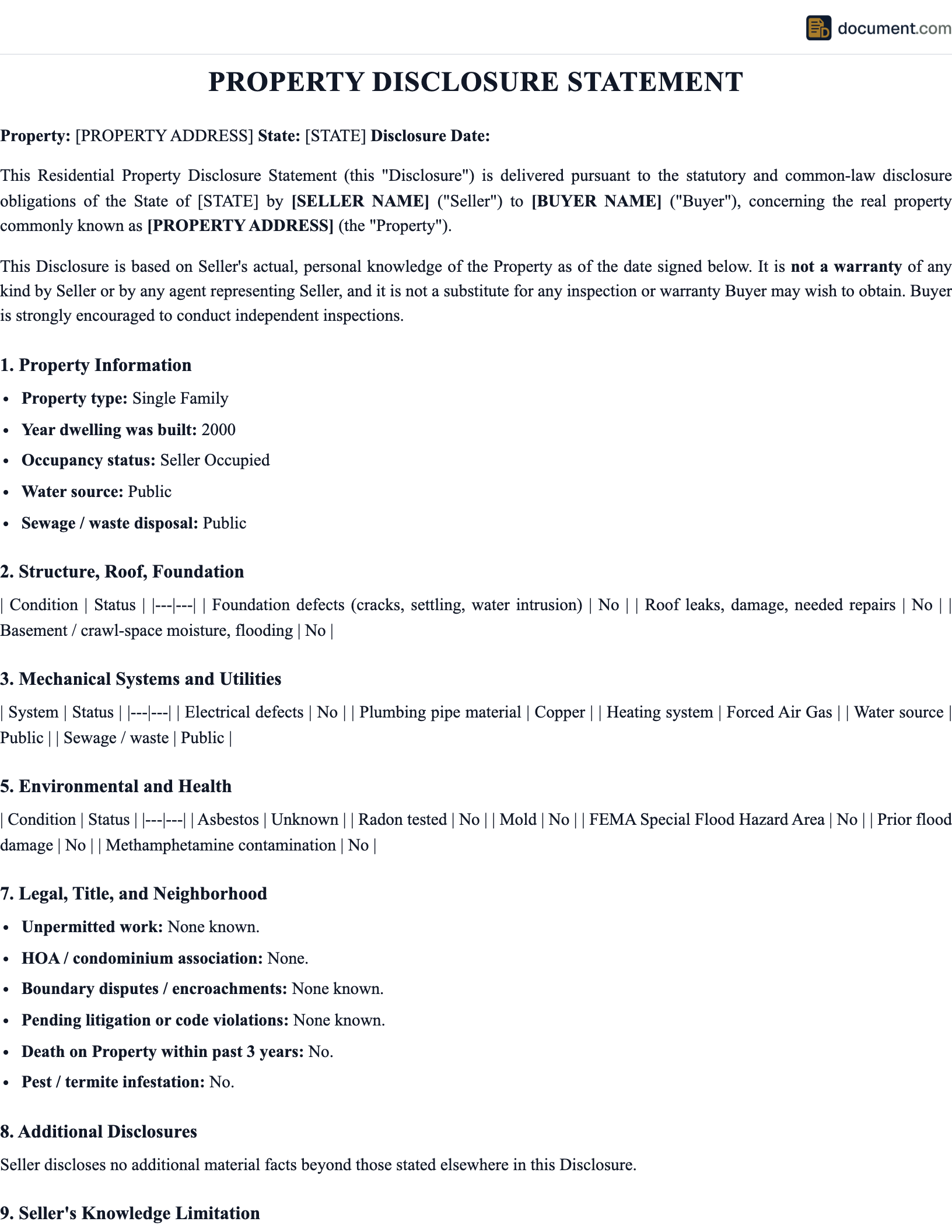
Sample Maryland Disclosure Statement
Preview of our Maryland-specific template. Your document will include all fields required for recording in any Maryland county.
PROPERTY DISCLOSURE STATEMENT
STATE OF MARYLAND
Legal Document
PARTY INFORMATION
Name: [Full Legal Name]
Address: [Maryland Address]
County: [County]
PROPERTY DESCRIPTION
County: [County] State: Maryland
Legal Description: [Per Recorded Plat]
Parcel No.: [APN]
Maryland Disclosure Statement FAQ
Common questions about filing in Maryland, including requirements, fees, and tax implications.
Official Maryland Resources
Official state resources for verifying requirements and finding your local recording office.
Important Considerations for Maryland Sellers
The disclosure versus disclaimer decision is one that Maryland sellers often make without fully understanding the consequences. Sellers who choose to disclaim sometimes believe they are eliminating all liability for the property's condition, which is not accurate. Disclaimer protects against claims based on conditions the seller genuinely did not know about, but it does not eliminate liability for intentional concealment. Sellers with known structural problems, foundation issues, or water damage history should think carefully before relying on a disclaimer to avoid discussion of those conditions.
Baltimore City sellers of rowhouses and other older properties should resolve the ground rent question before listing. Maryland has made ground rent registration mandatory in recent years, and properties with unregistered ground rents face restrictions on redemption and enforcement. Verifying whether a ground rent exists, confirming it is registered, and ensuring it is properly disclosed can prevent significant delays during the sale process.
Sellers in HOA-governed communities need to order the resale package well in advance of any expected closing. Maryland gives buyers rescission rights after receiving the HOA documents, and delays in obtaining the resale package can push back the entire closing timeline. Contact the HOA or property management company early in the listing process to understand what documents are required and how long they take to compile.
Maryland Seller Tip
If your property is a pre-1978 home in Baltimore City or the surrounding counties, be prepared for the lead paint process. Maryland's lead paint requirements are more detailed than the federal minimum, and buyers financing with FHA loans will face additional lead paint inspection requirements. Having any prior lead paint inspection or risk reduction documentation ready at listing will help the transaction move more smoothly.
Related Documents
Depending on your situation, you may need additional documents alongside this one. Below are commonly related documents that are frequently used together in real estate transactions.
Working with a Maryland Real Estate Attorney
Maryland is one of the few states where attorney involvement in residential real estate closings is not just common but essentially standard practice in many markets. Maryland settlement attorneys handle the closing process, prepare the deed, and ensure that all required disclosures and transfer documents are properly executed. The cost of settlement attorney services is typically shared between buyer and seller as part of the closing cost negotiation.
For sellers facing complex disclosure situations, having an attorney review the disclosure form before it is delivered to the buyer is advisable. This is particularly true for estate sales, properties with known structural issues, homes in historic districts with renovation restrictions, or any property subject to ground rent or complex HOA governance. An attorney can review the completed form and flag any areas where additional clarification or supporting documentation would reduce the seller's post-closing exposure.
After closing, retain all transaction documents including the signed disclosure or disclaimer form, the executed contract of sale, any HOA or condo resale documents, ground rent disclosures, lead paint disclosures, and inspection reports. Maryland's statute of limitations on fraud and misrepresentation claims allows buyers to bring suit for a period of years after discovering a concealed defect, so these records should be preserved indefinitely.
Professional Recommendation
Maryland sellers who are uncertain about whether to choose the disclosure or disclaimer option should consult a licensed Maryland real estate attorney before listing. The choice has meaningful legal and practical consequences, and it deserves more than a last-minute decision during the listing paperwork process.
Related Documents
Depending on your situation, you may need additional documents alongside this one. Below are commonly related documents that are frequently used together in real estate transactions.
Create your Maryland Property Disclosure Statement in under 5 minutes.
Answer a few questions and download a Maryland-compliant document, ready for the state agency.