



Louisiana Disclosure Statement Overview
Louisiana is unlike any other state when it comes to real estate law. As a civil law jurisdiction rooted in the Napoleonic Code, Louisiana uses legal concepts that have no direct equivalent in the other 49 states. The most important of these for property disclosure purposes is redhibition, which is the civil law doctrine covering hidden defects that would have prevented or altered the sale had the buyer known about them. The Louisiana Residential Property Disclosure Act, found at RS 9:3196 through 9:3200, was enacted to bring these obligations into a written form that sellers complete and deliver to buyers before each sale.
The disclosure form is given directly to the buyer. It is not filed with the parish clerk, not notarized as part of the disclosure process, and does not involve any government recording fee. Louisiana sellers should also understand that the state's climate creates specific disclosure concerns that are more pressing here than in most other states, particularly termite activity, flooding history, and storm damage from hurricanes and tropical weather.
$50
Recording fee
None
Transfer tax
Required
Notarization
2
Witnesses required
Louisiana Requirements
Under RS 9:3196, Louisiana sellers must complete and deliver the property disclosure form to the buyer before the sale is executed. The buyer then has 3 days to rescind after receiving the form. Louisiana's civil law framework gives buyers significant rights when sellers conceal redhibitory vices, making honest and thorough disclosure especially important in this state.
Louisiana Specific Note
Louisiana is a civil law state, and the legal consequences of concealing a redhibitory vice are more severe here than in most states. The buyer may have the right to rescind the entire sale, not just recover repair costs. Sellers should also be aware that WDI (termite and wood-destroying insect) reports are essentially required for every financed transaction given the state's climate. Flood history disclosure is critical for properties in any of Louisiana's many flood-prone areas.
What Louisiana Sellers Must Disclose
- Structural and foundation: Known settling, cracking, subsidence, or damage to load-bearing elements
- Termite and WDI history: Past or present termite activity, prior treatments, and any known damage
- Flood history: Any flooding on the property, disaster declarations, and current flood zone designation
- Storm damage: Prior hurricane or wind damage and insurance claims, including repairs made after storms
- Mechanical systems: HVAC, plumbing, electrical, and any known deficiencies in major systems
- Environmental: Asbestos, mold, lead paint in pre-1978 homes, and any known soil contamination
How to Deliver the Louisiana Disclosure Statement
The Louisiana property disclosure statement is not filed with any government office. It is a private document delivered by the seller to the buyer before the act of sale. The process is simple, though the timing requirements matter under RS 9:3196.
Complete Every Section of the Disclosure Form
Work through the Louisiana disclosure form carefully and answer honestly based on your knowledge as the property owner. Pay special attention to the flood history, termite and WDI history, and storm damage sections, which are especially relevant in Louisiana's climate.
Sign and Date the Form
The seller signs and dates the completed disclosure form. The property disclosure statement itself does not require notarization. Your signature certifies that the answers are accurate to the best of your knowledge at the time of signing.
Deliver to the Buyer Before Signing the Agreement
Provide the form to the buyer or their agent before the purchase agreement is executed. Keep a dated record of delivery, such as a signed receipt or an email confirmation with timestamp from the buyer's agent.
Allow the 3-Day Rescission Window
After receiving the disclosure, the buyer has 3 days to rescind the agreement. During this period, be responsive to buyer inquiries. If you have supporting documentation such as prior WDI reports, repair invoices, or elevation certificates, make them available promptly.
Retain the Signed Disclosure After Closing
Keep a copy of the signed disclosure form with your closing documents. Louisiana's civil law framework gives buyers significant rights after closing if undisclosed redhibitory vices are discovered, so your evidence of what was disclosed and when is important to preserve.
Louisiana Fees & Costs
Typical costs for filing in Louisiana. Actual fees may vary by county.
| Fee / Tax | Amount |
|---|---|
| Recording Fee | $50 |
| Transfer Tax | None |
| Notarization | $5 - $25 per signature |
| Certified Copy | $1 - $10 per page |
| Attorney Review (optional) | $150 - $500 |
Seller Liability and Legal Consequences in Louisiana
Louisiana's civil law tradition gives buyers unusually strong remedies when a seller conceals a redhibitory vice. Unlike common law states where the buyer's remedy is typically limited to damages, a Louisiana buyer who discovers a qualifying hidden defect may seek full rescission of the sale under Louisiana Civil Code Article 2520. This means the seller must return the purchase price plus reimburse the buyer for all related expenses, including closing costs and even reasonable attorney fees in some circumstances.
A seller who is found to have known about a redhibitory vice and concealed it in bad faith faces even greater exposure. Louisiana courts treat knowing concealment as a form of fraud, and the consequences extend beyond simple rescission to include additional damages for the buyer's losses. By contrast, a seller who genuinely did not know about a defect has limited liability under the Civil Code, particularly if the sale was made AS-IS with an appropriate reduction in price reflecting the uncertainty.
The practical lesson for Louisiana sellers is that the AS-IS mechanism only works as intended when it reflects a genuine negotiation. A seller who prices a property at full market value, adds a boilerplate AS-IS clause, and then conceals known defects is not protected by that language. The clause must correspond to an actual reduction in price or a documented acknowledgment that the buyer is accepting risk of specific unknown conditions.
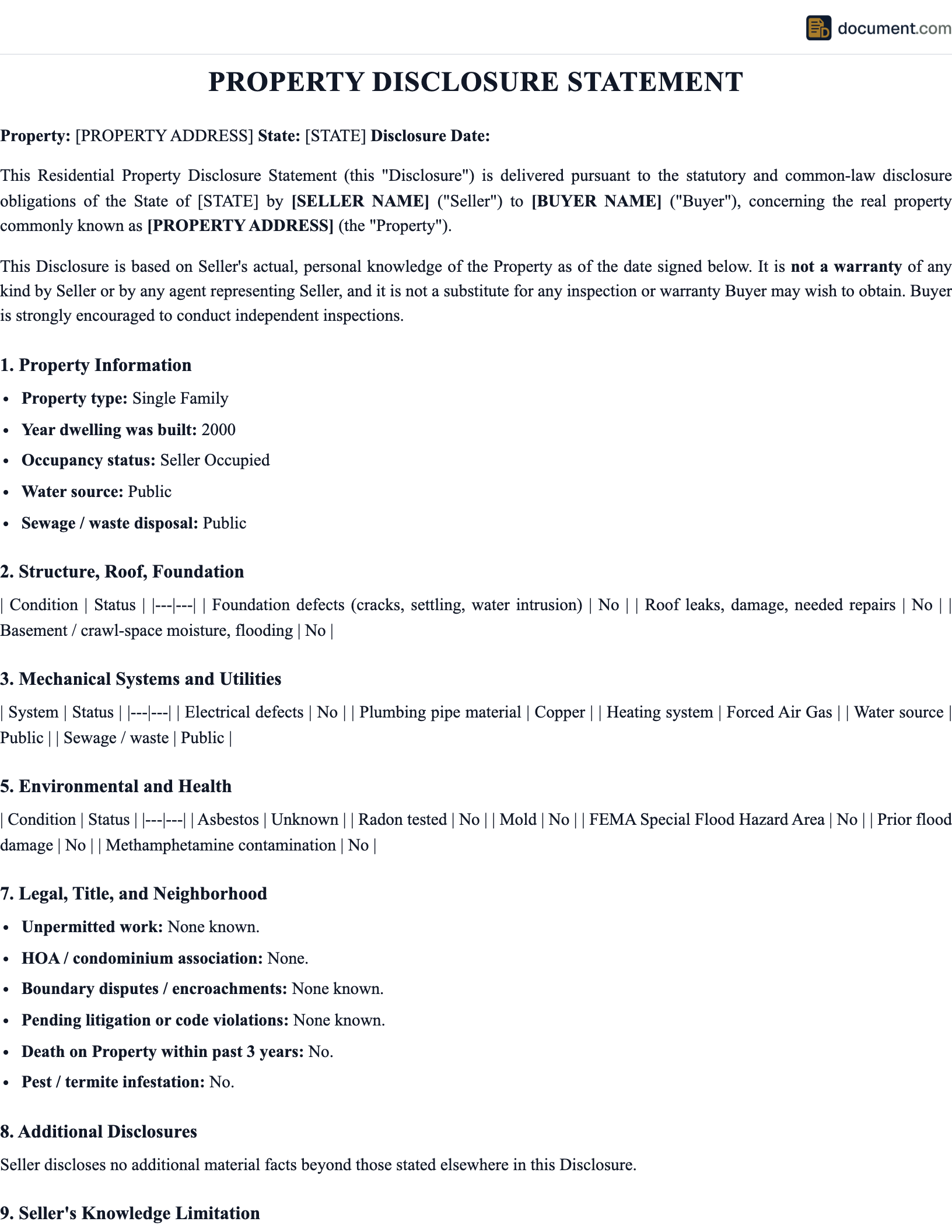
Sample Louisiana Disclosure Statement
Preview of our Louisiana-specific template. Your document will include all fields required for recording in any Louisiana county.
PROPERTY DISCLOSURE STATEMENT
STATE OF LOUISIANA
Legal Document
PARTY INFORMATION
Name: [Full Legal Name]
Address: [Louisiana Address]
County: [County]
PROPERTY DESCRIPTION
County: [County] State: Louisiana
Legal Description: [Per Recorded Plat]
Parcel No.: [APN]
Louisiana Disclosure Statement FAQ
Common questions about filing in Louisiana, including requirements, fees, and tax implications.
Official Louisiana Resources
Official state resources for verifying requirements and finding your local recording office.
Important Considerations for Louisiana Sellers
Louisiana sellers should gather supporting documentation before listing their property. A current WDI report from a licensed pest control operator, an elevation certificate from a licensed surveyor, and any insurance loss run reports from prior claims are documents that buyers will want to see and that support an honest disclosure. Having these ready before the first showing positions the seller as transparent and reduces the chance of contract disruptions later.
Properties that have sustained hurricane or tropical storm damage deserve particularly careful attention. Many Louisiana homeowners have made significant repairs over the years following storm events, and the disclosure form should reflect both the original damage and the repairs that were made. Buyers and their lenders will typically be looking at insurance claim history, and a disclosure that accurately reflects that history is far less problematic than one that appears to omit major storm events.
Sellers who purchased a property with known defects and are now reselling should be especially careful. If the prior seller disclosed something to you, that information is now known to you and must generally be passed along in your own disclosure. The obligation runs with the seller's knowledge, not just with conditions that arose during your specific ownership.
Louisiana Seller Tip
Because Louisiana is a civil law state with strong buyer remedies under the redhibition doctrine, sellers with any uncertainty about their disclosure obligations should consult a Louisiana real estate attorney before listing. The stakes of getting the disclosure wrong in Louisiana are higher than in most states, and a pre-listing legal review is time well spent.
Related Documents
Depending on your situation, you may need additional documents alongside this one. Below are commonly related documents that are frequently used together in real estate transactions.
Working with a Louisiana Real Estate Attorney
Louisiana real estate transactions are handled differently from those in common law states, and the involvement of a Louisiana notary public or real estate attorney in the closing process is standard practice. Louisiana notaries have authority to prepare and execute authentic acts of sale, and many Louisiana real estate closings are handled entirely by notaries rather than title companies in the traditional sense.
For disclosure purposes specifically, consulting a Louisiana real estate attorney before signing the disclosure form is advisable for any seller who has owned a property through significant storm events, has made major repairs, knows of prior defects, or is uncertain about the redhibition implications of their property's condition. An attorney familiar with Louisiana civil law can help sellers understand what must be disclosed and how to document it properly.
Retain all transaction documents after closing, including the signed disclosure form, the act of sale, any WDI reports, insurance documentation, and repair records. Louisiana's prescriptive period for redhibition claims is one year from discovery of the defect, or 10 years from the act of sale for apparent vices, so post-closing liability can extend for a significant period.
Professional Recommendation
Louisiana sellers with properties that have experienced hurricane damage, flooding, termite infestations, or other significant defect history should have their disclosure reviewed by a Louisiana real estate attorney before delivering it to the buyer. The redhibition doctrine gives buyers powerful remedies, and ensuring your disclosure is thorough and accurate is the most effective way to limit post-closing exposure.
Related Documents
Depending on your situation, you may need additional documents alongside this one. Below are commonly related documents that are frequently used together in real estate transactions.
Create your Louisiana Property Disclosure Statement in under 5 minutes.
Answer a few questions and download a Louisiana-compliant document, ready for the state agency.