
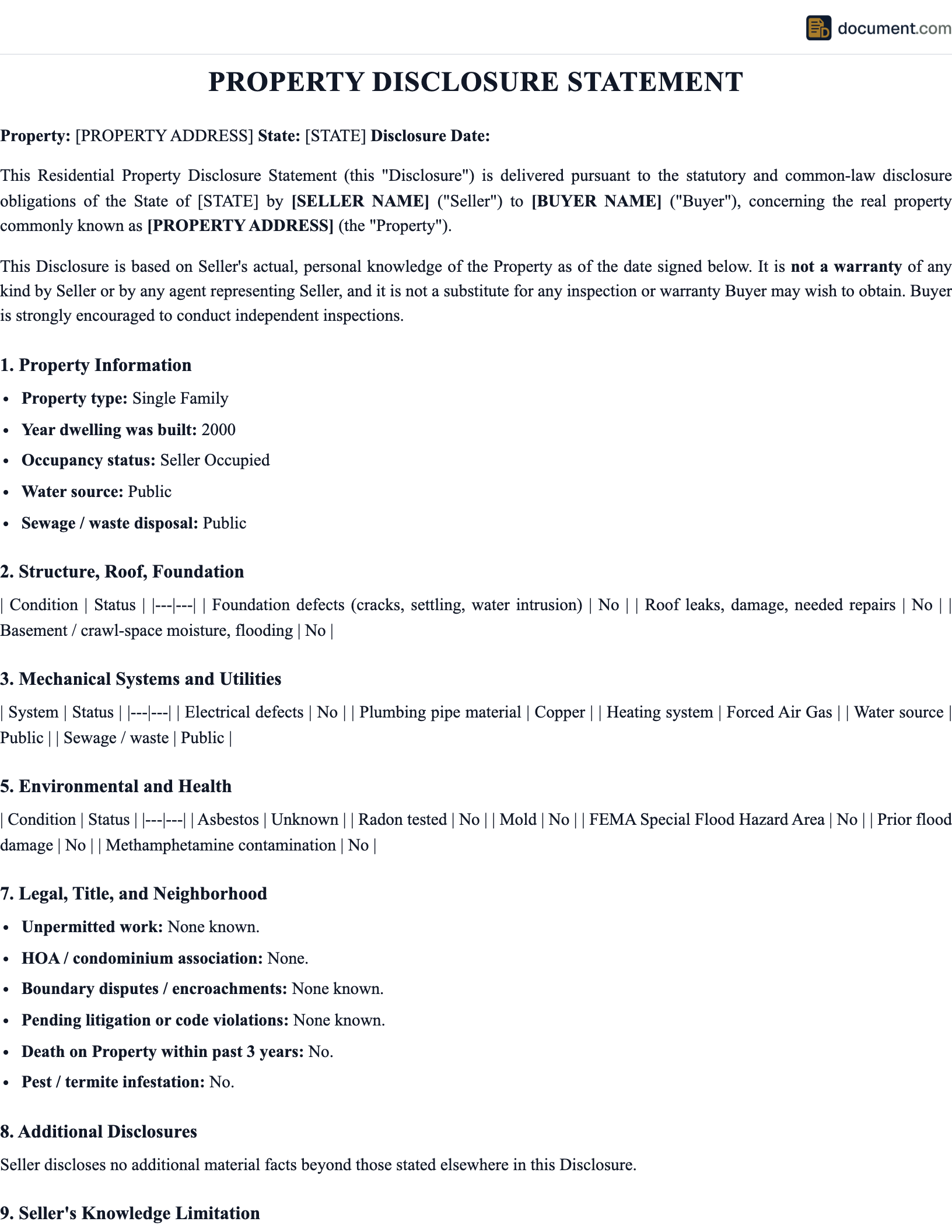



Kentucky Disclosure Statement Overview
Kentucky's mandatory seller disclosure law is codified at KRS 324.360 and applies to virtually all residential real property transactions in the state. The seller completes a standard disclosure form and delivers it to the buyer before a purchase contract is executed. The disclosure is a private document exchanged between the parties. It is not recorded at the courthouse, not notarized, and carries no filing fee.
One aspect of Kentucky disclosure practice that deserves particular attention is coal and mineral rights. Eastern Kentucky has a long history of severed mineral estates, and buyers purchasing property in Harlan, Pike, Letcher, or other coal-producing counties need to understand whether the mineral rights convey with the surface. Sellers in these areas should be prepared to disclose the status of mineral ownership clearly, since this is material information that affects property value and use.
$33
Recording fee
$0.50 per $500
Transfer tax
Required
Notarization
0
Witnesses required
Kentucky Requirements
Under KRS 324.360, sellers of residential real property in Kentucky must use the standard disclosure form approved by the Kentucky Real Estate Commission. The form must be completed and delivered to the buyer before the parties enter into a purchase agreement. After receiving the form, the buyer has 3 days to rescind the contract.
Kentucky Specific Note
Kentucky sellers in coal-producing counties must pay close attention to mineral rights disclosures. The severed mineral estate is one of the most common undisclosed issues in eastern Kentucky real estate transactions. Additionally, properties with older heating systems, well water, or septic systems require thorough answers on the mechanical and environmental sections of the form.
What the Kentucky Form Covers
- Structural: Foundation, roof, floors, walls, basement water intrusion, and chimney condition
- Mechanical systems: HVAC, plumbing, electrical, water heater, and fuel storage tanks
- Environmental: Radon, asbestos, lead paint, mold, and flooding history
- Mineral and coal rights: Whether mineral rights are severed or encumbered by mining leases
- Water and sewer: Public utility or private well and septic, and any known water quality issues
- Legal conditions: Easements, encroachments, HOA obligations, pending litigation, and zoning violations
How to Deliver the Kentucky Disclosure Statement
The Kentucky property disclosure statement is delivered directly to the buyer. It is not filed at a courthouse or recorded in any public registry. The process is relatively simple, but getting the timing right is critical under KRS 324.360.
Complete the Standard Kentucky Disclosure Form
Use the current form approved by the Kentucky Real Estate Commission. Work through each section carefully and answer every question honestly based on your knowledge as the owner. Do not leave items blank.
Sign and Date the Completed Form
The seller signs and dates the disclosure form. No notary is required. Your signature represents your honest acknowledgment of the property's condition to the best of your knowledge at the time of signing.
Deliver to the Buyer Before Contract Signing
Provide the form to the buyer or their agent before the purchase agreement is executed. In practice, this typically happens at or before the time the seller reviews the buyer's offer. Obtain a dated acknowledgment of receipt.
Respect the Buyer's 3-Day Rescission Right
After receiving the disclosure, the buyer has 3 days to rescind. During this period, be available to answer questions and consider whether any follow-up information or inspector access would help the buyer make an informed decision.
Retain Copies Through and After Closing
Keep a signed copy of the disclosure form in your records. Both parties should retain their copies after closing. This document can become important evidence if questions arise about what was disclosed before the sale.
Kentucky Fees & Costs
Typical costs for filing in Kentucky. Actual fees may vary by county.
| Fee / Tax | Amount |
|---|---|
| Recording Fee | $33 |
| Transfer Tax | $0.50 per $500 |
| Notarization | $5 - $25 per signature |
| Certified Copy | $1 - $10 per page |
| Attorney Review (optional) | $150 - $500 |
Seller Liability for Non-Disclosure in Kentucky
Kentucky sellers who knowingly misrepresent or omit a material fact from the property disclosure statement face civil liability under KRS 324.360 and established Kentucky common law on fraud and misrepresentation. A buyer who discovers a concealed defect after closing can bring a claim for the cost of repairs and, in appropriate cases, additional damages. The seller's real estate agent may also face liability if they knew about the issue and failed to ensure proper disclosure.
Kentucky courts look at what the seller knew or reasonably should have known. If a defect was plainly visible during showings but was not disclosed, the seller cannot easily claim ignorance. Similarly, sellers who have owned a property for many years are expected to know about recurring issues like basement flooding, roof problems, or drainage failures that occur predictably.
The good news for sellers is that honest disclosure rarely derails a transaction permanently. Buyers who learn about a defect from the disclosure form can negotiate, request repairs, or price accordingly. Buyers who discover the same defect after closing, without any prior disclosure, almost always pursue legal remedies. From a seller's perspective, transparency upfront is both the ethical choice and the practical one.
Sample Kentucky Disclosure Statement
Preview of our Kentucky-specific template. Your document will include all fields required for recording in any Kentucky county.
PROPERTY DISCLOSURE STATEMENT
STATE OF KENTUCKY
Legal Document
PARTY INFORMATION
Name: [Full Legal Name]
Address: [Kentucky Address]
County: [County]
PROPERTY DESCRIPTION
County: [County] State: Kentucky
Legal Description: [Per Recorded Plat]
Parcel No.: [APN]
Kentucky Disclosure Statement FAQ
Common questions about filing in Kentucky, including requirements, fees, and tax implications.
Official Kentucky Resources
Official state resources for verifying requirements and finding your local recording office.
Important Considerations for Kentucky Sellers
Sellers in eastern Kentucky face disclosure obligations that are genuinely different from those in other parts of the state. If your property is in a county with a history of coal mining, you need to know whether the mineral rights are intact or severed, and whether there are any active or abandoned mine workings that could affect the surface. These are not abstract legal questions; subsidence from abandoned underground mines has caused real property damage in parts of Kentucky, and buyers have every right to know about that risk.
Sellers throughout Kentucky should also think carefully about the age and condition of their home's systems. Many older Kentucky homes have knob-and-tube wiring, cast iron plumbing, or aging oil furnaces. These conditions are not necessarily deal-breakers for buyers, but they need to be disclosed. A buyer who is informed about older systems before making an offer is in a far better position than one who discovers them during a home inspection after going under contract.
Properties near Kentucky's rivers and floodplains also require careful attention to the flood history section of the disclosure. If the property has flooded even once, or is in a designated flood zone, buyers need to know. Flood insurance requirements and premiums vary significantly depending on flood zone designation, and this information is material to the buyer's decision.
Kentucky Seller Tip
If your property is in coal country and you are unsure about the status of the mineral rights, pull the deed chain and look for a mineral reservation. Your county clerk's office can assist with deed history searches, and a Kentucky real estate attorney can help you understand what the chain of title reveals about mineral ownership before you fill out the disclosure form.
Related Documents
Depending on your situation, you may need additional documents alongside this one. Below are commonly related documents that are frequently used together in real estate transactions.
Working with a Kentucky Real Estate Attorney
Kentucky does not require attorneys to be involved in residential real estate closings, and many transactions proceed entirely through real estate agents and title companies. However, transactions with complexity deserve legal review. Estate sales, properties with known defects, homes with mineral rights questions, or any situation where the seller is uncertain about disclosure obligations are all good candidates for an attorney consultation before the property is listed.
A Kentucky real estate attorney can review the completed disclosure form before it goes to a buyer, identify any gaps or ambiguous answers, and advise on whether additional documentation such as past inspection reports or repair invoices should accompany the disclosure. This kind of pre-listing review is particularly valuable for high-value properties or those with known issues.
After closing, keep copies of all transaction documents including the signed disclosure form, purchase agreement, inspection reports, and any repair receipts. If a buyer later claims that something was concealed, your documentation from the transaction is your primary evidence of what was disclosed and when.
Professional Recommendation
Kentucky sellers dealing with properties that have complicated mineral rights situations, known structural issues, or a history of flood damage should consult a licensed Kentucky real estate attorney before listing. The cost of a consultation is minimal compared to the potential cost of a post-closing misrepresentation claim.
Related Documents
Depending on your situation, you may need additional documents alongside this one. Below are commonly related documents that are frequently used together in real estate transactions.
Create your Kentucky Property Disclosure Statement in under 5 minutes.
Answer a few questions and download a Kentucky-compliant document, ready for the state agency.