



Kansas Disclosure Statement Overview
Kansas requires residential sellers to complete a written property disclosure statement before a purchase contract is signed. The legal framework comes from KSA 58-30,101 through 58-30,126, which outlines what must be disclosed, when the form must be delivered, and the buyer's right to rescind. The disclosure is given directly to the buyer as part of the transaction, not filed with any government office or recorded at the courthouse.
The Kansas form covers a wide range of property conditions: the structural integrity of the home, the condition of major mechanical systems, known environmental hazards, water source and quality, and whether there are any known boundary disputes. Sellers are required to answer based on their actual knowledge, and knowingly leaving out a material defect can expose them to civil liability after closing.
$21
Recording fee
None
Transfer tax
Required
Notarization
0
Witnesses required
Kansas Requirements
Kansas law requires the seller of residential real property to complete a disclosure statement and deliver it to the buyer before a purchase agreement is executed. The form must reflect the seller's honest, current knowledge about the property's condition. Once delivered, the buyer has 3 business days to rescind the contract if the disclosure reveals something unacceptable.
Kansas Specific Note
The Kansas disclosure statement is delivered directly to the buyer. It is not filed with the county, not notarized, and not subject to any recording fee or transfer tax. Agricultural land is generally exempt from the disclosure requirements under KSA 58-30,126, but residential properties always require a completed form.
What the Kansas Disclosure Must Cover
- Structural conditions: Foundation, roof, walls, floors, and any known settling or movement
- Mechanical systems: HVAC, plumbing, electrical, and water heater condition
- Environmental hazards: Asbestos, radon, underground storage tanks, contamination
- Water and sewer: Source of water supply, well condition, septic system status
- Boundary disputes: Any known disputes over property lines or encroachments
- Legal matters: Easements, liens, pending litigation, or HOA violations affecting the property
How to Deliver the Kansas Disclosure Statement
Delivering a property disclosure statement in Kansas is straightforward, but timing matters. The form goes directly to the buyer before the purchase contract is signed. There is no government office involved and no fee to pay.
Complete the Kansas Disclosure Form
Go through every section honestly. For each question, answer based on your actual knowledge of the property. If you are uncertain about something, note it rather than guessing. Leave no question blank.
Sign and Date the Form
The seller signs and dates the completed form. Kansas does not require notarization of the property disclosure statement. Your signature certifies that the answers are accurate to the best of your knowledge.
Deliver to the Buyer Before Contract Signing
Hand the form to the buyer or their agent before a purchase agreement is executed. Delivery through the listing agent is standard practice. Keep proof of delivery, such as a dated receipt or email confirmation.
Allow the Buyer's 3-Day Rescission Period
Once delivered, the buyer has 3 business days to review and decide whether to rescind the contract. During this window the buyer may ask follow-up questions or request inspection access for specific concerns raised in the disclosure.
Keep a Signed Copy in the Transaction File
Retain a copy of the signed disclosure statement throughout the transaction and after closing. If any dispute arises later about what was or was not disclosed, this document is your evidence of what the buyer was told.
Kansas Fees & Costs
Typical costs for filing in Kansas. Actual fees may vary by county.
| Fee / Tax | Amount |
|---|---|
| Recording Fee | $21 |
| Transfer Tax | None |
| Notarization | $5 - $25 per signature |
| Certified Copy | $1 - $10 per page |
| Attorney Review (optional) | $150 - $500 |
Seller Liability and Legal Consequences in Kansas
Kansas sellers who fail to complete the disclosure form, or who knowingly misrepresent or conceal a material defect, can be held liable under KSA 58-30,101 and related misrepresentation law. A buyer who discovers an undisclosed defect after closing has grounds to pursue a civil claim seeking damages, including repair costs and potentially consequential damages depending on the severity of the problem.
Fraudulent concealment is treated more seriously than simple negligence. If a seller actively hides a known problem such as covering water damage before showings or painting over visible mold, courts are unlikely to be sympathetic. Kansas courts have found sellers liable for both the cost of repairs and associated losses in these situations.
The best protection a Kansas seller has is a thorough, honest disclosure. Disclosing a defect gives the buyer the option to negotiate a price reduction, request repairs, or walk away. It does not necessarily kill the deal, but concealing it and having it discovered after closing almost always leads to worse outcomes for the seller.
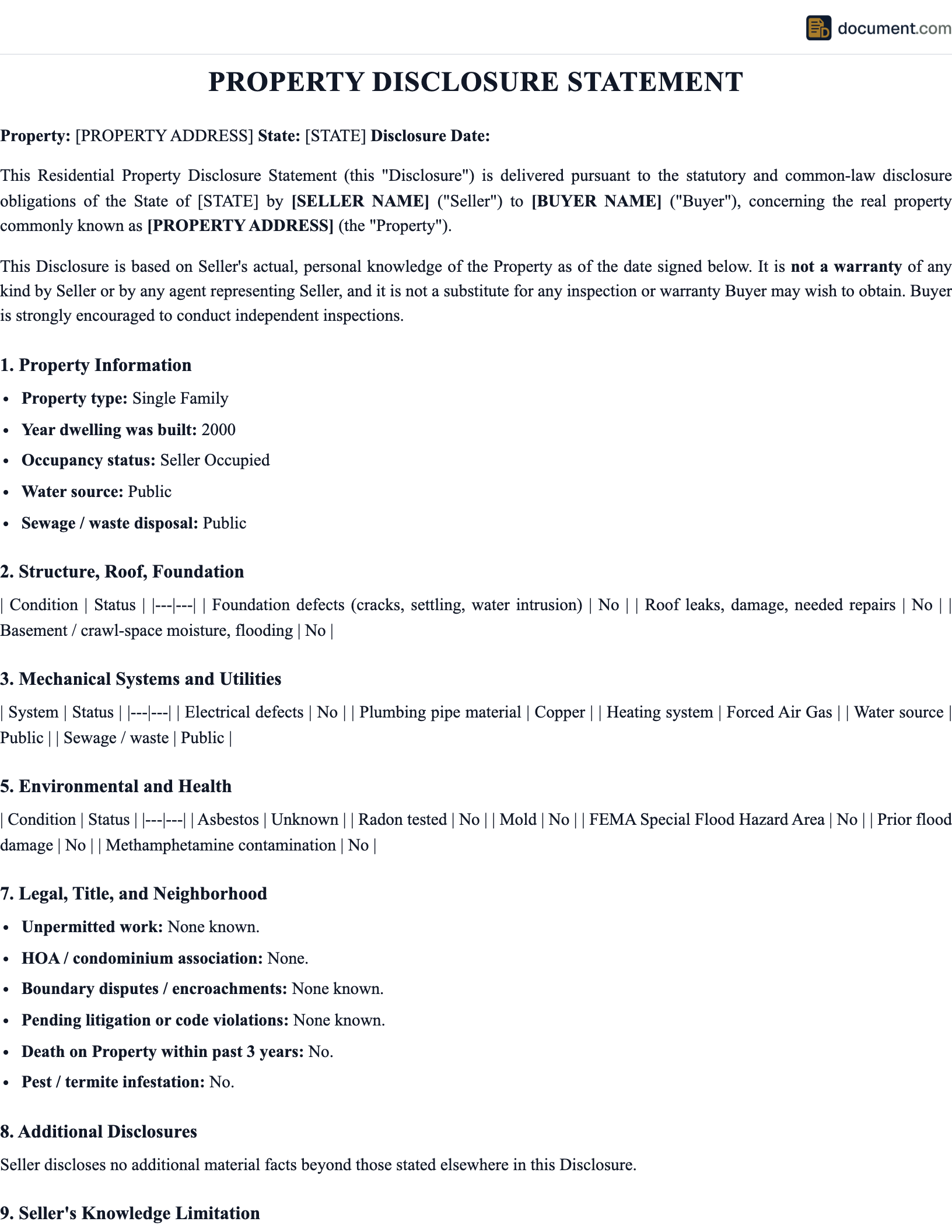
Sample Kansas Disclosure Statement
Preview of our Kansas-specific template. Your document will include all fields required for recording in any Kansas county.
PROPERTY DISCLOSURE STATEMENT
STATE OF KANSAS
Legal Document
PARTY INFORMATION
Name: [Full Legal Name]
Address: [Kansas Address]
County: [County]
PROPERTY DESCRIPTION
County: [County] State: Kansas
Legal Description: [Per Recorded Plat]
Parcel No.: [APN]
Kansas Disclosure Statement FAQ
Common questions about filing in Kansas, including requirements, fees, and tax implications.
Official Kansas Resources
Official state resources for verifying requirements and finding your local recording office.
Important Considerations for Kansas Sellers
Kansas sellers should complete the disclosure form themselves rather than delegating it entirely to their real estate agent. The statute requires seller knowledge, and a seller who lets someone else fill in the answers could face problems if the answers later prove inaccurate. Take your time going through each section and think carefully about what you have observed during your ownership.
If a condition has been repaired, note both the original problem and the repair. Disclosing that a roof leak occurred and was professionally repaired in a specific year is better than omitting it entirely. Buyers appreciate transparency about past issues that have been addressed, and documented repairs often satisfy buyer concerns more than a blank disclosure ever would.
Kansas sellers with rural properties should pay particular attention to well and septic disclosures. Buyers financing through USDA or FHA loans often have specific requirements about water quality and septic system adequacy, so having recent inspection reports on hand can prevent delays during the contract period.
Kansas Seller Tip
If you are unsure whether something needs to be disclosed, err on the side of disclosure. Kansas courts have not been forgiving of sellers who claimed ignorance about problems that a reasonable inspection would have revealed. When in doubt, a brief note explaining what you know and when you observed it is always better than leaving the question blank or answering "unknown" without explanation.
Related Documents
Depending on your situation, you may need additional documents alongside this one. Below are commonly related documents that are frequently used together in real estate transactions.
Working with a Kansas Real Estate Attorney
Most Kansas residential transactions proceed without legal counsel on either side, with agents handling the paperwork. However, sellers in unusual situations should strongly consider working with a Kansas real estate attorney. This includes transactions involving estate sales, properties with known environmental issues, homes with significant deferred maintenance, or any situation where the seller is uncertain about what must be disclosed.
An attorney can review the completed disclosure form before it is delivered to the buyer and flag any areas where additional information or clarification would reduce legal risk. This kind of review is particularly valuable when a seller has made significant renovations, since work done without permits can create disclosure obligations that sellers sometimes overlook.
After closing, retain the signed disclosure form along with the purchase agreement and any inspection reports. Kansas does not have a specific statute of limitations on fraud claims, and defect disputes can arise years after a sale. Your documentation from the transaction is your best evidence of what was disclosed and when.
Professional Recommendation
Kansas sellers handling complex transactions should have the disclosure form reviewed by a licensed Kansas real estate attorney before delivering it to the buyer. A brief review is far less expensive than defending a post-closing misrepresentation claim.
Related Documents
Depending on your situation, you may need additional documents alongside this one. Below are commonly related documents that are frequently used together in real estate transactions.
Create your Kansas Property Disclosure Statement in under 5 minutes.
Answer a few questions and download a Kansas-compliant document, ready for the state agency.