



Iowa Disclosure Statement Overview
Iowa sellers of residential real property are required by Iowa Code 558A to complete a written property disclosure and give it to the buyer before the purchase agreement is signed. The form is delivered directly to the buyer. It is not filed at the county recorder's office or recorded in the public land records.
Iowa's disclosure law has a practical character that reflects the state's mix of rural and suburban real estate. The form asks sellers to disclose not just structural and mechanical defects but also neighborhood and environmental conditions that could materially affect the property's value or the buyer's decision to purchase. Importantly, agricultural land transfers are generally exempt from the residential disclosure requirements, making Iowa one of the few states where a substantial category of real property is excluded from the seller disclosure framework. Buyers have 5 business days to rescind after receiving the form, and sellers who omit known material defects face statutory and common law liability.
5 Bus. Days
Buyer rescission period
Iowa 558A
Governing statute
Required
Before contract signing
Residential
Ag land exempt
Iowa Requirements
The Iowa disclosure form must be completed based on the seller's actual knowledge and delivered to the buyer before the purchase agreement is executed. Sellers are not required to conduct investigations or inspections before completing the form; they are only required to disclose what they actually know. However, sellers who do know of a material defect and omit it have no protection from that knowledge.
Agricultural Land Is Generally Exempt from Iowa's Residential Disclosure Law
Iowa Code 558A applies to residential property. Agricultural land sales, including farmland without a residential dwelling, are typically not subject to the same seller disclosure requirements. Sellers of Iowa farmland should confirm with a local real estate attorney whether their specific transaction triggers any disclosure obligations, as this is one area where Iowa law differs meaningfully from most other states.
What the Iowa Disclosure Form Must Cover
- Structural Condition: Foundation, walls, roof, floors, and any known settling or water intrusion
- Mechanical Systems: Heating, cooling, plumbing, electrical, and appliances conveyed with the sale
- Environmental Hazards: Lead paint, radon, underground storage tanks, asbestos, and any known soil or water contamination
- Flooding and Drainage: History of flooding, drainage problems, or any prior flood insurance claims on the property
- Legal and Title Conditions: Known easements, boundary disputes, encroachments, or liens affecting the property
- Neighborhood Conditions: Known conditions in the area that would materially affect the property's value, such as nearby industrial activity or zoning changes
How to Deliver the Disclosure in Iowa
The Iowa property disclosure travels from seller to buyer before the purchase agreement is signed. It is not submitted to or recorded at any government office. These steps reflect the process under Iowa Code 558A.
Complete the Iowa Disclosure Form Honestly and Thoroughly
Fill out every section of the Iowa disclosure based on what you actually know about the property's condition. Iowa's statute uses a broad definition of material conditions, so err on the side of inclusion when you are uncertain whether something should be disclosed. Leaving a field blank is not a defense if you had actual knowledge.
Confirm Whether Your Sale Requires the Form
Iowa Code 558A applies to residential property. If you are selling agricultural land or a property that is exclusively commercial, confirm with an Iowa real estate attorney whether the form is required. Mixed-use or residential-adjacent properties fall into a gray area that warrants professional confirmation.
Deliver the Completed Form Before the Buyer Signs
Provide the disclosure to the buyer or their agent before the purchase agreement is executed. Document when and how the form was delivered. Email delivery with a timestamp is acceptable and creates a reliable record. Your agent's transaction platform will typically log delivery automatically.
Obtain a Signed Receipt from the Buyer
Have the buyer acknowledge receipt of the disclosure in writing. Retain a copy of the signed acknowledgment in your transaction file. This record establishes when the buyer's 5-day rescission window started and protects you if a dispute later arises about whether the disclosure was timely delivered.
Amend and Re-Deliver If New Conditions Come to Light
Iowa sellers have an ongoing obligation to supplement the disclosure if they become aware of new material conditions before closing. Prepare an amendment, deliver it to the buyer, and obtain a new acknowledgment. The buyer is entitled to a new 5-day rescission window from receipt of the amendment.
Iowa Disclosure at a Glance
Key facts about Iowa's property disclosure requirements for sellers of residential real property.
| Requirement | Details |
|---|---|
| Governing Statute | Iowa Code 558A |
| Who Must Disclose | Sellers of residential real property |
| Delivery Timing | Before buyer signs purchase contract |
| Buyer Rescission Period | 5 business days from receipt |
| Agricultural Land | Generally exempt from residential disclosure law |
Seller Liability and Legal Consequences in Iowa
Iowa sellers who knowingly fail to disclose a material condition face liability under Iowa Code 558A and common law fraud and misrepresentation principles. The typical measure of damages is the cost to address the undisclosed defect and any resulting diminution in the property's value. Iowa courts have allowed buyers to pursue these claims without being limited to the purchase price or any other arbitrary cap, making significant concealment a financially serious risk for sellers.
Flooding history is a particularly sensitive disclosure topic in Iowa. Given the state's history of significant flood events, buyers and their lenders pay close attention to whether a property has flooded and whether it is in a federally designated flood zone. A seller who conceals a prior flood event or flood insurance claim faces both statutory disclosure liability and potential fraud claims. Flood history can dramatically affect a property's insurability and financing, making it among the most material conditions a buyer could learn about.
Iowa real estate agents have independent disclosure obligations. Agents who become aware of material property conditions that the seller has omitted from the disclosure form are generally required to disclose those conditions to buyers or advise the seller to do so. Agents who choose to stay silent when they know of a material condition risk their license and face civil liability alongside the seller.
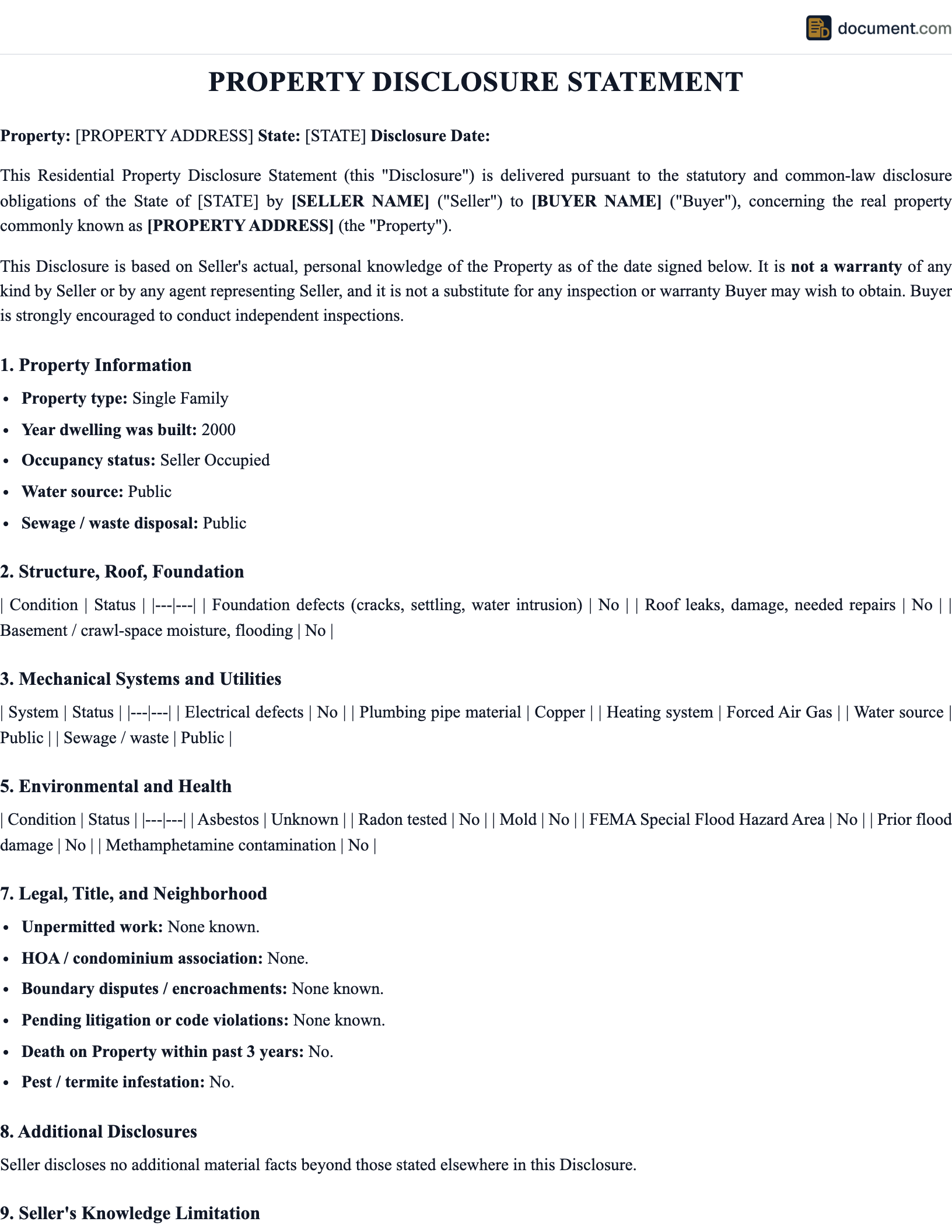
Sample Iowa Disclosure Statement
Preview of our Iowa-specific template. Your document will include all fields required for recording in any Iowa county.
PROPERTY DISCLOSURE STATEMENT
STATE OF IOWA
Legal Document
PARTY INFORMATION
Name: [Full Legal Name]
Address: [Iowa Address]
County: [County]
PROPERTY DESCRIPTION
County: [County] State: Iowa
Legal Description: [Per Recorded Plat]
Parcel No.: [APN]
Iowa Disclosure Statement FAQ
Common questions about filing in Iowa, including requirements, fees, and tax implications.
Official Iowa Resources
Official state resources for verifying Iowa disclosure requirements and accessing property-related information.
Important Considerations for Iowa Sellers
Flooding is a significant issue in many Iowa communities, and sellers should take this part of the disclosure seriously. If the property has ever experienced a flood, water entry from a storm event, sewer backup, or any flood insurance claim, that history should be disclosed clearly. Iowa buyers frequently ask about flooding, and agents on both sides of the transaction will flag any apparent inconsistency between the disclosure and the property's flood zone designation or insurance records.
Radon is present at elevated levels in many Iowa homes, particularly those with basements. The Iowa Radon Program, administered by the Iowa Department of Health and Human Services, provides information on radon testing and mitigation. If you have had the home tested and the results exceed 4 pCi/L, disclose the result. If you have installed a mitigation system, disclose that as well, as it is a meaningful piece of information for a buyer who relies on the mitigation system to maintain safe radon levels after purchase.
Iowa sellers of rural residential properties should think carefully about the condition of septic systems, private wells, and shared well or drainage arrangements with neighboring properties. These conditions are especially relevant for buyers who may be unfamiliar with rural property ownership. A disclosure that accurately describes a shared well agreement or a failing septic system allows a buyer to make an informed decision rather than discover a problem after closing.
Honest Disclosure Protects Iowa Sellers More Than Silence Does
Iowa buyers and their agents have access to county flood records, FEMA maps, and permit histories. Sellers who try to avoid disclosing a known condition often find that the buyer discovers it during due diligence anyway, at which point the seller has both damaged their credibility and created a record of concealment. A complete and honest disclosure, delivered before the contract is signed, is the strongest protection a seller can have against post-closing claims.
Related Documents
Depending on your situation, you may need additional documents alongside this one. Below are commonly related documents that are frequently used together in real estate transactions.
Important Considerations for Iowa Sellers
Flooding is a significant issue in many Iowa communities, and sellers should take this part of the disclosure seriously. If the property has ever experienced a flood, water entry from a storm event, sewer backup, or any flood insurance claim, that history should be disclosed clearly. Iowa buyers frequently ask about flooding, and agents on both sides of the transaction will flag any apparent inconsistency between the disclosure and the property's flood zone designation or insurance records.
Radon is present at elevated levels in many Iowa homes, particularly those with basements. The Iowa Radon Program, administered by the Iowa Department of Health and Human Services, provides information on radon testing and mitigation. If you have had the home tested and the results exceed 4 pCi/L, disclose the result. If you have installed a mitigation system, disclose that as well, as it is a meaningful piece of information for a buyer who relies on the mitigation system to maintain safe radon levels after purchase.
Iowa sellers of rural residential properties should think carefully about the condition of septic systems, private wells, and shared well or drainage arrangements with neighboring properties. These conditions are especially relevant for buyers who may be unfamiliar with rural property ownership. A disclosure that accurately describes a shared well agreement or a failing septic system allows a buyer to make an informed decision rather than discover a problem after closing.
Honest Disclosure Protects Iowa Sellers More Than Silence Does
Iowa buyers and their agents have access to county flood records, FEMA maps, and permit histories. Sellers who try to avoid disclosing a known condition often find that the buyer discovers it during due diligence anyway, at which point the seller has both damaged their credibility and created a record of concealment. A complete and honest disclosure, delivered before the contract is signed, is the strongest protection a seller can have against post-closing claims.
Related Documents
Depending on your situation, you may need additional documents alongside this one. Below are commonly related documents that are frequently used together in real estate transactions.
Create your Iowa Property Disclosure Statement in under 5 minutes.
Answer a few questions and download a Iowa-compliant document, ready for the state agency.