
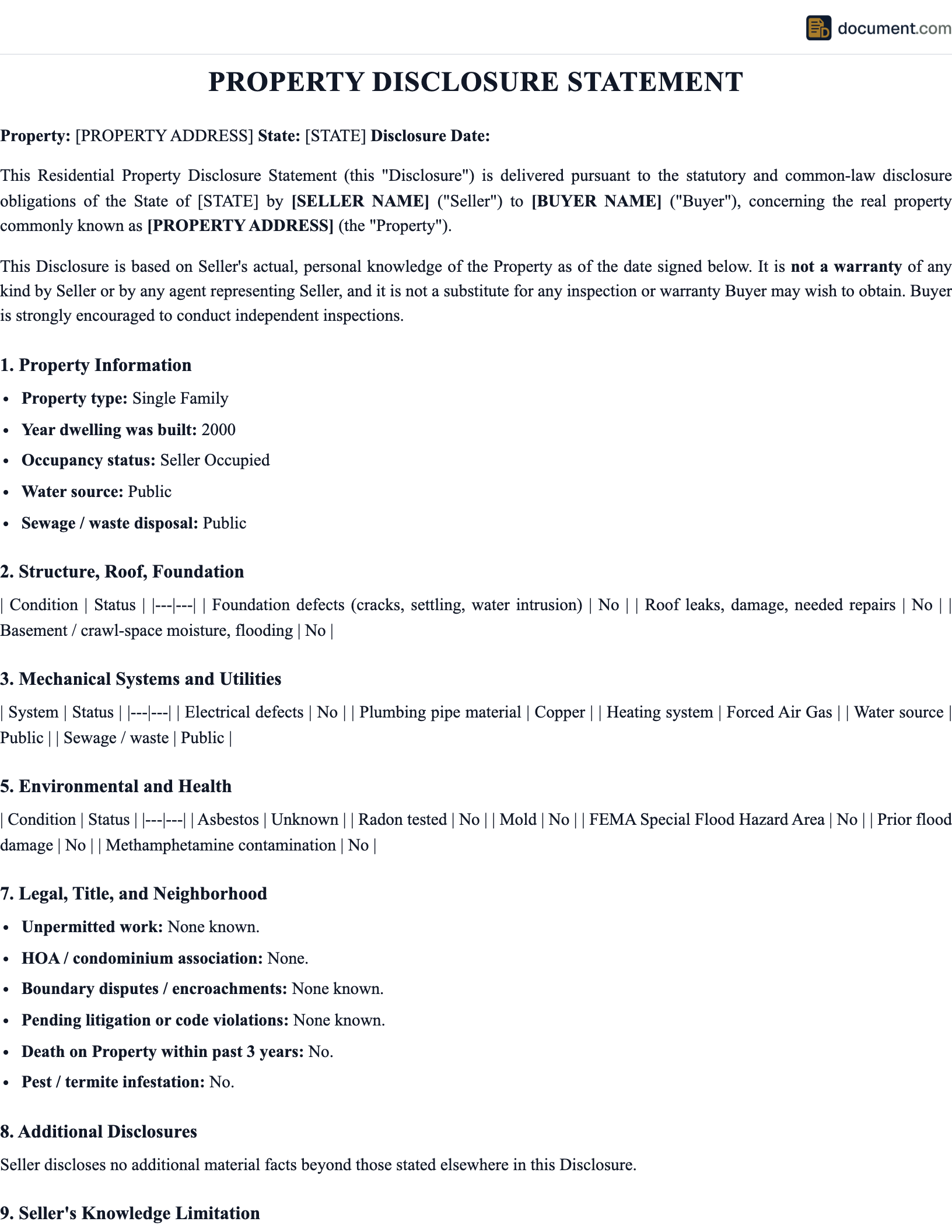



Illinois Disclosure Statement Overview
Illinois sellers of residential real property must complete and deliver a Residential Real Property Disclosure Report to the buyer before the purchase contract is signed. This obligation is governed by the Residential Real Property Disclosure Act (765 ILCS 77). The form goes directly from seller to buyer; it is not recorded or filed with any county office.
Illinois has among the more detailed residential disclosure requirements in the Midwest. The standard form covers a wide range of structural, mechanical, and environmental conditions, including radon, lead paint, and underground storage tanks. Sellers in Chicago must also comply with certain city-level disclosure obligations that go beyond what the state form requires. Buyers receive 5 business days to rescind after receiving the disclosure, a window that does not run on weekends or holidays. Sellers who take shortcuts on the form do so at real legal and financial risk.
5 Bus. Days
Buyer rescission period
765 ILCS 77
Governing statute
Required
Before contract signing
Standardized
State-approved form
Illinois Requirements
Illinois uses a standardized Residential Real Property Disclosure Report form. Sellers must use this specific form rather than a substitute. The completed form must be delivered to the buyer before the purchase contract is executed. Illinois also requires sellers to disclose any changes that occur between contract signing and closing.
Chicago-Area Sellers: Additional Requirements Apply
Sellers within the city of Chicago face additional municipal disclosure obligations beyond what the state form requires. This can include disclosure of building code violations, certain inspection certifications depending on property type, and compliance with local landlord-tenant ordinances. Sellers in Cook County and Chicago should consult with a local real estate attorney to confirm they are meeting all applicable local requirements.
What the Illinois Disclosure Report Must Cover
- Structural Defects: Foundation, walls, roof, ceilings, and known water infiltration into the basement or crawlspace
- Mechanical Systems: Heating, cooling, plumbing, electrical, and any appliances included in the sale
- Radon: Known radon test results and any prior mitigation systems installed
- Lead-Based Paint: Presence of known lead paint hazards (separate federal disclosure required for pre-1978 homes)
- Underground Storage Tanks: Any known buried fuel tanks on the property
- Legal Conditions: Pending litigation, code violations, and any easements or encroachments affecting the property
How to Deliver the Disclosure in Illinois
The Illinois disclosure report goes from seller to buyer before the purchase contract is signed. It is not filed at a county office or recorded in the public land records. Here is how the process works under 765 ILCS 77.
Obtain and Complete the Official Illinois Disclosure Form
Use the state-approved Residential Real Property Disclosure Report. Sellers cannot substitute their own form. Answer every question based on your actual knowledge of the property's condition. If you genuinely do not know the answer to a question, indicate that rather than guessing.
Check for Chicago or Local Municipal Requirements
If the property is in Chicago or another Illinois municipality with local disclosure requirements, confirm what additional forms or certifications are needed before listing the property. Some Chicago transactions require additional disclosures at or before closing.
Deliver the Form Before the Buyer Signs the Purchase Agreement
Provide the completed form to the buyer or their agent before the contract is signed. Keep a record of how and when delivery occurred, whether by email, in person, or through your transaction platform. This documentation matters if timing is ever disputed.
Collect the Buyer's Signed Acknowledgment
Have the buyer sign and date an acknowledgment of receipt. Illinois real estate agents typically include this acknowledgment as a standard part of their transaction files. Retain a copy through and beyond closing.
Supplement if Conditions Change Before Closing
Illinois sellers have a continuing obligation to update the disclosure if they become aware of new material conditions between contract signing and closing. Deliver any amendments to the buyer promptly and obtain a new acknowledgment of receipt.
Illinois Disclosure at a Glance
Key facts about Illinois's property disclosure requirements for sellers of residential real property.
| Requirement | Details |
|---|---|
| Governing Statute | 765 ILCS 77 (Residential Real Property Disclosure Act) |
| Who Must Disclose | Sellers of residential real property |
| Delivery Timing | Before buyer signs purchase contract |
| Buyer Rescission Period | 5 business days from receipt |
| Chicago Local Requirements | Additional municipal disclosures may apply |
Seller Liability and Legal Consequences in Illinois
The Illinois Residential Real Property Disclosure Act gives buyers a statutory right to sue sellers who deliver false or incomplete disclosures. Buyers can recover the actual damages caused by the undisclosed defect, which typically includes the cost of repair and any resulting diminution in property value. Illinois courts have not placed a damages cap on these claims, meaning a significant concealment can lead to a substantial judgment against the seller.
When a seller's non-disclosure rises to the level of intentional fraud, the buyer can pursue additional theories of recovery outside the disclosure statute itself. Common law fraud claims carry their own elements and potential remedies, and some Illinois courts have allowed punitive damages where the concealment was particularly egregious. The combination of statutory and common law exposure makes honest disclosure the only sensible approach.
Real estate licensees in Illinois who help a seller conceal a known material defect risk disciplinary proceedings with the Illinois Department of Financial and Professional Regulation in addition to civil liability. Licensed agents are expected to encourage sellers to complete disclosures fully and accurately, not to help sellers minimize what buyers learn before signing a contract.
Sample Illinois Disclosure Statement
Preview of our Illinois-specific template. Your document will include all fields required for recording in any Illinois county.
PROPERTY DISCLOSURE STATEMENT
STATE OF ILLINOIS
Legal Document
PARTY INFORMATION
Name: [Full Legal Name]
Address: [Illinois Address]
County: [County]
PROPERTY DESCRIPTION
County: [County] State: Illinois
Legal Description: [Per Recorded Plat]
Parcel No.: [APN]
Illinois Disclosure Statement FAQ
Common questions about filing in Illinois, including requirements, fees, and tax implications.
Official Illinois Resources
Official state resources for verifying Illinois disclosure requirements and accessing property-related information.
Important Considerations for Illinois Sellers
Radon testing is particularly relevant in Illinois. The state has significant radon presence in many areas, and the Illinois Emergency Management Agency publishes county-level data showing where radon levels are most commonly elevated. Sellers in high-radon areas who have never tested the property should be aware that buyers may make the purchase contingent on satisfactory radon results. If an existing radon mitigation system is in place, sellers should disclose it and have documentation of the installation.
Basement water infiltration is one of the most frequently litigated disclosure issues in Illinois. Sellers who have experienced seasonal water entry, sump pump failures, or any form of moisture intrusion into the basement should disclose it clearly on the form, even if they believe the problem has been resolved. Buyers who later discover evidence of prior water damage and learn the seller knew about it have strong grounds for a claim.
Sellers in the Chicago metropolitan area should confirm whether the property is subject to any open building code violations or permit issues. Unpermitted additions, renovations completed without a required inspection, or open permits from prior work can all complicate a buyer's financing and create post-closing liability for sellers who did not disclose them.
Illinois Attorneys Are Standard, Not Optional
Unlike most states, Illinois residential transactions routinely involve attorneys for both buyer and seller, not just agents. This is standard practice, not a sign of a complicated deal. An Illinois real estate attorney who reviews your disclosure form before delivery can identify potential liability issues and help you phrase uncertain conditions accurately, which is one of the better investments a seller can make before listing.
Related Documents
Depending on your situation, you may need additional documents alongside this one. Below are commonly related documents that are frequently used together in real estate transactions.
Important Considerations for Illinois Sellers
Radon testing is particularly relevant in Illinois. The state has significant radon presence in many areas, and the Illinois Emergency Management Agency publishes county-level data showing where radon levels are most commonly elevated. Sellers in high-radon areas who have never tested the property should be aware that buyers may make the purchase contingent on satisfactory radon results. If an existing radon mitigation system is in place, sellers should disclose it and have documentation of the installation.
Basement water infiltration is one of the most frequently litigated disclosure issues in Illinois. Sellers who have experienced seasonal water entry, sump pump failures, or any form of moisture intrusion into the basement should disclose it clearly on the form, even if they believe the problem has been resolved. Buyers who later discover evidence of prior water damage and learn the seller knew about it have strong grounds for a claim.
Sellers in the Chicago metropolitan area should confirm whether the property is subject to any open building code violations or permit issues. Unpermitted additions, renovations completed without a required inspection, or open permits from prior work can all complicate a buyer's financing and create post-closing liability for sellers who did not disclose them.
Illinois Attorneys Are Standard, Not Optional
Unlike most states, Illinois residential transactions routinely involve attorneys for both buyer and seller, not just agents. This is standard practice, not a sign of a complicated deal. An Illinois real estate attorney who reviews your disclosure form before delivery can identify potential liability issues and help you phrase uncertain conditions accurately, which is one of the better investments a seller can make before listing.
Related Documents
Depending on your situation, you may need additional documents alongside this one. Below are commonly related documents that are frequently used together in real estate transactions.
Create your Illinois Property Disclosure Statement in under 5 minutes.
Answer a few questions and download a Illinois-compliant document, ready for the state agency.