
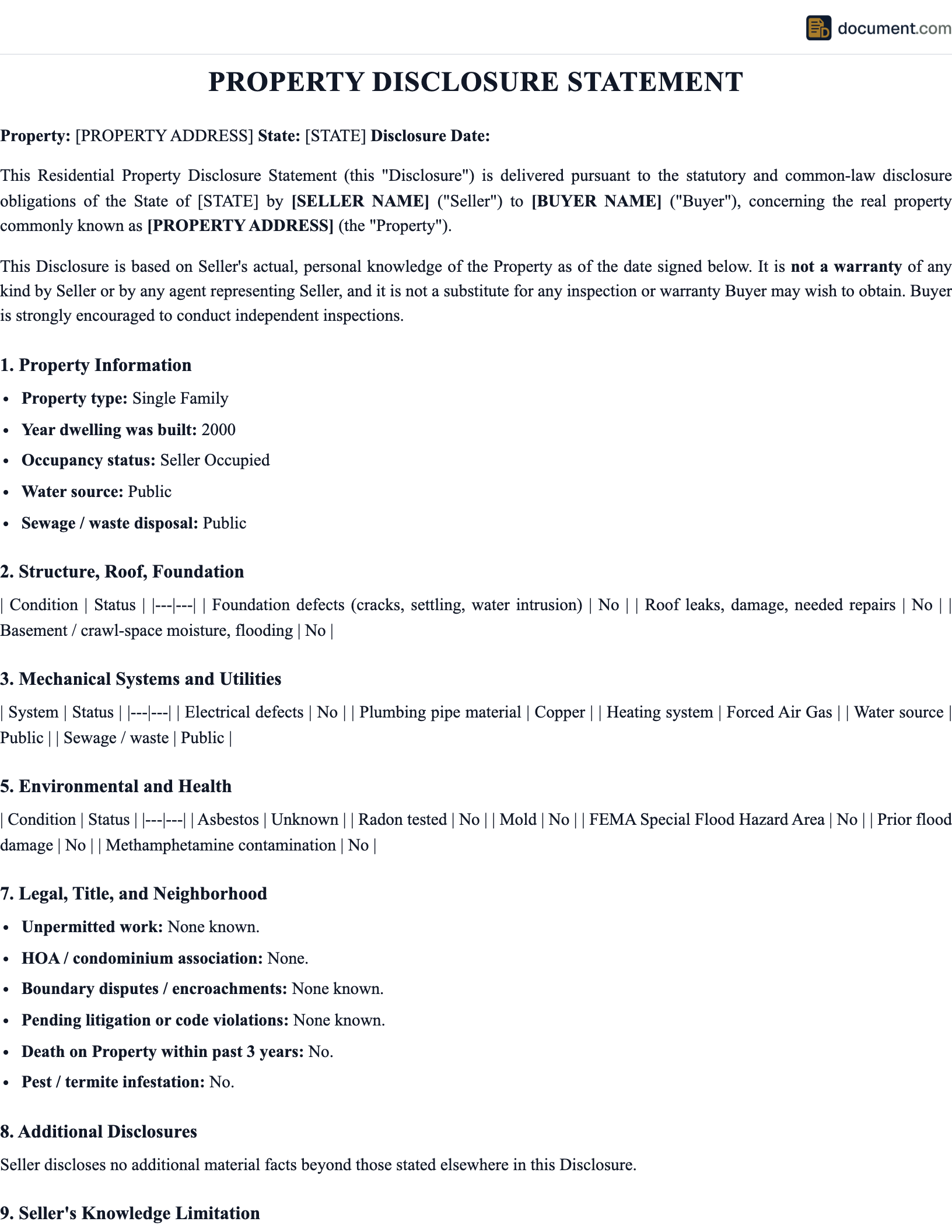



Idaho Disclosure Statement Overview
Idaho sellers of residential property must complete a written disclosure form and deliver it to the buyer before the purchase agreement is signed. This obligation comes from Idaho Code 55-2501 through 55-2516. The disclosure is given directly to the buyer, not filed with any county office or recorded anywhere in the public land records.
What makes Idaho's disclosure requirements stand out is the emphasis on natural resource conditions. In a state where water rights can be worth more than the land itself and where mineral rights are routinely severed from surface ownership, Idaho sellers must address these topics with specificity. A disclosure that covers structural defects but ignores water rights and mineral rights status is incomplete under Idaho standards. Buyers who later discover undisclosed water rights problems have successfully sued sellers in Idaho courts, making thoroughness in the original disclosure the best protection a seller can have.
3 Days
Buyer rescission period
IC 55-2501
Governing statute
Required
Before contract signing
Residential
Property coverage
Idaho Requirements
The Idaho disclosure form must be completed and delivered before the buyer signs the purchase agreement. Sellers cannot wait until after contract signing without giving the buyer grounds to rescind. Idaho also requires sellers to update the disclosure if new material information comes to light before closing.
Water Rights and Mineral Rights Warning
Idaho sellers must address water rights and mineral rights status in their disclosure. If water rights have been partially or fully severed from the property, or if mineral rights are held by a third party, these facts must be disclosed before the buyer signs the contract. Omitting this information in Idaho is one of the most common disclosure failures that leads to post-closing litigation.
What the Idaho Disclosure Form Must Cover
- Structural Defects: Foundation, walls, roof, floors, and any known settling or movement
- Mechanical Systems: Heating, plumbing, electrical, and any appliances conveyed with the sale
- Water Supply: Source of water (well, municipal, irrigation), water rights status, and any water quality issues
- Mineral Rights: Whether mineral rights are included in the sale or have been previously severed
- Environmental Conditions: Soil contamination, underground storage tanks, lead paint, and hazardous materials
- Legal and Neighborhood Conditions: Encroachments, easements, disputes with neighbors, and any pending legal action affecting the property
How to Deliver the Disclosure in Idaho
The Idaho disclosure goes from seller to buyer before contract signing. It is not submitted to any government office. The steps below describe the proper process under Idaho Code 55-2501 through 55-2516.
Complete the Idaho State Disclosure Form
Fill out every section honestly, including structural, mechanical, environmental, and natural resource conditions. Address water rights and mineral rights specifically. If you are uncertain about a condition, note the uncertainty rather than leaving the field blank.
Gather Supporting Documentation
Collect any relevant inspection reports, well tests, water rights certificates, or prior repair records. Attaching supporting documentation strengthens your position and helps the buyer make an informed decision.
Deliver the Form Before the Buyer Signs
Provide the completed disclosure to the buyer or their agent before the purchase agreement is executed. Delivery can be in person, by email, or through your transaction management platform. Keep a record of when and how you delivered it.
Obtain a Signed Acknowledgment of Receipt
Have the buyer sign and date an acknowledgment confirming they received the disclosure. Keep this document in your transaction file. If a dispute arises later, proof of timely delivery and buyer acknowledgment is essential.
Amend If New Information Arises
If you discover a new defect or material condition after delivering the original form but before closing, amend the disclosure and re-deliver it promptly. Idaho buyers who receive an amendment get a new 3-day window to rescind.
Idaho Disclosure at a Glance
Key facts about Idaho's property disclosure requirements for sellers of residential real property.
| Requirement | Details |
|---|---|
| Governing Statute | Idaho Code 55-2501 through 55-2516 |
| Who Must Disclose | Sellers of residential real property |
| Delivery Timing | Before buyer signs purchase contract |
| Buyer Rescission Period | 3 business days from receipt |
| Water & Mineral Rights | Must be specifically disclosed |
Seller Liability and Legal Consequences in Idaho
Idaho sellers who fail to disclose known defects face potential liability under both the disclosure statute and common law fraud and misrepresentation principles. A buyer who later discovers a concealed defect can sue to recover the cost of repair, any diminution in the property's value, and other consequential damages. In cases where the seller deliberately concealed the defect, courts have not been sympathetic to seller defenses.
Water rights disputes are among the costliest post-closing disputes in Idaho. If a seller fails to disclose that water rights have been severed or that an irrigation water right is disputed, the buyer may face significant expense to obtain alternative water access. This type of claim often survives the usual contract defenses, including AS-IS clauses, because courts treat it as fraud rather than a simple breach of contract.
Idaho real estate licensees who are aware of a material condition and help a seller conceal it can face license suspension or revocation by the Idaho Real Estate Commission in addition to civil liability. Both sellers and their agents have a stake in completing the disclosure form accurately and completely.
Sample Idaho Disclosure Statement
Preview of our Idaho-specific template. Your document will include all fields required for recording in any Idaho county.
PROPERTY DISCLOSURE STATEMENT
STATE OF IDAHO
Legal Document
PARTY INFORMATION
Name: [Full Legal Name]
Address: [Idaho Address]
County: [County]
PROPERTY DESCRIPTION
County: [County] State: Idaho
Legal Description: [Per Recorded Plat]
Parcel No.: [APN]
Idaho Disclosure Statement FAQ
Common questions about filing in Idaho, including requirements, fees, and tax implications.
Official Idaho Resources
Official state resources for verifying Idaho disclosure requirements and accessing property-related information.
Important Considerations for Idaho Sellers
Water rights are the single most important Idaho-specific issue for sellers to get right. If the property includes irrigation water rights, the seller should identify the water right permit number, the source, the priority date, and the number of acre-feet involved. If the water right has not been exercised recently, buyers and their attorneys will want to know whether it is still valid.
Rural Idaho properties with private wells should include any available water quality test results. While sellers are not required to test the water before selling, providing existing test data is good practice and reduces the chance of a post-closing dispute about water quality.
Sellers of properties with septic systems should disclose the age of the system, its last inspection date, any known failures or repairs, and whether it has been approved by the county health department. Idaho buyers of rural properties frequently make the purchase contingent on a satisfactory septic inspection, and sellers who already have inspection records can streamline this process considerably.
Consult an Idaho Real Estate Attorney for Complex Properties
Properties with water rights, mineral rights, agricultural easements, or shared access roads involve disclosure complexities that a standard form does not fully address. An Idaho real estate attorney who handles rural property transactions can help you present these facts clearly and completely, reducing the risk of a buyer claiming they were misled about conditions that are common in Idaho but unfamiliar to buyers from other states.
Related Documents
Depending on your situation, you may need additional documents alongside this one. Below are commonly related documents that are frequently used together in real estate transactions.
Important Considerations for Idaho Sellers
Water rights are the single most important Idaho-specific issue for sellers to get right. If the property includes irrigation water rights, the seller should identify the water right permit number, the source, the priority date, and the number of acre-feet involved. If the water right has not been exercised recently, buyers and their attorneys will want to know whether it is still valid.
Rural Idaho properties with private wells should include any available water quality test results. While sellers are not required to test the water before selling, providing existing test data is good practice and reduces the chance of a post-closing dispute about water quality.
Sellers of properties with septic systems should disclose the age of the system, its last inspection date, any known failures or repairs, and whether it has been approved by the county health department. Idaho buyers of rural properties frequently make the purchase contingent on a satisfactory septic inspection, and sellers who already have inspection records can streamline this process considerably.
Consult an Idaho Real Estate Attorney for Complex Properties
Properties with water rights, mineral rights, agricultural easements, or shared access roads involve disclosure complexities that a standard form does not fully address. An Idaho real estate attorney who handles rural property transactions can help you present these facts clearly and completely, reducing the risk of a buyer claiming they were misled about conditions that are common in Idaho but unfamiliar to buyers from other states.
Related Documents
Depending on your situation, you may need additional documents alongside this one. Below are commonly related documents that are frequently used together in real estate transactions.
Create your Idaho Property Disclosure Statement in under 5 minutes.
Answer a few questions and download a Idaho-compliant document, ready for the state agency.