



Georgia Disclosure Statement Overview
Georgia Code Section 44-1-16 requires sellers of residential real property to disclose known latent defects to buyers. The Georgia Association of Realtors publishes a standard Seller's Property Disclosure Statement that has become the norm for residential transactions across the state. Sellers complete the form, deliver it to the buyer, and give the buyer three days to decide whether to walk away. This entire process happens between seller and buyer. No recording office, transfer tax, or notarization is involved in the disclosure process itself.
Georgia's disclosure form includes a specific question about flood zone status, which matters a great deal in counties along Georgia's coast and along its major river systems. Sellers who know their property falls within a FEMA-designated Special Flood Hazard Area must say so. Buyers who purchase without this knowledge and later discover mandatory flood insurance requirements often have a strong basis for a legal claim against the seller.
$25
Recording fee
$1.00 per $1,000
Transfer tax
Required
Notarization
0
Witnesses required
Georgia Requirements
Georgia sellers of residential property must disclose known latent defects under OCGA 44-1-16 by delivering a completed disclosure form to the buyer before or at the time of contract signing. Buyers have three days from receipt of the disclosure to rescind. Sellers who are using the standard GAR contract should confirm with their agent that the disclosure is being delivered through the transaction platform in a way that creates a timestamped record of receipt.
Georgia Specific Note
Georgia requires disclosure of flood zone status. Sellers should verify their property's FEMA flood zone designation before completing the form. Many Georgia properties along river corridors and along the coastal plain are in or near Special Flood Hazard Areas, and buyers who are unaware may face significant ongoing costs. Check the FEMA Flood Map Service Center to confirm your parcel's status.
What Georgia Sellers Must Disclose
- Latent structural defects: Foundation problems, framing issues, roof defects not readily visible
- Systems deficiencies: Known problems with plumbing, electrical, HVAC, and water heater
- Flood zone status: Whether the property is in a FEMA Special Flood Hazard Area
- Environmental hazards: Known presence of mold, radon, asbestos, or underground storage tanks
- Pest damage: Prior or active termite or pest infestation
- Lead paint (separate): Federal disclosure form required for homes built before 1978
How to Deliver the Disclosure in Georgia
In Georgia, the seller's disclosure goes directly to the buyer and is part of the contract package, not a government filing. Here is how to handle the process cleanly from start to finish.
Check Your Flood Zone Status First
Before completing the form, look up your property on the FEMA Flood Map Service Center. Georgia has a variety of flood-prone areas, and knowing your designation before you complete the disclosure prevents you from inadvertently answering incorrectly.
Complete the GAR Disclosure Form
Use the Georgia Association of Realtors Seller's Property Disclosure Statement. Answer every question based on your actual knowledge. Do not leave sections blank. If you are uncertain about a condition, state what you know and note the limits of your knowledge.
Deliver Before Contract Signing
Provide the completed disclosure to the buyer before or at the time the purchase and sale agreement is signed. Your listing agent manages this in most transactions. In a private sale, you are responsible for delivery and should obtain proof of the delivery date.
Obtain Written Acknowledgment
Have the buyer sign and date an acknowledgment showing when they received the form. The three-day rescission window starts from that date. Keep the signed acknowledgment in your transaction file.
Handle Lead Paint Separately for Pre-1978 Homes
If your home was built before 1978, prepare the federal lead-based paint disclosure and addendum as a separate document. This is required by federal law and must be delivered before the buyer signs the purchase contract.
Georgia Fees & Costs
Typical costs for filing in Georgia. Actual fees may vary by county.
| Fee / Tax | Amount |
|---|---|
| Recording Fee | $25 |
| Transfer Tax | $1.00 per $1,000 |
| Notarization | $5 - $25 per signature |
| Certified Copy | $1 - $10 per page |
| Attorney Review (optional) | $150 - $500 |
Seller Liability for Non-Disclosure in Georgia
Georgia sellers who fail to disclose known latent defects under OCGA 44-1-16 face civil liability from buyers who discover those conditions after closing. The primary remedies are rescission of the sale and damages. In cases where the failure to disclose was intentional, fraud claims are also available, with potentially longer statutes of limitations and broader damages.
The three-day rescission window protects buyers who receive a late or incomplete disclosure. But even after that window closes, buyers retain the ability to pursue legal claims if they can prove the seller knew of a defect that was deliberately withheld. Georgia courts look at what the seller knew and when, not just at what was written on the form.
Georgia real estate licensees also carry disclosure obligations under state licensing law. An agent who knew of a material defect and did not disclose it can face disciplinary action and civil liability in addition to the seller. This is why Georgia sellers working with agents should always be honest with their own representative. Hiding something from your agent does not protect you, and it may expose the agent to claims they were not expecting.
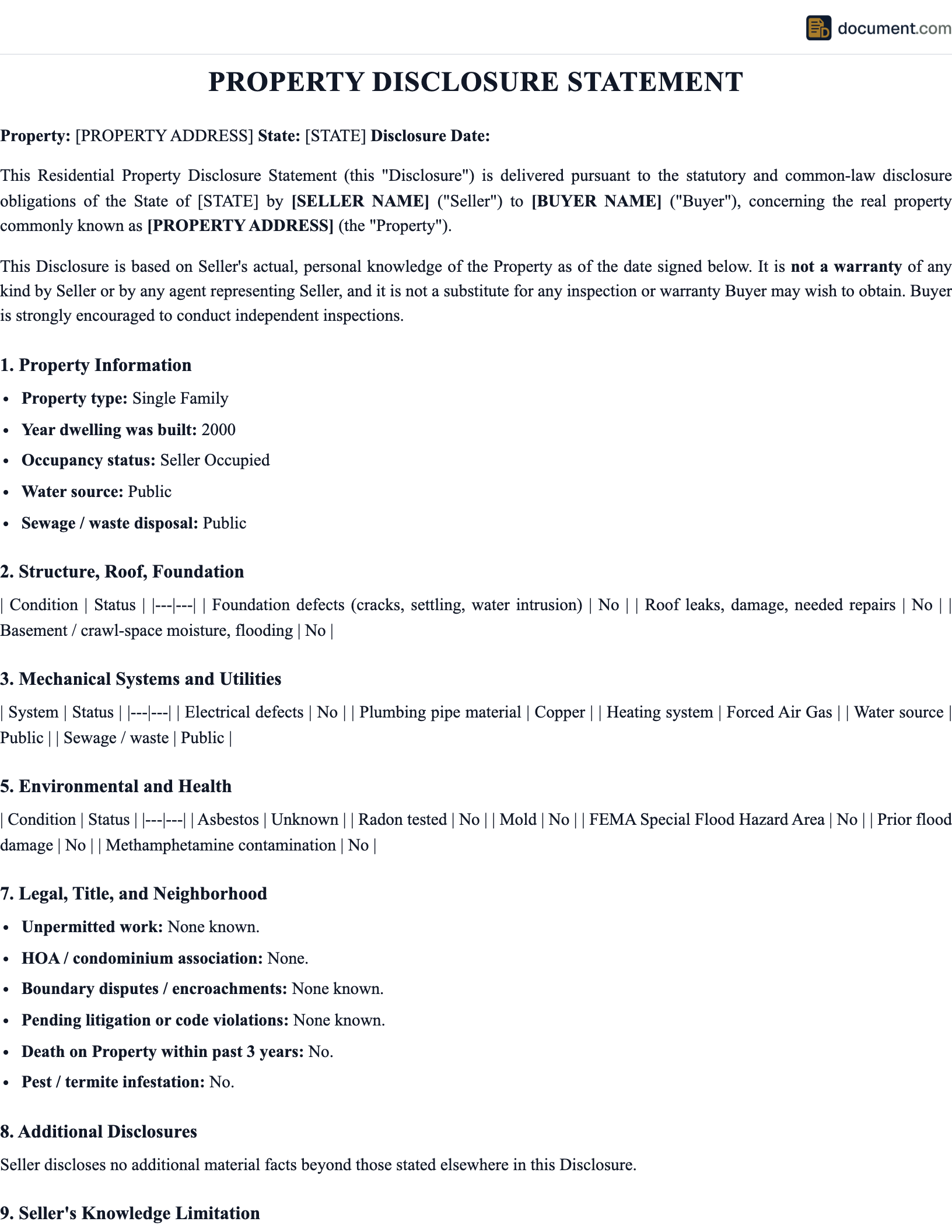
Sample Georgia Disclosure Statement
Preview of our Georgia-specific template. Your document will include all fields required for recording in any Georgia county.
PROPERTY DISCLOSURE STATEMENT
STATE OF GEORGIA
Legal Document
PARTY INFORMATION
Name: [Full Legal Name]
Address: [Georgia Address]
County: [County]
PROPERTY DESCRIPTION
County: [County] State: Georgia
Legal Description: [Per Recorded Plat]
Parcel No.: [APN]
Georgia Disclosure Statement FAQ
Common questions about filing in Georgia, including requirements, fees, and tax implications.
Official Georgia Resources
Official state resources for verifying requirements and finding your local recording office.
Important Considerations for Georgia Sellers
Termite damage is a genuine and common issue in Georgia, where the warm, humid climate creates favorable conditions for subterranean termites year-round. Sellers who know of prior or active infestations, or who have had termite treatment done, should include that on the disclosure form. Buyers in Georgia often request a separate pest inspection, and sellers who have addressed the issue can frame it positively while still being transparent.
The flood zone question on Georgia's disclosure form can surprise sellers in inland areas who do not think of their property as flood-prone. Many properties along Georgia's rivers, including the Chattahoochee, Savannah, Altamaha, and their tributaries, fall within FEMA flood zones even if they have never personally experienced flooding. A brief check of your county's flood maps before completing the disclosure prevents an inadvertent omission.
Georgia's older housing stock, particularly in older Atlanta neighborhoods and smaller cities, frequently has deferred maintenance that qualifies as a latent defect. Sellers of homes with aging roofs, galvanized plumbing, knob-and-tube wiring, or other aging systems should answer the disclosure questions conservatively rather than optimistically. If a buyer's inspector finds it, the seller is better positioned having disclosed it.
Georgia Sellers Without an Agent
Private sellers in Georgia are fully subject to OCGA 44-1-16 and must complete and deliver the disclosure form. Without an agent to manage the process, sellers take on the responsibility of delivery, receipt documentation, and compliance with the lead paint disclosure requirement for pre-1978 homes. Consider having a Georgia real estate attorney review your completed form before delivering it to the buyer.
Related Documents
Depending on your situation, you may need additional documents alongside this one. Below are commonly related documents that are frequently used together in real estate transactions.
Working With a Georgia Real Estate Attorney
Georgia real estate closings are conducted by attorneys, and your closing attorney is a key resource during the transaction. In addition to handling the closing itself, they can review the disclosure form for completeness, advise on how to address conditions that fall in gray areas, and confirm that the lead paint addendum and HOA disclosures are properly handled.
If a buyer submits an inspection amendment after reviewing the disclosure, your attorney can help you evaluate the requests and decide how to respond. Sellers who handle inspection negotiations thoughtfully tend to close more deals. Those who refuse to acknowledge reasonable concerns often find buyers exercising their right to terminate under the contract's due diligence period.
After closing, keep the signed disclosure and buyer acknowledgment in a permanent file. Georgia's limitations period for fraud-based claims can run from when the buyer discovered the concealed condition rather than from the closing date, which means years of exposure can follow a transaction that appeared to close cleanly.
Georgia Resources
The Georgia Association of Realtors publishes the standard Seller's Property Disclosure Statement used in most residential transactions. The Georgia Real Estate Commission regulates licensees and their disclosure obligations. For flood zone verification, use the FEMA Flood Map Service Center to look up your property by address before completing the form.
Related Documents
Depending on your situation, you may need additional documents alongside this one. Below are commonly related documents that are frequently used together in real estate transactions.
Create your Georgia Property Disclosure Statement in under 5 minutes.
Answer a few questions and download a Georgia-compliant document, ready for the state agency.