



Florida Disclosure Statement Overview
Florida does not require sellers to use a specific state-mandated disclosure form. What Florida does require, under the common law standard established by the Florida Supreme Court in Johnson v. Davis (1985), is that sellers disclose all known facts that materially affect the value of residential real property and are not readily observable to the buyer. This is a robust obligation, and Florida courts enforce it aggressively. Sellers who stay silent about known material defects face the same legal exposure whether or not they filled out a form.
In practice, most Florida residential transactions use the Florida Realtors / Florida Bar standard contract, which includes disclosure provisions and addenda for radon, energy efficiency, and other state-specific matters. Sellers in private transactions who skip these forms are not legally excused from the underlying duty. They are simply removing the documentation that would otherwise protect them if a buyer raises a post-closing claim.
$10
Recording fee
$0.70 per $100
Transfer tax
Required
Notarization
2
Witnesses required
Florida Requirements
Florida sellers must disclose known material facts about the property that are not readily observable. This duty comes from common law and applies regardless of whether a formal disclosure form is used. In addition to the general materiality standard, Florida statutes impose specific disclosure obligations for radon gas and energy efficiency, both of which appear in the standard Florida contract addenda.
Florida Specific Note
Florida is one of the few states where the disclosure obligation comes primarily from case law rather than a mandatory form. This means the standard is defined by what a court would consider material to a reasonable buyer, not by a checklist. Sellers who are unsure whether a condition needs to be disclosed should err on the side of disclosing it. The cost of disclosure is zero. The cost of a post-closing misrepresentation lawsuit is not.
What Florida Sellers Must Disclose
- Known material defects: Any condition not readily observable that a reasonable buyer would consider material to the purchase decision
- Radon: Florida law requires a radon gas notification to buyers in all residential sales
- Energy efficiency: Florida requires disclosure of the property's energy efficiency rating or estimated energy costs where applicable
- Sinkhole history: Known sinkhole activity or prior sinkhole insurance claims must be disclosed
- Flood and storm damage: Prior insurance claims for flood or hurricane damage are material and should be disclosed
- Lead paint (separate): Federal addendum required for homes built before 1978
How to Deliver the Disclosure in Florida
In Florida, the property disclosure goes from seller to buyer. Nothing gets filed at a courthouse or county office. The goal is to document what the seller knew and ensure the buyer received that information before committing to the purchase.
Prepare a Written Disclosure
Use the Florida Realtors disclosure form or a comparably thorough written document. Cover all known material conditions, prior damage, radon notification, and any sinkhole history. Even though no state form is mandated, writing everything down is essential for your own protection.
Include the Radon and Energy Addenda
Florida law requires radon gas notification to all buyers. Include the radon disclosure language in your contract or as a separate addendum. If the standard Florida contract is being used, these addenda are typically already incorporated.
Deliver to the Buyer Before or at Contract Signing
Get the disclosure into the buyer's hands before they sign a purchase contract. Florida does not have a statutory delivery timeline, but early delivery is always better. Buyers who claim they never received the disclosure are a common source of post-closing disputes.
Get the Buyer's Signed Acknowledgment
Have the buyer sign the disclosure form or a separate receipt confirming they received it. This creates a record that the buyer was informed. Keep this documentation permanently.
Update If New Information Comes to Light
If a condition you were unaware of surfaces during the buyer's inspection or at any point before closing, disclose it immediately. A seller who learns of a defect and stays silent through closing takes on additional legal exposure.
Florida Fees & Costs
Typical costs for filing in Florida. Actual fees may vary by county.
| Fee / Tax | Amount |
|---|---|
| Recording Fee | $10 |
| Transfer Tax | $0.70 per $100 |
| Notarization | $5 - $25 per signature |
| Certified Copy | $1 - $10 per page |
| Attorney Review (optional) | $150 - $500 |
Seller Liability for Non-Disclosure in Florida
Florida's common law disclosure standard, rooted in Johnson v. Davis, gives buyers a strong foundation for post-closing litigation when sellers conceal known material facts. Buyers can seek rescission of the sale, damages, or both. Fraud-based claims are also available when concealment was intentional, and Florida's statute of limitations for fraud can run four years from the date the fraud was discovered, not from the date of closing.
Florida sellers sometimes believe that using an as-is contract relieves them of this duty. It does not. As-is in Florida means the buyer does not require repairs. The seller's obligation to disclose known material facts runs independently of whether the contract is as-is, and Florida courts have consistently held that as-is language does not excuse concealment. The as-is contract does, however, limit the buyer's ability to demand repairs, which is a separate matter.
Listing agents who have actual knowledge of a material defect also face potential liability if they do not disclose it. Florida real estate licensees have their own duty to disclose under the Florida Real Estate Commission rules. Sellers who try to hide a known condition from their own agent do not eliminate the legal risk to themselves; they simply add uncertainty about whether the agent knew too.
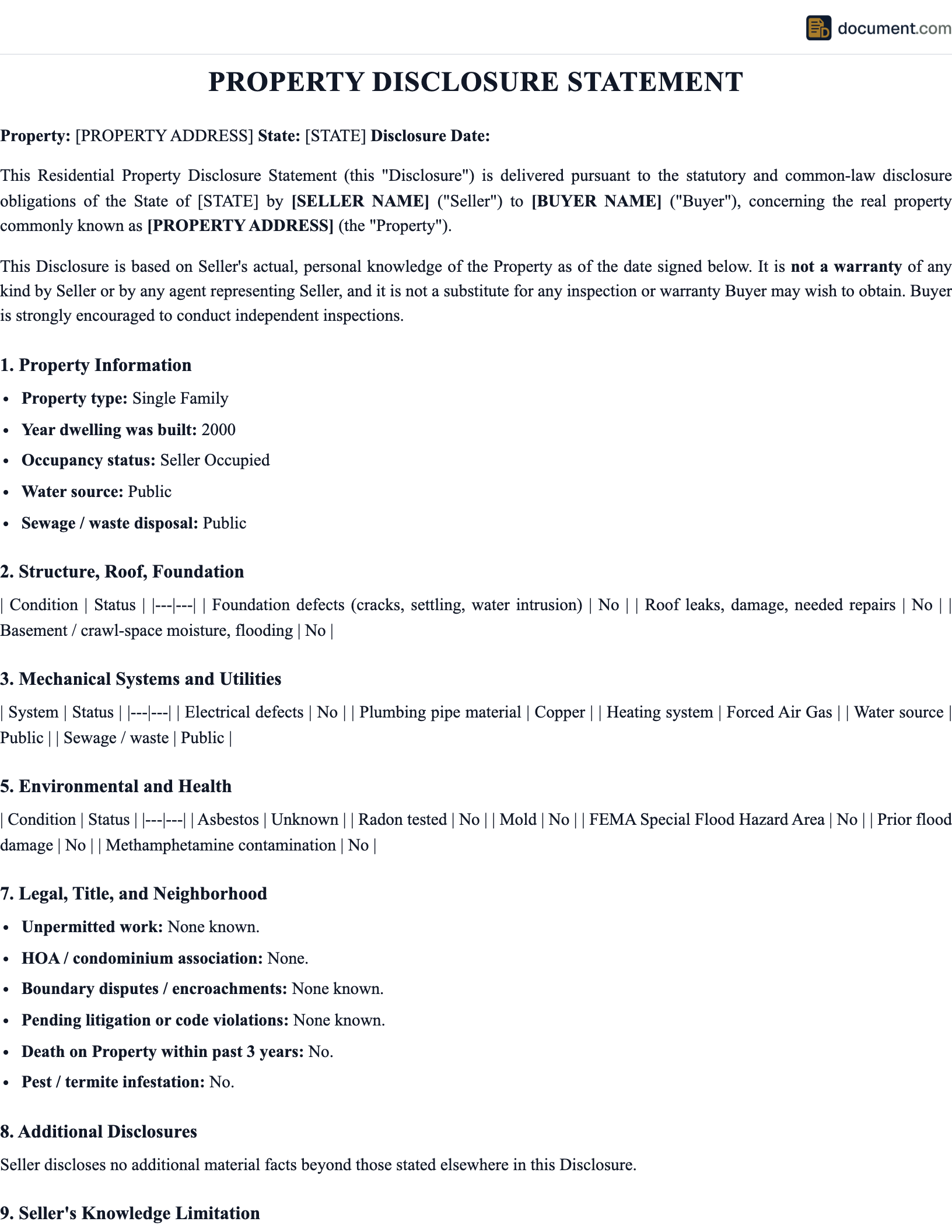
Sample Florida Disclosure Statement
Preview of our Florida-specific template. Your document will include all fields required for recording in any Florida county.
PROPERTY DISCLOSURE STATEMENT
STATE OF FLORIDA
Legal Document
PARTY INFORMATION
Name: [Full Legal Name]
Address: [Florida Address]
County: [County]
PROPERTY DESCRIPTION
County: [County] State: Florida
Legal Description: [Per Recorded Plat]
Parcel No.: [APN]
Florida Disclosure Statement FAQ
Common questions about filing in Florida, including requirements, fees, and tax implications.
Official Florida Resources
Official state resources for verifying requirements and finding your local recording office.
Important Considerations for Florida Sellers
Florida's sinkhole issue is not something sellers should underestimate. Central Florida in particular sits on limestone geology that makes sinkhole formation a genuine risk. If your home has had sinkhole activity, repairs, or insurance claims related to ground movement, that history is material and must be disclosed. Buyers who purchase without knowing about prior sinkhole damage can face significant repair costs and difficulty obtaining insurance or financing after the fact.
Hurricane and flood damage history is also a significant disclosure issue in Florida. Sellers who have made homeowner's insurance claims for wind damage, water intrusion, or flooding should include that in the disclosure. Buyers need to know the property's damage history to accurately assess insurance costs and the condition of repairs that were made. Concealing a prior claim and subsequent repair is one of the more common sources of post-closing litigation in Florida.
Florida's common law standard means that the disclosure obligation is not capped by a checklist. If you are aware of something that a reasonable buyer would want to know before paying the asking price, you should disclose it. When in doubt, disclose. The burden of having that conversation is far lighter than the burden of defending a lawsuit.
A Note on Florida's As-Is Contracts
Florida as-is contracts are common, particularly in the resale market, and they do limit the buyer's ability to require repairs. However, the as-is designation does not reduce the seller's common law disclosure duty one bit. Florida sellers who think as-is means they do not have to disclose anything have a fundamental misunderstanding of how the law works here. Johnson v. Davis applies whether the contract says as-is or not.
Related Documents
Depending on your situation, you may need additional documents alongside this one. Below are commonly related documents that are frequently used together in real estate transactions.
Private Sales and the Florida Disclosure Duty
Florida sellers who choose to sell without a real estate agent should understand that the Johnson v. Davis duty applies fully to for-sale-by-owner transactions. There is no agent in the middle to prepare disclosure addenda or flag issues that need to be addressed. The seller takes on the full responsibility of identifying and disclosing material conditions in writing.
Private sellers should use a written disclosure form even though none is specifically required. The form creates a record of what was disclosed and when. Without that record, a buyer who claims after closing that they were never told about a defect has a much easier case to make.
Having a Florida real estate attorney review your disclosure form before you deliver it to a buyer is a reasonable precaution, particularly for older homes, properties with known issues, or transactions involving significant value. The review fee is modest compared to the potential cost of defending a misrepresentation claim.
Florida Resources
Florida Realtors and the Florida Bar jointly publish the standard Residential Contract for Sale and Purchase, which includes radon, energy efficiency, and other state-specific disclosure provisions. The Florida Real Estate Commission provides guidance on agent disclosure duties. The Florida Department of Environmental Protection can be consulted for questions about environmental conditions affecting specific properties.
Related Documents
Depending on your situation, you may need additional documents alongside this one. Below are commonly related documents that are frequently used together in real estate transactions.
Create your Florida Property Disclosure Statement in under 5 minutes.
Answer a few questions and download a Florida-compliant document, ready for the state agency.