



Delaware Disclosure Statement Overview
Under Delaware Code Title 6, Chapter 25, sellers of residential properties with one to four units must provide a written disclosure of known defects to prospective buyers. This is a direct seller-to-buyer document. It is not recorded at the county recorder of deeds and does not require notarization. The seller completes the form and hands it to the buyer, who then has five days to decide whether to proceed with the purchase.
Delaware's disclosure requirements include a specific question about flood zone status, which sets it apart from many other states. Given Delaware's coastal geography and the number of properties in or near FEMA-designated flood areas, this question carries real financial weight for buyers. Sellers who know their property is in a flood zone must say so, and buyers who discover it post-closing when they cannot get financing without costly flood insurance have legitimate legal claims against sellers who concealed it.
$33
Recording fee
4% split
Transfer tax
Required
Notarization
0
Witnesses required
Delaware Requirements
Delaware's disclosure statute covers all known defects that materially affect the residential property. The form is completed by the seller and delivered to the buyer before or at the time a purchase contract is signed. The buyer then has five days after receipt to rescind the contract if they choose not to proceed. Sellers should understand that the five-day clock runs from actual receipt, not from when the form was mailed or uploaded.
Delaware Specific Note
Delaware sellers must specifically disclose whether the property is in a FEMA Special Flood Hazard Area. This is not a standard question in all states, and Delaware buyers near the coast or in low-lying areas place significant weight on it. Check your current flood map status through FEMA's Flood Map Service Center before completing the disclosure form.
What Delaware Sellers Must Disclose
- Structural systems: Foundation, framing, roofing, walls, and ceilings
- Mechanical systems: Plumbing, electrical, heating, and air conditioning
- Flood zone status: Whether the property lies within a FEMA Special Flood Hazard Area
- Environmental hazards: Underground storage tanks, asbestos, radon, mold
- Water and sewer: Public vs. private supply, well condition, septic system status
- Lead paint (separate): Federal disclosure form required for homes built before 1978
How to Deliver the Disclosure in Delaware
The Delaware property disclosure goes directly from seller to buyer. There is no filing with a government office, no recording fee, and no notarization required for the disclosure itself. The process is straightforward, but the timing and documentation matter.
Check Your Flood Zone Status
Before completing the form, verify whether your property is in a FEMA Special Flood Hazard Area using the FEMA Flood Map Service Center. This determines how you answer the flood zone question on the form.
Complete the Disclosure Form
Fill out every section of the Delaware property disclosure report based on your actual knowledge of the property. Address structural systems, mechanical systems, flood zone status, and environmental conditions.
Deliver to the Buyer
Give the completed disclosure to the buyer before or at contract signing. If using a real estate agent, coordinate this through your agent. In a private sale, hand delivery or traceable electronic delivery are both appropriate.
Document the Date of Receipt
Get the buyer to acknowledge in writing the date they received the form. Delaware's five-day rescission clock starts on the date of actual receipt, so this record is important if any dispute arises.
Prepare the Federal Lead Paint Disclosure Separately
For homes built before 1978, complete and deliver the federal lead-based paint disclosure addendum as a separate document. This is required under federal law regardless of whether Delaware law applies to your specific transaction type.
Delaware Fees & Costs
Typical costs for filing in Delaware. Actual fees may vary by county.
| Fee / Tax | Amount |
|---|---|
| Recording Fee | $33 |
| Transfer Tax | 4% split |
| Notarization | $5 - $25 per signature |
| Certified Copy | $1 - $10 per page |
| Attorney Review (optional) | $150 - $500 |
Seller Liability for Non-Disclosure in Delaware
Delaware sellers who fail to complete the required disclosure or who knowingly provide false information face significant legal exposure. The primary remedy available to buyers is rescission: the buyer can seek to void the transaction and recover the purchase price. This remains available after closing if the buyer can show the seller knew of a defect that was deliberately omitted from the disclosure.
Buyers can also sue for damages rather than rescission, particularly when they prefer to keep the property and simply recover the cost of remediation or repair. Courts determine damages based on the diminution in value caused by the concealed condition. In flood zone cases, where mandatory insurance costs can run thousands of dollars per year, the financial impact on the buyer can be substantial.
Delaware's five-day rescission window is specifically designed to give buyers a quick exit if the disclosure raises concerns. But this window closing does not eliminate the buyer's other legal remedies. If the seller's disclosure was fraudulent, the buyer retains the ability to sue even after the rescission period has passed and the transaction has closed.
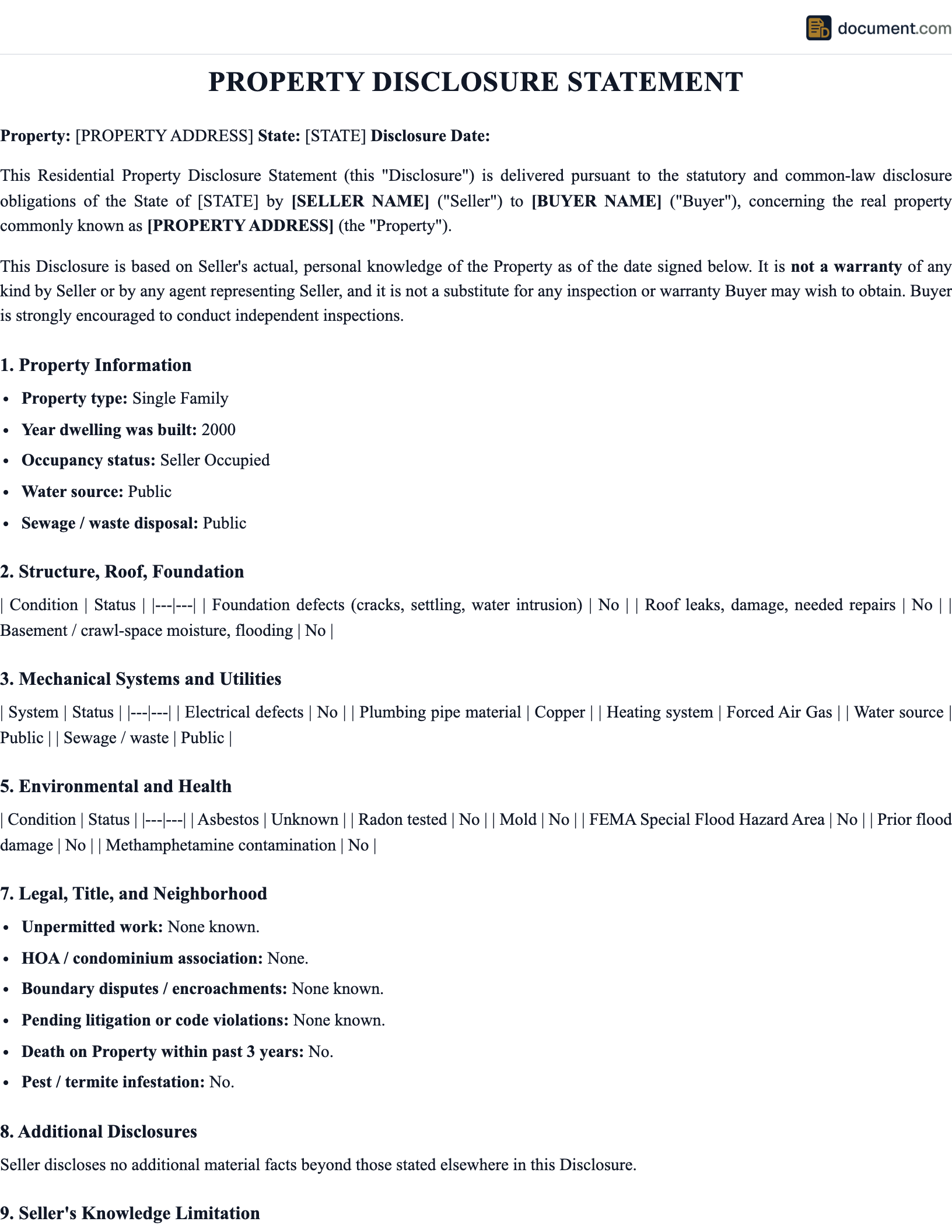
Sample Delaware Disclosure Statement
Preview of our Delaware-specific template. Your document will include all fields required for recording in any Delaware county.
PROPERTY DISCLOSURE STATEMENT
STATE OF DELAWARE
Legal Document
PARTY INFORMATION
Name: [Full Legal Name]
Address: [Delaware Address]
County: [County]
PROPERTY DESCRIPTION
County: [County] State: Delaware
Legal Description: [Per Recorded Plat]
Parcel No.: [APN]
Delaware Disclosure Statement FAQ
Common questions about filing in Delaware, including requirements, fees, and tax implications.
Official Delaware Resources
Official state resources for verifying requirements and finding your local recording office.
Important Considerations for Delaware Sellers
The flood zone question on Delaware's disclosure form deserves more attention than it typically gets. Delaware's coastal communities, including areas in Sussex County and along the Chesapeake and Delaware Bay watersheds, have significant numbers of properties that fall at least partially within FEMA flood zones. Sellers sometimes assume they are not in a flood zone because they have never flooded, but the FEMA designation is based on modeled risk, not actual flood history. Check the current FEMA flood map for your parcel before completing the form.
Older Delaware homes also frequently have legacy environmental issues: abandoned oil tanks, asbestos in floor tiles or pipe insulation, and lead paint in windows and trim. Many sellers are genuinely unaware of these conditions. If you have any doubt, consider having a pre-listing inspection done so you can fill out the disclosure accurately rather than guessing. Disclosing a condition you had addressed is far better than having a buyer discover it during their own inspection.
The five-day rescission period in Delaware is longer than in most states, and it means buyers have a real opportunity to review the form carefully before they are committed. Sellers who deliver a thorough, honest disclosure typically see that window close without incident. Sellers who cut corners on the form often find buyers using the rescission period as their escape route.
Private Sales in Delaware
Delaware's disclosure requirement applies to private sales as well as agent-assisted transactions. If you are selling without a real estate agent, you are still obligated to complete and deliver the disclosure form. Consider having a Delaware real estate attorney review your completed form before delivery to confirm you have covered all required areas.
Related Documents
Depending on your situation, you may need additional documents alongside this one. Below are commonly related documents that are frequently used together in real estate transactions.
Working With a Delaware Real Estate Attorney
Delaware residential closings are typically handled by real estate attorneys, and your attorney is a key resource for navigating the disclosure process. They can review the completed form for adequacy, advise you on how to describe ambiguous conditions, and confirm that the federal lead paint addendum has been properly handled for older properties.
If a buyer raises a post-disclosure issue during their inspection period, your attorney can help you evaluate whether to update the form, negotiate a repair or credit, or hold your position. Sellers who respond thoughtfully to inspection-period concerns tend to close transactions more reliably than those who refuse to engage.
Keep your signed disclosure and the buyer's written receipt in a file you retain after closing. Delaware's fraud statute of limitations can run several years from the date the buyer discovered the concealed condition, not from the date of closing. Your documentation is your protection.
Delaware Resources
The Delaware Real Estate Commission and the Delaware Association of Realtors provide guidance on standard disclosure forms and requirements. The FEMA Flood Map Service Center is the appropriate resource for verifying your property's flood zone designation before completing the flood zone section of the disclosure.
Related Documents
Depending on your situation, you may need additional documents alongside this one. Below are commonly related documents that are frequently used together in real estate transactions.
Create your Delaware Property Disclosure Statement in under 5 minutes.
Answer a few questions and download a Delaware-compliant document, ready for the state agency.