



Connecticut Disclosure Statement Overview
Connecticut General Statutes Section 20-327b requires sellers of residential real property to complete and deliver a written property disclosure report to prospective buyers before the buyer signs a purchase contract. This is not an optional formality. The law creates a specific timeline, and sellers who get it wrong hand buyers a contractual escape hatch. The disclosure goes directly to the buyer and their agent. Nothing about this process involves the town clerk, recording fees, or notarization.
Connecticut's disclosure form covers a broad range of conditions: structural integrity, roofing, plumbing, HVAC, electrical, well and septic, environmental hazards including underground oil storage tanks, and neighborhood conditions. Sellers also need to address the state's smoke detector certification requirement separately before closing. Treating both as part of the same pre-closing checklist keeps transactions on track.
$60
Recording fee
0.75% - 2.25%
Transfer tax
Required
Notarization
2
Witnesses required
Connecticut Requirements
The Connecticut property disclosure report must be completed in writing by the seller and delivered to the buyer before the purchase contract is signed. If timing slips and the buyer receives it after signing, the buyer has three days to void the contract. That is a tight window, and it gives buyers real leverage. Sellers who get this right from the start avoid creating an unnecessary exit for buyers who might otherwise commit.
Connecticut Specific Note
Connecticut requires a smoke detector compliance certification separate from the property disclosure form. Sellers must confirm that working smoke detectors are installed per state requirements before closing. Buyers sometimes overlook this, but closing attorneys in Connecticut routinely check for it. Missing this step can delay your closing.
What Connecticut Sellers Must Disclose
- Structural conditions: Known problems with foundation, walls, roof, and framing
- Mechanical systems: Heating, cooling, plumbing, and electrical defects known to the seller
- Environmental conditions: Radon, underground oil storage tanks, asbestos, lead paint, mold
- Water systems: Well condition, water quality tests, septic system condition and age
- Legal issues: Pending litigation, zoning violations, easements affecting the property
- Smoke detector compliance: Certification that detectors meet Connecticut standards
How to Deliver the Disclosure in Connecticut
Delivering the disclosure in Connecticut is a buyer-facing process, not a government filing. No recording office is involved. Here is how sellers should handle it to stay on the right side of CGS 20-327b.
Complete the Disclosure Form Fully
Work through every section of the Connecticut property disclosure report. Answer based on what you actually know. Leaving items blank or writing "unknown" for conditions you are aware of will not protect you from liability.
Confirm Smoke Detector Compliance Separately
Connecticut requires a smoke detector certification at closing. Verify that your detectors meet current state requirements before listing, so you are not scrambling to address it in the final days of the transaction.
Deliver Before the Contract is Signed
Give the completed form to the buyer before they sign the purchase contract. Your real estate agent typically handles delivery, but in a private sale you are responsible for making sure it reaches the buyer in time.
Collect a Signed Receipt from the Buyer
Ask the buyer to sign a receipt confirming they got the disclosure and the date they received it. This establishes when the three-day rescission window started and protects you if the buyer later claims they never got the form.
Update the Disclosure If Anything Changes
If you discover a new problem after delivering the disclosure, update the form and re-deliver it. Connecticut courts have held that sellers have a continuing duty to provide accurate information through closing.
Connecticut Fees & Costs
Typical costs for filing in Connecticut. Actual fees may vary by county.
| Fee / Tax | Amount |
|---|---|
| Recording Fee | $60 |
| Transfer Tax | 0.75% - 2.25% |
| Notarization | $5 - $25 per signature |
| Certified Copy | $1 - $10 per page |
| Attorney Review (optional) | $150 - $500 |
Seller Liability for Non-Disclosure in Connecticut
Connecticut sellers who violate CGS 20-327b or who complete the disclosure form dishonestly expose themselves to civil liability. The most direct remedy is rescission: a buyer who can show the seller knew of a material condition and failed to disclose it can seek to undo the entire transaction. That means the seller returns the purchase price and the buyer returns the property. In a rising market, that outcome can be financially devastating for a seller.
Beyond rescission, a buyer can sue for damages covering the cost to remediate or repair the undisclosed condition, as well as any other losses stemming from the misrepresentation. Intentional concealment can support a fraud claim, which opens the door to additional relief and potentially a longer statute of limitations than a simple breach of contract claim.
Connecticut real estate agents also face potential liability if they have material knowledge they did not pass along. However, an agent's liability does not reduce the seller's. Sellers cannot hide behind their agent. The obligation under the statute runs directly from the seller to the buyer.
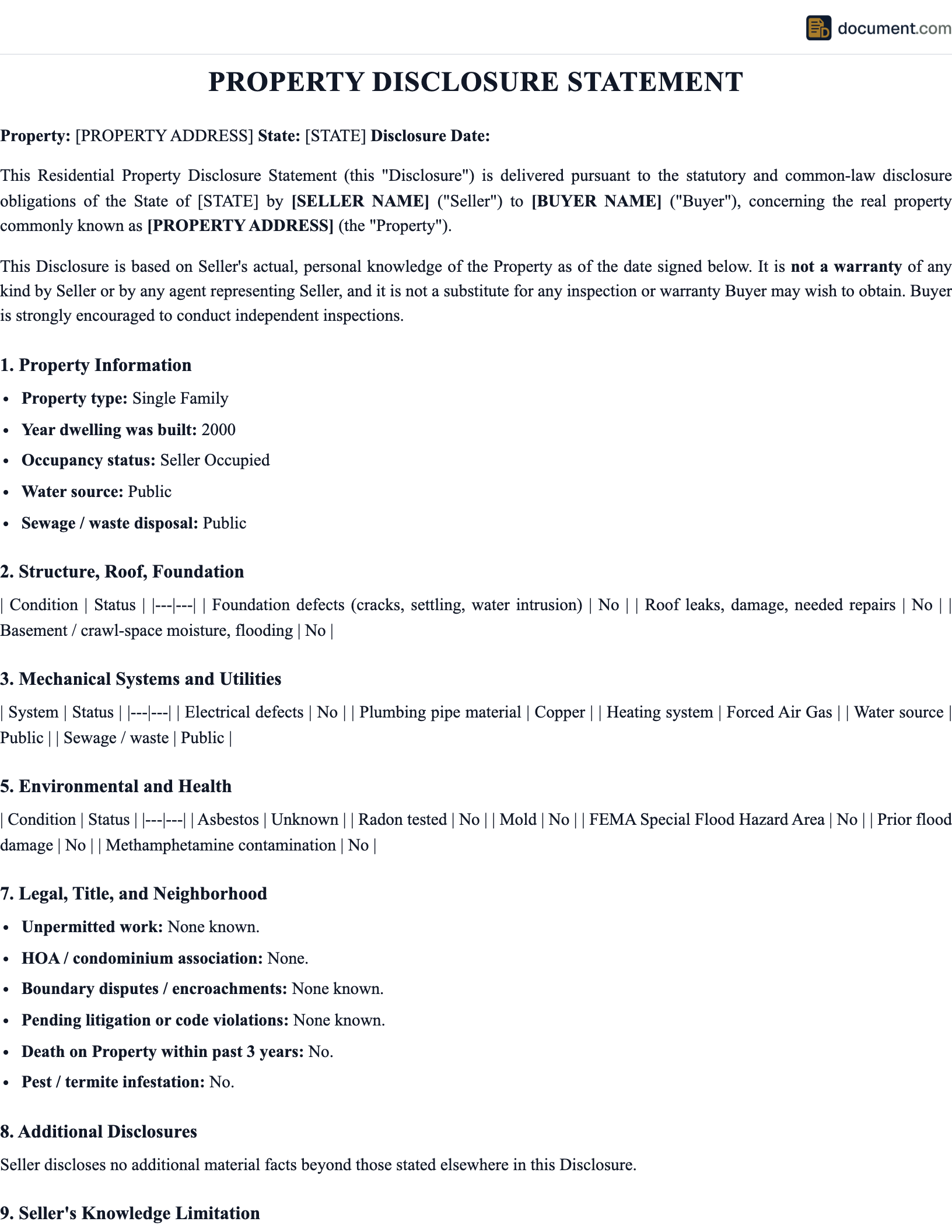
Sample Connecticut Disclosure Statement
Preview of our Connecticut-specific template. Your document will include all fields required for recording in any Connecticut county.
PROPERTY DISCLOSURE STATEMENT
STATE OF CONNECTICUT
Legal Document
PARTY INFORMATION
Name: [Full Legal Name]
Address: [Connecticut Address]
County: [County]
PROPERTY DESCRIPTION
County: [County] State: Connecticut
Legal Description: [Per Recorded Plat]
Parcel No.: [APN]
Connecticut Disclosure Statement FAQ
Common questions about filing in Connecticut, including requirements, fees, and tax implications.
Official Connecticut Resources
Official state resources for verifying requirements and finding your local recording office.
Important Considerations for Connecticut Sellers
Underground oil tanks are one of the most problematic issues in Connecticut residential transactions. Many older homes heated with oil have tanks that were buried decades ago and later abandoned in place. Sellers must disclose known underground tanks, and buyers routinely request testing or removal as a condition of sale. If you are unsure whether your property has one, a sweep by a licensed company before listing is money well spent.
Radon testing is common in Connecticut, and sellers who have test results on file should include that information in the disclosure. Buyers are likely to test anyway, and volunteering the information builds trust. If elevated radon was found and a mitigation system was installed, disclose both the original finding and the remediation. Buyers understand that mitigation works. What they do not like is discovering things that were hidden.
Connecticut uses attorneys to close real estate transactions. Your closing attorney will review the disclosure paperwork and the smoke detector certification before the closing takes place. If anything is missing or needs updating, they will flag it. Working with your attorney early in the process rather than waiting until closing week reduces the chance of last-minute delays.
Timing Is Everything in Connecticut
The three-day rescission window that kicks in when a buyer receives a late disclosure is one of the sharpest buyer protections in Connecticut real estate law. Get the disclosure into the buyer's hands before they sign the contract, and make sure you have documentation to prove it. That single step eliminates one of the biggest leverage points buyers can use to walk away after a deal is made.
Related Documents
Depending on your situation, you may need additional documents alongside this one. Below are commonly related documents that are frequently used together in real estate transactions.
Working With a Connecticut Closing Attorney
Connecticut is an attorney-closing state, which means a licensed real estate attorney must oversee the closing process. Your attorney will confirm that the CGS 20-327b disclosure was properly prepared and delivered, that the smoke detector certification is in order, and that the lead paint addendum is in place for older homes.
Sellers who engage their attorney early, rather than waiting until the week of closing, have more time to address issues that come up. If a buyer raises concerns about the disclosure after their inspection, your attorney can help you evaluate whether to update the form, negotiate a credit, or hold firm.
Keep copies of the signed disclosure, the buyer's receipt, and any updates or amendments. Connecticut's statute of limitations for contract claims is generally six years. For fraud claims it can be longer from the date of discovery. Having clean documentation from the transaction is your best protection long after closing.
Connecticut Resources
The Connecticut Department of Consumer Protection oversees real estate licensing and can answer questions about disclosure requirements. The Connecticut Association of Realtors also publishes guidance on the standard disclosure form and its proper use in residential transactions.
Related Documents
Depending on your situation, you may need additional documents alongside this one. Below are commonly related documents that are frequently used together in real estate transactions.
Create your Connecticut Property Disclosure Statement in under 5 minutes.
Answer a few questions and download a Connecticut-compliant document, ready for the state agency.