
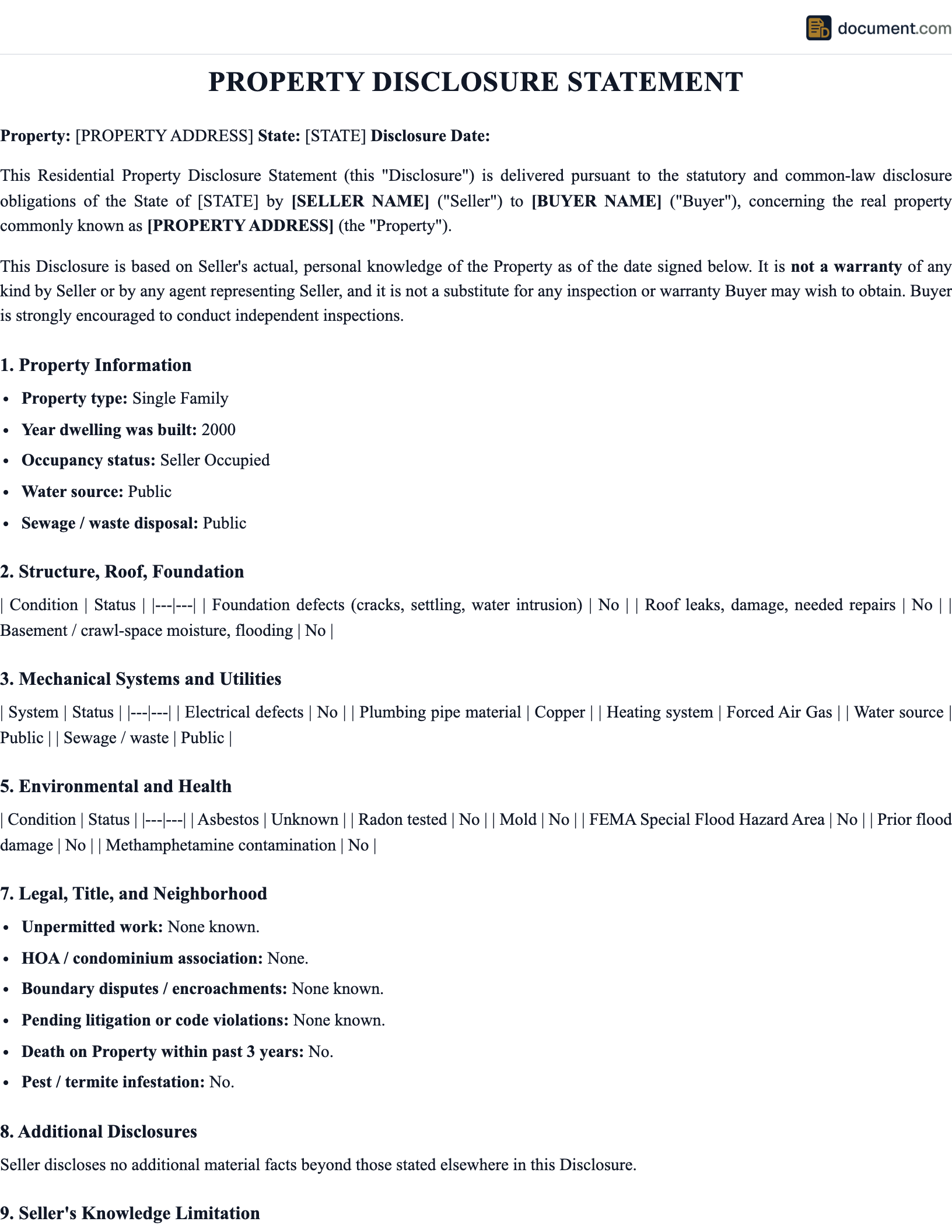



Colorado Disclosure Statement Overview
Colorado requires residential sellers to disclose known adverse conditions affecting the property under CRS 38-35.5-101. The Colorado Real Estate Commission has developed an approved Seller's Property Disclosure form that covers structural systems, environmental hazards, water and sewer, and neighborhood conditions. Sellers complete this form and deliver it directly to prospective buyers before or at contract signing. There is no government office where the disclosure is recorded or filed.
One aspect that sets Colorado apart from most states is the mineral rights question. Because oil and gas rights are commonly severed from surface rights in Colorado, sellers who know the mineral estate has been separated from the surface must include that in the disclosure. Buyers who skip this question could find themselves owning land where someone else controls what happens underground.
$13
Recording fee
$0.01 per $100
Transfer tax
Required
Notarization
0
Witnesses required
Colorado Requirements
Colorado sellers of residential property must complete a disclosure covering all known adverse conditions before a buyer signs a purchase contract. The Colorado Real Estate Commission's approved form is the standard, and most licensed agents require its use. Private-sale sellers should use the same form or a comparably thorough equivalent to protect themselves from liability later.
Colorado Specific Note
Colorado law requires disclosure of mineral rights severance if the seller is aware the surface and mineral estates have been separated. This is a question that often gets overlooked in other states but is critical in Colorado given the prevalence of oil and gas activity. Sellers should research their title before filling out the form.
What Must Be Disclosed
- Structural and mechanical systems: Known defects in roof, foundation, HVAC, plumbing, and electrical
- Environmental hazards: Radon, mold, asbestos, lead paint, underground storage tanks
- Water and sewer: Source of water supply, septic system condition, well test results if known
- Mineral rights: Whether the mineral estate has been severed from the surface estate
- Legal and HOA issues: Pending litigation, special assessments, HOA violations
- Neighborhood conditions: Known noise, nuisance, or adverse conditions near the property
How to Deliver the Disclosure in Colorado
In Colorado, the property disclosure statement is delivered to the buyer, not filed with any government office. Here is how the process typically works from preparing the form through buyer receipt.
Complete the CREC Disclosure Form
Use the Colorado Real Estate Commission's approved Seller's Property Disclosure form. Answer every question honestly based on your actual knowledge. Do not skip sections or write "unknown" for conditions you are aware of.
Research Your Mineral Rights Status
Before completing the form, review your title history or ask your title company whether the mineral estate has been severed from the surface. This is a Colorado-specific item that catches sellers off guard when it comes up after closing.
Deliver to the Buyer Before Contract
Provide the completed disclosure to the prospective buyer before or at the time the purchase contract is signed. Your listing agent can handle the handoff, or you can deliver it directly in a private sale.
Get Written Acknowledgment
Have the buyer sign and date an acknowledgment confirming they received the disclosure. Keep this in your transaction file alongside a copy of the completed form.
Update If Conditions Change
If you discover a new defect after delivering the disclosure but before closing, update the form and re-deliver it to the buyer. Failing to amend a disclosure you know is no longer accurate can expose you to liability.
Colorado Fees & Costs
Typical costs for filing in Colorado. Actual fees may vary by county.
| Fee / Tax | Amount |
|---|---|
| Recording Fee | $13 |
| Transfer Tax | $0.01 per $100 |
| Notarization | $5 - $25 per signature |
| Certified Copy | $1 - $10 per page |
| Attorney Review (optional) | $150 - $500 |
Seller Liability for Non-Disclosure in Colorado
Colorado sellers who fail to disclose known defects face real legal exposure. A buyer who discovers after closing that the seller was aware of a material condition can pursue rescission of the transaction, seeking to undo the sale and recover the purchase price. Alternatively, the buyer may sue for damages representing the cost to repair the defect or the reduction in the property's fair market value.
When a court finds that the seller's omission or misrepresentation was intentional, additional remedies may be available under Colorado fraud law. The statute of limitations for fraud-based claims in Colorado is generally longer than for simple contract claims, meaning buyers can pursue sellers years after closing if they can show the concealment was deliberate.
Real estate agents in Colorado can also face liability if they had knowledge of a defect that was not disclosed. Sellers who try to hide conditions from their own agent do not necessarily insulate the agent from claims, but a seller who lies on the disclosure form takes on personal liability that the agent may not share. Getting the form right protects everyone in the transaction.
Sample Colorado Disclosure Statement
Preview of our Colorado-specific template. Your document will include all fields required for recording in any Colorado county.
PROPERTY DISCLOSURE STATEMENT
STATE OF COLORADO
Legal Document
PARTY INFORMATION
Name: [Full Legal Name]
Address: [Colorado Address]
County: [County]
PROPERTY DESCRIPTION
County: [County] State: Colorado
Legal Description: [Per Recorded Plat]
Parcel No.: [APN]
Colorado Disclosure Statement FAQ
Common questions about filing in Colorado, including requirements, fees, and tax implications.
Official Colorado Resources
Official state resources for verifying requirements and finding your local recording office.
Important Considerations for Colorado Sellers
Colorado sellers commonly underestimate the mineral rights question on the disclosure form. If your property is in a county with active oil and gas exploration, review your title carefully before completing the form. A title search will show whether the mineral estate was severed in a prior transaction, sometimes decades ago. This is not the kind of thing to guess at.
Radon is also a significant concern in Colorado. The state has some of the highest radon concentrations in the country, particularly along the Front Range. If you have not had your home tested, consider doing so before listing. Disclosing a radon test result and the presence of a mitigation system is far better than a buyer discovering it during their own inspection and walking away from the deal.
If you receive an inspection objection from a buyer after the disclosure is delivered, take it seriously. The buyer's inspection period gives them the right to raise issues and negotiate repairs or credits. Sellers who refuse to engage reasonably at this stage often find buyers terminating and moving on. That costs time and puts you back at square one with new buyers who may ask the same questions.
A Note on As-Is Sales in Colorado
Selling as-is is a legitimate choice, and Colorado buyers sometimes accept properties in that condition. But as-is does not override your disclosure obligations. You must still complete the form accurately. The as-is designation simply tells buyers not to expect you to make repairs. It does not give you permission to omit what you know.
Related Documents
Depending on your situation, you may need additional documents alongside this one. Below are commonly related documents that are frequently used together in real estate transactions.
Working With a Colorado Real Estate Attorney
Most Colorado residential sales go through licensed real estate agents who are familiar with the CREC disclosure form. But sellers in private sales, those dealing with complex property histories, or those who have owned the property for many decades should strongly consider having an attorney review the completed form before delivery.
An attorney can help identify conditions you may not have recognized as disclosable, review your title for mineral rights issues, and advise on how to frame conditions that are ambiguous. That review typically costs far less than defending a post-closing lawsuit from a buyer who claims you knew more than you revealed.
Keep a copy of the signed disclosure, the buyer's acknowledgment, and any amendments in a file you retain after closing. If a dispute arises years later, your documentation that the buyer received the form and signed off on it is your primary defense.
Colorado Resources
The Colorado Real Estate Commission publishes its approved disclosure forms and buyer and seller guides on its website. If your transaction involves an HOA, Colorado law requires separate disclosure of HOA documents and financials, which is handled through the HOA's required disclosure package, not the seller's property disclosure form.
Related Documents
Depending on your situation, you may need additional documents alongside this one. Below are commonly related documents that are frequently used together in real estate transactions.
Create your Colorado Property Disclosure Statement in under 5 minutes.
Answer a few questions and download a Colorado-compliant document, ready for the state agency.