



California Disclosure Statement Overview
California has the most comprehensive seller disclosure requirements in the country. The foundation is the Transfer Disclosure Statement (TDS), mandated by Civil Code Section 1102 for sales of one-to-four-unit residential properties. But the TDS is only one document in a larger disclosure package that California sellers must assemble. A typical California real estate transaction requires the TDS, a Natural Hazard Disclosure (NHD) report, a lead-based paint disclosure for older properties, Mello-Roos and special assessment disclosure, smoke detector and water heater compliance statements, and an Agent Visual Inspection Disclosure (AVID) from each participating agent.
None of these documents are filed or recorded with the county recorder. They are all delivered directly to the buyer as part of the transaction. Buyers have three calendar days after in-person delivery of the TDS, or five days if it was mailed, to rescind the purchase contract under Civil Code 1102.3. California's disclosure framework is so comprehensive that the state's real estate industry has developed sophisticated systems for managing, delivering, and tracking acknowledgment of these multiple required documents.
$15
Recording fee
$1.10 per $1,000
Transfer tax
Required
Notarization
0
Witnesses required
California Requirements
California sellers face an extensive set of disclosure obligations spread across multiple documents and statutes. The TDS is the central document, but it sits within a broader framework that includes environmental and hazard disclosures, local ordinance requirements, and agent-specific duties that do not exist in most other states. Understanding what each required document covers helps sellers approach the process systematically rather than treating it as a single form exercise.
California Three-and-Five-Day Rescission Rule
Under Civil Code 1102.3, buyers have three calendar days to rescind after in-person TDS delivery, or five calendar days if the TDS was mailed. This right applies when the TDS is delivered after the purchase contract is signed. Sellers who provide the TDS before the contract is executed avoid this specific statutory rescission window, though buyers negotiate inspection contingencies that serve a similar purpose. Timing the TDS delivery correctly is a meaningful transaction management decision.
Required California Disclosure Documents
- Transfer Disclosure Statement (TDS): Mandatory seller disclosure of known defects and property conditions under Civil Code 1102
- Natural Hazard Disclosure (NHD): Third-party report identifying flood, fire, earthquake, and other hazard zones affecting the property
- Agent Visual Inspection Disclosure (AVID): Each agent's documented observations from a visual inspection of accessible property areas
- Lead-Based Paint Disclosure: Federal requirement for pre-1978 properties, including the EPA pamphlet and seller certification
- Mello-Roos and Special Assessments: Disclosure of Community Facilities District taxes and special assessments that will continue after purchase
- Smoke Detector and Water Heater Compliance: Certification that smoke detectors are installed per state law and water heater is braced against earthquakes
How to Complete and Deliver California Disclosures
California disclosure documents are private documents delivered to buyers, not filed with any government agency. Managing the delivery of multiple required forms requires coordination. Here is how the process typically works in a California residential sale.
Complete the TDS Thoroughly and Accurately
The TDS has three parts: a seller section, an agent section, and a buyer acknowledgment. Sellers complete Part I, covering property systems and known conditions. Be specific about defects and their status. A disclosure that says "roof has been repaired" should explain what was repaired, when, and by whom, to the extent the seller knows.
Order the NHD Report Early
Natural Hazard Disclosure reports are typically ordered from third-party disclosure companies through your title company or agent. Order this early, as the report takes time to prepare and is needed before closing. The report identifies whether your property falls within any state-designated hazard zones and carries legal significance for buyers making location-based decisions.
Coordinate Agent AVID Completion
Your listing agent is required under Civil Code 2079 to conduct a visual inspection of the property and complete an AVID. Buyers' agents complete their own AVID after viewing the property. These forms document what agents can observe and are delivered separately from but concurrently with the seller's TDS.
Deliver the Full Disclosure Package and Track Acknowledgments
Deliver all required disclosures together and obtain signed buyer acknowledgments for each document. California's disclosure system is paperwork-intensive by design. In agent-assisted transactions, disclosures are typically tracked through transaction management platforms, but sellers should confirm that all required documents have been properly acknowledged before proceeding to closing.
Supplement Disclosures If Conditions Change Before Closing
California sellers who discover new material conditions between disclosure delivery and closing should supplement the TDS promptly. A supplemental disclosure resets the buyer's three-or-five-day rescission window for the new information disclosed, which sellers need to account for in their closing timeline planning.
California Fees & Costs
Typical costs for filing in California. Actual fees may vary by county.
| Fee / Tax | Amount |
|---|---|
| Recording Fee | $15 |
| Transfer Tax | $1.10 per $1,000 |
| Notarization | $5 - $25 per signature |
| Certified Copy | $1 - $10 per page |
| Attorney Review (optional) | $150 - $500 |
Seller Liability for Disclosure Failures in California
California courts have consistently interpreted seller disclosure duties broadly and enforced them aggressively. A seller who fails to provide the TDS at all gives buyers a right to rescind. A seller who provides an inaccurate TDS, omitting known defects or providing false information about property systems, faces claims for fraud, negligent misrepresentation, and breach of statutory duty. The remedies available include rescission, actual damages for repair costs and related expenses, and punitive damages when intentional misconduct is proven.
California courts have also been consistent that disclosure obligations attach to facts the seller should know through reasonable inquiry, not just facts the seller has actual current knowledge of. If a seller has reason to investigate a condition but deliberately avoids doing so to preserve ignorance, courts have found that constructive knowledge sufficient to support a fraud claim. This makes the "I didn't know" defense harder to maintain in California than in many other states.
Agent liability is particularly significant in California. Civil Code 2079 creates a statutory duty for agents to conduct a visual inspection and disclose what they find. An agent who fails to identify a visible defect that a competent inspection would reveal can be held liable alongside the seller. Buyers in California get the benefit of two layers of disclosure duty - the seller's knowledge-based duty and the agent's observation-based duty - which makes California real estate one of the more protective disclosure frameworks in the nation.
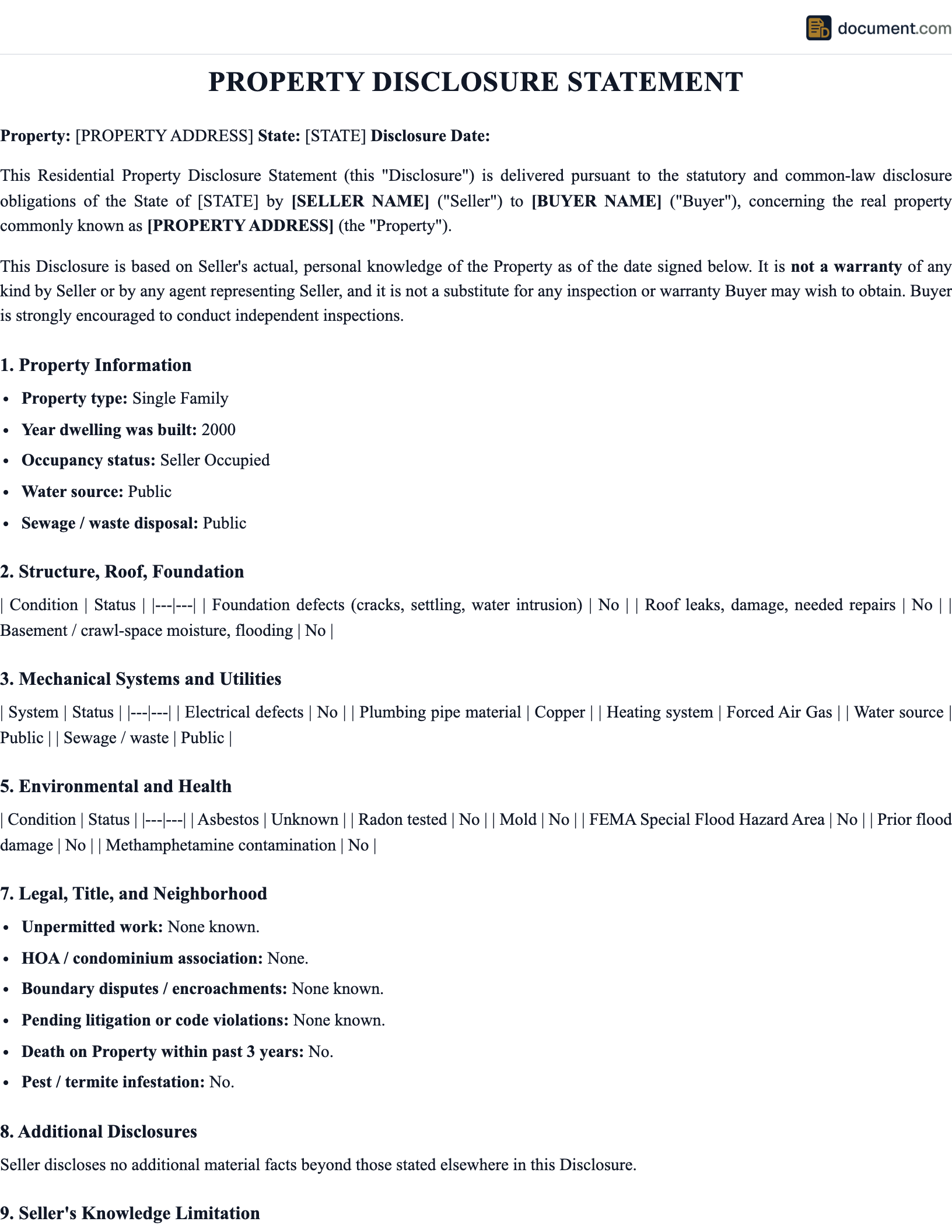
Sample California Disclosure Statement
Preview of our California-specific template. Your document will include all fields required for recording in any California county.
PROPERTY DISCLOSURE STATEMENT
STATE OF CALIFORNIA
Legal Document
PARTY INFORMATION
Name: [Full Legal Name]
Address: [California Address]
County: [County]
PROPERTY DESCRIPTION
County: [County] State: California
Legal Description: [Per Recorded Plat]
Parcel No.: [APN]
California Disclosure Statement FAQ
Common questions about filing in California, including requirements, fees, and tax implications.
Official California Resources
Official state resources for verifying requirements and finding your local recording office.
Important Considerations for California Sellers
California sellers who own properties in designated fire hazard zones face heightened scrutiny after repeated wildfire events across the state. The NHD report will flag Very High Fire Hazard Severity Zone designation, and sellers should be prepared for buyers to ask detailed questions about defensible space, fire insurance availability, and any past fire damage or smoke intrusion. Honesty on these points protects sellers from post-closing claims far better than minimizing the issue in hopes buyers will not probe.
Mello-Roos disclosures require special attention in newer California communities. Mello-Roos tax bonds are commonly used to fund infrastructure in master-planned communities throughout the Inland Empire, Central Valley, and other high-growth areas. These special tax obligations can add thousands of dollars annually to a buyer's carrying costs, and sellers who understate or misrepresent Mello-Roos obligations face serious liability. Verify the current Mello-Roos balance and annual assessment with the local taxing authority before completing this portion of the disclosure package.
Local ordinance disclosures vary significantly across California. Some cities and counties require additional disclosures beyond state law, covering topics like energy efficiency, sewer line condition, solar agreements, or rent control status. Sellers in San Francisco, Los Angeles, Oakland, and other larger municipalities should confirm what local requirements apply to their specific property before assuming state-level disclosures cover the full picture.
California Disclosure Is an Ongoing Obligation
California sellers must update the TDS if they discover new material facts before closing. A supplemental TDS delivery resets the buyer's rescission window for the new information. Sellers should build supplemental disclosure time into their closing timeline and resist the temptation to withhold new information to avoid complicating the deal. The risk of holding back material information far outweighs the transaction management inconvenience of updating the disclosure.
Related Documents
Depending on your situation, you may need additional documents alongside this one. Below are commonly related documents that are frequently used together in real estate transactions.
What California Buyers Should Know
California buyers receive more disclosure information than buyers in virtually any other state, but the volume of paperwork can be overwhelming. Focus first on the TDS seller section and the AVID, since these are the documents that capture what humans who have actually seen the property observed and knew. The NHD, while important, is a third-party report about zone designations - what matters more is what the seller and agents tell you about conditions they personally encountered.
Your three-or-five-day TDS rescission window is separate from your inspection contingency. Do not confuse them. The rescission right under Civil Code 1102.3 is automatic and requires no justification. Your inspection contingency, negotiated separately, is your opportunity to investigate conditions and request repairs or credits. Both rights have independent timelines that you need to manage carefully.
California's disclosure framework is designed to protect buyers, but it only works when buyers actually read what they receive. Before waiving your inspection contingency or your TDS rescission right, read every disclosure document you have been given and ask your agent about anything that raises questions. The disclosures exist to inform your decision, not to serve as paperwork to sign on the way to closing.
Professional Recommendation
California buyers who discover a material defect after closing that was not disclosed should consult a California real estate attorney before taking any action. The statute of limitations for TDS-related claims and fraud claims runs from discovery, not from closing, which means prompt consultation is important once you identify a potential problem. Document everything you find, including when you first noticed it, before contacting the seller or their agent.
Related Documents
Depending on your situation, you may need additional documents alongside this one. Below are commonly related documents that are frequently used together in real estate transactions.
Create your California Property Disclosure Statement in under 5 minutes.
Answer a few questions and download a California-compliant document, ready for the state agency.