
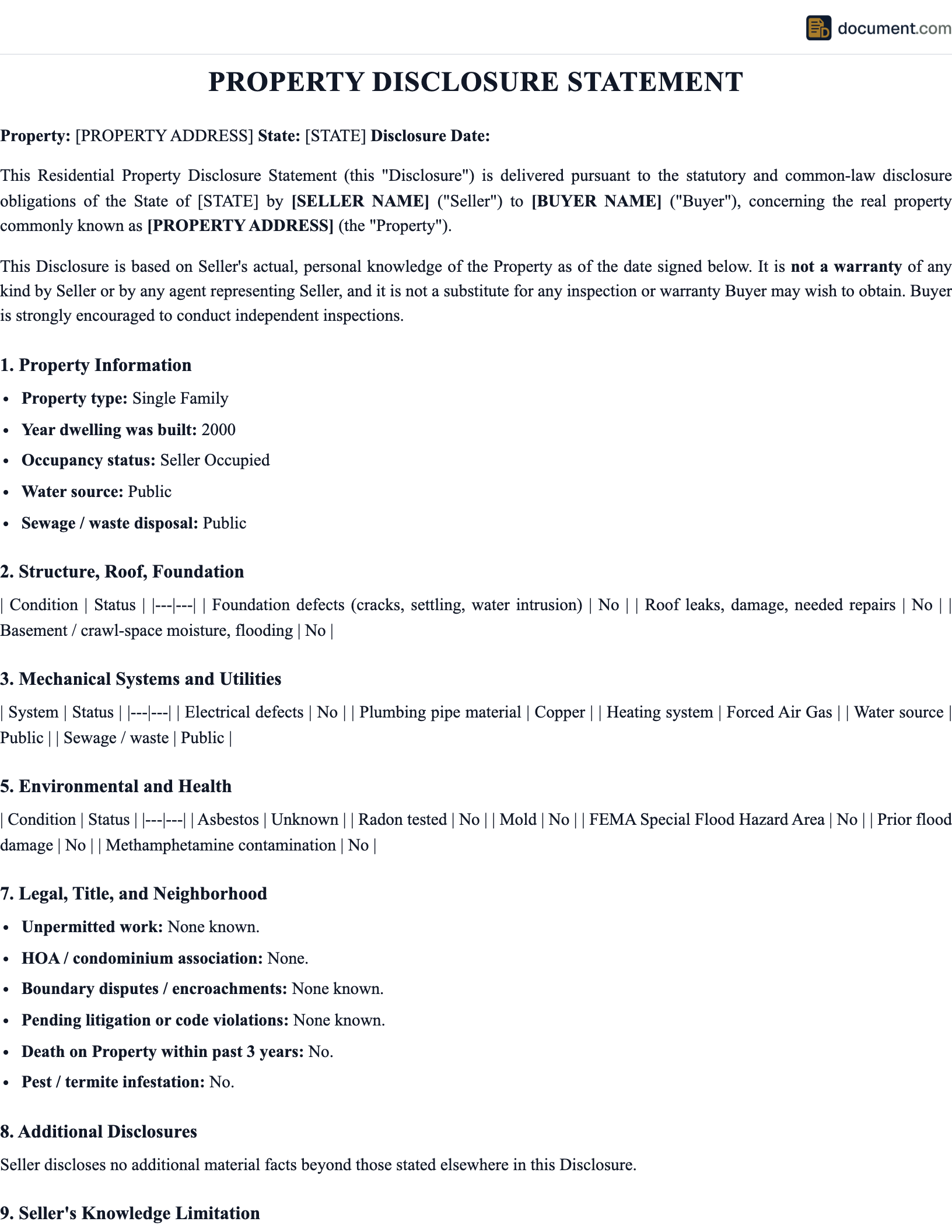



Arkansas Disclosure Statement Overview
Arkansas requires sellers of residential real property to complete a written disclosure statement under the Residential Property Disclosure Act (Arkansas Code Annotated 18-12-101 et seq.). The statute covers residential properties with one to four dwelling units and obligates sellers to disclose all known material defects in the property before the buyer commits to purchase. The disclosure form is delivered to the buyer directly - it is not filed, recorded, or submitted to any government office.
The Arkansas law is particularly attentive to timing. Sellers are supposed to provide the disclosure before or at the time a buyer makes an offer. If the disclosure comes later, after the buyer has already signed a purchase agreement, Arkansas law grants the buyer a two-business-day window to rescind the contract after receiving the form. This rescission right makes timing a practical negotiating consideration in Arkansas residential sales.
$15
Recording fee
$3.30 per $1,000
Transfer tax
Required
Notarization
0
Witnesses required
Arkansas Requirements
Under Arkansas Code Annotated 18-12-101 through 18-12-113, sellers must complete the disclosure form covering all material defects they are aware of that are not readily observable in a reasonable inspection. The form addresses structural components, mechanical systems, environmental conditions, legal matters, and prior repair history. Arkansas sellers must also indicate whether any disclosed defects were repaired and whether the repairs were fully addressed.
Arkansas Two-Day Rescission Window
Arkansas buyers who receive the disclosure form after signing a purchase agreement have two business days to rescind the contract. To avoid creating this window, sellers should deliver the completed disclosure before the buyer executes the agreement. Once rescission rights expire, buyers retain remedies based on misrepresentation but lose the automatic right to cancel the contract on statutory grounds alone.
Topics Covered by the Arkansas Disclosure Form
- Structural Components: Foundation, roof, walls, floors, ceilings, and any known defects or prior damage
- Mechanical Systems: HVAC, electrical, plumbing, and any known failures or repairs
- Water and Drainage: Water supply type, known drainage problems, basement or crawl space moisture history
- Environmental Hazards: Known presence of lead paint, asbestos, radon, underground storage tanks, or soil contamination
- Legal and Title Issues: Easements, encroachments, boundary disputes, HOA membership, or pending assessments
- Repair History: Material defects that were repaired and whether the repairs resolved the underlying condition
How to Complete and Deliver an Arkansas Disclosure
The Arkansas property disclosure statement is a private document exchanged between seller and buyer. It is not recorded at the circuit clerk's office or any other government office. Here is how the process works.
Complete the Form Before Listing or Marketing
Arkansas sellers should complete the disclosure form before the property is shown or marketed to potential buyers. Having the form ready at the time of offer avoids the statutory rescission window and demonstrates good faith to buyers from the start.
Be Specific About Repairs and Their Outcomes
Arkansas law requires sellers to disclose not just current defects but also material defects that were repaired. If a roof leaked five years ago and was repaired, that history belongs in the disclosure along with whether the repair fully resolved the problem. Sellers who say defects were repaired when they are not sure the underlying cause was addressed take on additional risk.
Deliver Before the Buyer Signs the Purchase Agreement
Providing the disclosure at or before the time of offer is the most legally favorable approach under Arkansas law. This timing eliminates the buyer's statutory two-day rescission right under ACA 18-12-104 and reduces the risk of late-disclosure complications arising during the contract period.
Obtain a Signed Receipt
Have the buyer date and sign an acknowledgment that they received the disclosure form. This receipt, along with your completed disclosure, should be kept in your transaction file and treated as a permanent record of the transaction.
Supplement If New Issues Are Discovered
If you become aware of a new material defect between the disclosure date and closing, supplement the disclosure promptly. A seller who fails to update a disclosure when material new information comes to their attention is in a weaker legal position if that defect later becomes a dispute.
Arkansas Fees & Costs
Typical costs for filing in Arkansas. Actual fees may vary by county.
| Fee / Tax | Amount |
|---|---|
| Recording Fee | $15 |
| Transfer Tax | $3.30 per $1,000 |
| Notarization | $5 - $25 per signature |
| Certified Copy | $1 - $10 per page |
| Attorney Review (optional) | $150 - $500 |
Seller Liability Under the Arkansas Disclosure Act
The Residential Property Disclosure Act creates concrete consequences for Arkansas sellers who fail to comply. A seller who does not provide the required disclosure form at all gives buyers the right to rescind the contract before closing. A seller who provides an incomplete or knowingly false disclosure faces claims for breach of the statutory duty and common law misrepresentation, with remedies including rescission and actual damages covering repair costs and related losses.
Arkansas courts have also allowed buyers to pursue fraud claims when sellers made affirmative false statements on the disclosure form. Unlike simple nondisclosure, affirmative misrepresentation can support claims for punitive damages in addition to compensatory relief. The distinction between filling out the form inaccurately and simply omitting an answer matters legally, but both can create substantial exposure for sellers.
Sellers who used licensed real estate agents should be aware that agents carry their own disclosure duties under the Arkansas Real Estate Commission rules. An agent who knows of a material defect that the seller has not disclosed faces independent liability. Sellers cannot instruct their agents to remain silent about conditions the agent has independently observed.
Sample Arkansas Disclosure Statement
Preview of our Arkansas-specific template. Your document will include all fields required for recording in any Arkansas county.
PROPERTY DISCLOSURE STATEMENT
STATE OF ARKANSAS
Legal Document
PARTY INFORMATION
Name: [Full Legal Name]
Address: [Arkansas Address]
County: [County]
PROPERTY DESCRIPTION
County: [County] State: Arkansas
Legal Description: [Per Recorded Plat]
Parcel No.: [APN]
Arkansas Disclosure Statement FAQ
Common questions about filing in Arkansas, including requirements, fees, and tax implications.
Official Arkansas Resources
Official state resources for verifying requirements and finding your local recording office.
Important Considerations for Arkansas Sellers
Flooding and drainage history is one of the most sensitive disclosure areas in Arkansas. The state's geography, including the Arkansas River valley, the Mississippi Delta, and numerous low-lying communities, means water intrusion issues are common and buyers are particularly attentive to them. Sellers who have experienced any flooding, standing water, or significant drainage problems on the property should address those directly and specifically in the disclosure.
Sellers who inherited the property or owned it only briefly may have limited knowledge of the property's history. Arkansas law ties the disclosure obligation to the seller's actual knowledge, so sellers who genuinely lack information about a property's prior condition should say so rather than answering questions in the negative by default. A disclosure that honestly states "unknown" in multiple places is legally preferable to one that answers "no" to questions the seller has no actual basis to address.
Sellers of rural Arkansas properties with private wells and septic systems face additional scrutiny. Septic system condition and compliance with county health department requirements are frequently material to buyers, particularly in areas where system repairs or replacements are expensive. Sellers who know of any history of septic problems, even if resolved, should include that information in the disclosure.
Provide the Disclosure Before the Offer
The single most effective step an Arkansas seller can take to reduce post-contract risk is to provide the completed disclosure form to buyers before they sign the purchase agreement. This eliminates the statutory rescission window and signals transparency that tends to reduce buyer anxiety about hidden problems. Sellers who wait until after the contract is signed are always at a disadvantage.
Related Documents
Depending on your situation, you may need additional documents alongside this one. Below are commonly related documents that are frequently used together in real estate transactions.
What Arkansas Buyers Should Know
Read the Arkansas disclosure form carefully when you receive it. Pay particular attention to anything the seller discloses in the repair history section, since that information tells you what went wrong in the past and whether it was actually fixed. An inspector can verify the current condition of any previously repaired item, which is valuable information in negotiations.
If you receive the disclosure after signing the purchase agreement, your two-business-day rescission clock is running. Use that time to review the form carefully. If anything concerns you, contact your real estate agent or an Arkansas attorney right away. Decisions made inside that window carry different legal consequences than those made after it closes.
The disclosure covers what the seller knows, which may not be everything. Always commission an independent home inspection. For properties in flood-prone areas, request a copy of any flood elevation certificates and verify flood zone status with FEMA independently. The seller's disclosure is a starting point, not a substitute for your own due diligence.
Professional Recommendation
Arkansas buyers who discover a significant undisclosed defect after closing should document the condition immediately, preserve any evidence of when it first appeared, and consult an Arkansas real estate attorney. Statutory and common law remedies for disclosure violations have time limits, and delay reduces your options. Early consultation gives you the best picture of what relief may be available.
Related Documents
Depending on your situation, you may need additional documents alongside this one. Below are commonly related documents that are frequently used together in real estate transactions.
Create your Arkansas Property Disclosure Statement in under 5 minutes.
Answer a few questions and download a Arkansas-compliant document, ready for the state agency.