



Arizona Disclosure Statement Overview
Arizona has one of the most structured seller disclosure processes in the western United States, driven largely by the Arizona Association of Realtors and its widely-used Seller's Property Disclosure Statement (SPDS). While Arizona does not have a single mandatory statute requiring a specific form for all residential sales, the SPDS is the de facto standard in agent-assisted transactions, and sellers have common law and regulatory obligations to disclose known material defects regardless of whether an agent is involved.
The SPDS covers an unusually broad range of topics for a disclosure form, including property condition, HOA information, and items specific to Arizona living like swimming pool equipment, septic systems, and proximity to agricultural operations. Buyers in standard Arizona transactions typically have five days after receiving the SPDS to rescind the contract, making the timing and content of the disclosure genuinely consequential to both parties.
$30
Recording fee
None
Transfer tax
Required
Notarization
0
Witnesses required
Arizona Requirements
The SPDS in Arizona is comprehensive by design. It addresses a broad range of property conditions and legal matters that Arizona's diverse housing stock makes relevant. In addition to the SPDS, separate HOA disclosure requirements under ARS 33-1806 (planned communities) and ARS 33-1260 (condominiums) require HOA documents to be delivered within specific timeframes. Sellers in HOA communities must coordinate both disclosures carefully.
Arizona SPDS and HOA Disclosure
Properties in homeowners associations require both a completed SPDS and separate HOA disclosure documents under ARS 33-1806 or ARS 33-1260. The HOA disclosure package must include governing documents, financial statements, and fee information. Failure to deliver HOA documents within the required timeframe can give buyers cancellation rights independent of the SPDS rescission period.
Key SPDS Sections Arizona Sellers Must Complete
- Property Condition: Known defects in structure, foundation, roof, walls, and all mechanical systems
- Water and Sewer: Type of water supply, water quality issues, and septic system information if applicable
- Pool and Spa: Condition of pool, spa, equipment, and any known repairs or leaks
- HOA Information: Monthly dues, pending assessments, special assessments, and community rules
- Environmental and Legal: Known contamination, easements, encroachments, and pending litigation
- Agricultural Proximity: Proximity to agricultural operations and any associated nuisance disclosures required by Arizona law
How to Complete and Deliver the Arizona SPDS
The SPDS is a private document exchanged between seller and buyer - it is never recorded at the county recorder's office. Here is how the delivery process typically works in an Arizona residential transaction.
Complete the SPDS in Full
Work through each section methodically. Do not leave sections blank. For any question where you are uncertain, mark it as unknown or explain what you do know. A complete, honest SPDS provides the best protection against post-closing claims.
Deliver Alongside the Listing or Early in Negotiations
Delivering the SPDS before the buyer signs the purchase contract avoids triggering the five-day rescission period. Many Arizona sellers include the SPDS in the listing package so buyers have full information before making an offer.
Coordinate HOA Document Delivery Separately
If the property is in an HOA, the HOA disclosure package must be provided within the timeframe specified in the purchase contract and Arizona law. This is a separate obligation from the SPDS. Contact the HOA early to request the disclosure package, as some associations take time to prepare the documents.
Collect a Signed Acknowledgment
The AAR purchase contract includes buyer acknowledgment of the SPDS. Ensure this acknowledgment is signed and dated. Retain copies in your transaction file as evidence that the disclosure was delivered and received.
Update If New Information Comes to Light
If a home inspection reveals issues the seller was not previously aware of, review your SPDS and determine whether an amendment is appropriate. Sellers who receive inspection reports identifying defects they had not previously noticed may need to update their disclosure accordingly before closing.
Arizona Fees & Costs
Typical costs for filing in Arizona. Actual fees may vary by county.
| Fee / Tax | Amount |
|---|---|
| Recording Fee | $30 |
| Transfer Tax | None |
| Notarization | $5 - $25 per signature |
| Certified Copy | $1 - $10 per page |
| Attorney Review (optional) | $150 - $500 |
Legal Implications of SPDS Failures in Arizona
Arizona sellers who provide incomplete or inaccurate SPDS information face several overlapping legal theories. The Arizona Consumer Fraud Act (ARS 44-1522) is one of the most significant tools available to buyers because it reaches conduct that is deceptive or misleading, not just intentionally fraudulent. Courts have applied the Consumer Fraud Act to seller misrepresentations in SPDS forms, and the statute allows recovery of attorney's fees, which increases the practical consequences of a disclosure failure.
Beyond the Consumer Fraud Act, buyers can pursue common law claims for negligent misrepresentation if a seller made a false statement without reasonable basis, and for fraud if the omission or misstatement was knowing. The five-day rescission right in the purchase contract coexists with these longer-term legal remedies. A buyer who does not rescind within five days does not lose the ability to sue for damages based on a material misrepresentation discovered later.
Licensed agents in Arizona face separate disciplinary exposure from the Arizona Department of Real Estate (ADRE) for failing to disclose known material defects, making agent-assisted transactions particularly high-stakes from a compliance standpoint. An agent who ignores a seller's incomplete SPDS can be disciplined even if the seller, not the agent, made the misstatement.
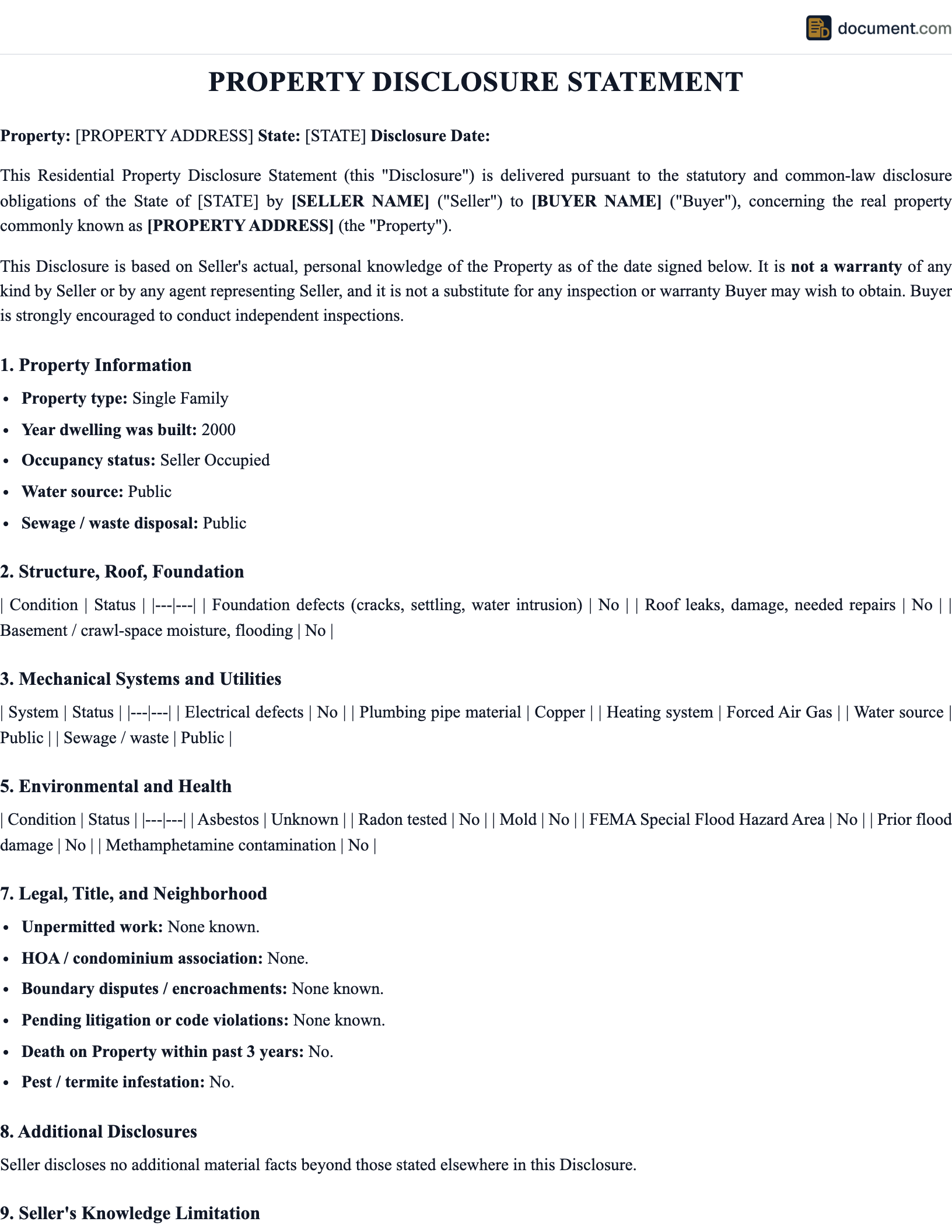
Sample Arizona Disclosure Statement
Preview of our Arizona-specific template. Your document will include all fields required for recording in any Arizona county.
PROPERTY DISCLOSURE STATEMENT
STATE OF ARIZONA
Legal Document
PARTY INFORMATION
Name: [Full Legal Name]
Address: [Arizona Address]
County: [County]
PROPERTY DESCRIPTION
County: [County] State: Arizona
Legal Description: [Per Recorded Plat]
Parcel No.: [APN]
Arizona Disclosure Statement FAQ
Common questions about filing in Arizona, including requirements, fees, and tax implications.
Official Arizona Resources
Official state resources for verifying requirements and finding your local recording office.
Important Considerations for Arizona Sellers
Arizona's SPDS is detailed enough that sellers who have not lived in the property for an extended period, such as those who inherited it or purchased it as an investment, should be particularly careful about how they answer questions in sections covering property history. Answering questions based on what you know rather than what you assume avoids the most common disclosure pitfall.
Pool disclosure is a significant issue in Arizona's real estate market. If the property has a pool or spa, answer all pool-related sections of the SPDS in detail. Equipment age, known repairs, any history of leaks or liner issues, and compliance with pool barrier requirements under Arizona law are all matters buyers and their attorneys scrutinize closely.
The agricultural proximity disclosure requirement deserves attention from sellers in rural areas, the Phoenix metro periphery, and agricultural communities in the valley. Arizona has a right-to-farm statute, and properties near agricultural operations require specific disclosures about associated dust, odors, noise, and chemical applications that buyers have a right to know about before purchasing.
Consumer Fraud Act Exposure
The Arizona Consumer Fraud Act creates meaningful liability exposure for sellers who make misleading SPDS representations, even without proving intentional deception. Sellers who are uncertain whether a condition requires disclosure should consult an Arizona real estate attorney before submitting the SPDS. The cost of that consultation is far less than defending a Consumer Fraud Act claim.
Related Documents
Depending on your situation, you may need additional documents alongside this one. Below are commonly related documents that are frequently used together in real estate transactions.
What Arizona Buyers Should Know
The SPDS five-day review period runs concurrently with your inspection contingency in most Arizona purchase contracts. Use both effectively. Read the SPDS carefully when you receive it and flag any answers that seem inconsistent with what you have observed about the property. Your inspector can then prioritize those areas during the physical inspection.
HOA documents require separate attention. For properties in planned communities or condominiums, review the HOA financials and meeting minutes carefully. Pending litigation against the HOA, large deferred maintenance items, or underfunded reserves are material facts that can significantly affect your decision to purchase and the property's long-term value.
If you discover after closing that the seller omitted a known defect from the SPDS, consult an Arizona real estate attorney promptly. Claims under the Consumer Fraud Act have a one-year statute of limitations from discovery, and preserving your rights requires acting early once you identify a potential problem.
Professional Recommendation
Arizona buyers should treat the SPDS as a starting point for investigation, not an endpoint. Even the most thorough seller disclosures reflect only what the seller knows. An independent inspection by a licensed Arizona home inspector, and specialists for pools, septic systems, or HVAC as needed, remains your most reliable protection.
Related Documents
Depending on your situation, you may need additional documents alongside this one. Below are commonly related documents that are frequently used together in real estate transactions.
Create your Arizona Property Disclosure Statement in under 5 minutes.
Answer a few questions and download a Arizona-compliant document, ready for the state agency.