



Alabama Disclosure Statement Overview
Alabama occupies unusual territory in American real estate law. Unlike the vast majority of states that require sellers to complete a written disclosure form before a residential sale, Alabama has retained the common-law doctrine of caveat emptor, which places the burden of property inspection on the buyer rather than the seller. There is no Alabama statute that mandates a standardized seller disclosure form for residential real property transactions.
That said, caveat emptor in Alabama is not a license to deceive. Courts have consistently held that sellers who actively conceal known defects, or who make affirmative false statements about a property's condition, can be held liable for fraud and misrepresentation. The protection the doctrine offers runs only to sellers who stay silent about discoverable conditions, not to sellers who lie or cover things up. Because this line can be murky in practice, many Alabama sellers and their agents choose to use voluntary disclosure forms as a practical risk-management tool.
$13
Recording fee
None
Transfer tax
Required
Notarization
0
Witnesses required
Alabama Requirements
Because Alabama has no mandatory disclosure statute for residential resale transactions, there is no state-prescribed form that sellers must use. However, voluntary disclosure forms used in Alabama transactions should cover the key categories of condition that buyers care about and that, if misrepresented, could expose the seller to liability.
Alabama Caveat Emptor Warning
Alabama is one of the very few states that still follows caveat emptor in residential sales. This means buyers take on significant responsibility for inspecting property before purchase. Buyers should never skip an independent home inspection in Alabama. Sellers should understand that while they have no statutory duty to disclose, they cannot actively mislead buyers without risking fraud liability.
What a Voluntary Disclosure Should Cover
- Structural Conditions: Foundation, roof, walls, and any known settling or movement issues
- Water and Moisture: Known leaks, flooding history, drainage problems, or moisture intrusion
- Pest History: Termite damage or treatment history is especially important in Alabama's climate
- Mechanical Systems: HVAC, plumbing, electrical systems, and any known deficiencies
- Environmental Hazards: Known lead paint, asbestos, underground storage tanks, or hazardous materials
- Legal Matters: Pending litigation, easements, encroachments, or title disputes affecting the property
How to Deliver a Disclosure in Alabama
Property disclosure statements are not filed or recorded anywhere in Alabama. They are private documents delivered directly from the seller to the prospective buyer as part of the transaction. Here is how that process typically works in an Alabama residential sale.
Complete the Disclosure Form
Work through each section of the form carefully, answering based on your actual knowledge of the property. Answer truthfully. If you do not know the answer to a question, mark it accordingly rather than guessing.
Deliver to the Buyer Before Contract
Present the completed form to any prospective buyer before they sign a purchase agreement. Providing it early gives buyers a chance to factor the disclosed conditions into their offer and inspection requests.
Get a Signed Acknowledgment
Have the buyer sign and date a receipt confirming they received the disclosure form. Keep this acknowledgment in your transaction file. It documents that the buyer had the information before committing to purchase.
Update If Conditions Change
If you discover a new material defect between the disclosure date and closing, provide the buyer with an amended disclosure. Failing to update a disclosure when you learn new information can undermine the protection the original disclosure offered.
Retain Your Copy After Closing
Keep a copy of the signed disclosure and acknowledgment after closing. Post-closing disputes over property condition can arise years later. Having written documentation of what you disclosed and when protects you if a buyer later claims you hid something.
Alabama Fees & Costs
Typical costs for filing in Alabama. Actual fees may vary by county.
| Fee / Tax | Amount |
|---|---|
| Recording Fee | $13 |
| Transfer Tax | None |
| Notarization | $5 - $25 per signature |
| Certified Copy | $1 - $10 per page |
| Attorney Review (optional) | $150 - $500 |
Seller Liability in Alabama
Even in a caveat emptor state, Alabama sellers face real legal exposure when they cross the line from silence into misrepresentation. The most common basis for post-closing seller liability is fraudulent concealment. Alabama courts have held that a seller who takes affirmative steps to hide a known defect, such as freshly painting over a water-stained ceiling or landscaping over a drainage problem, has committed actionable fraud regardless of what the purchase contract says.
Remedies available to Alabama buyers who successfully prove fraud or misrepresentation include rescission of the sale, which unwinds the transaction entirely, and compensatory damages, which cover the cost to repair the undisclosed defect. In egregious cases, courts have awarded punitive damages on top of actual losses. An AS-IS clause in the purchase contract does not reliably defeat these claims when deliberate concealment is proven.
Sellers who use a licensed real estate agent face additional risk exposure. Agents carry independent duties to buyers and can be held liable alongside their client sellers for negligent misrepresentation. An agent who repeats a seller's false statements about the property's condition, or who fails to disclose a known material defect they personally observed, exposes both themselves and the seller to claims.
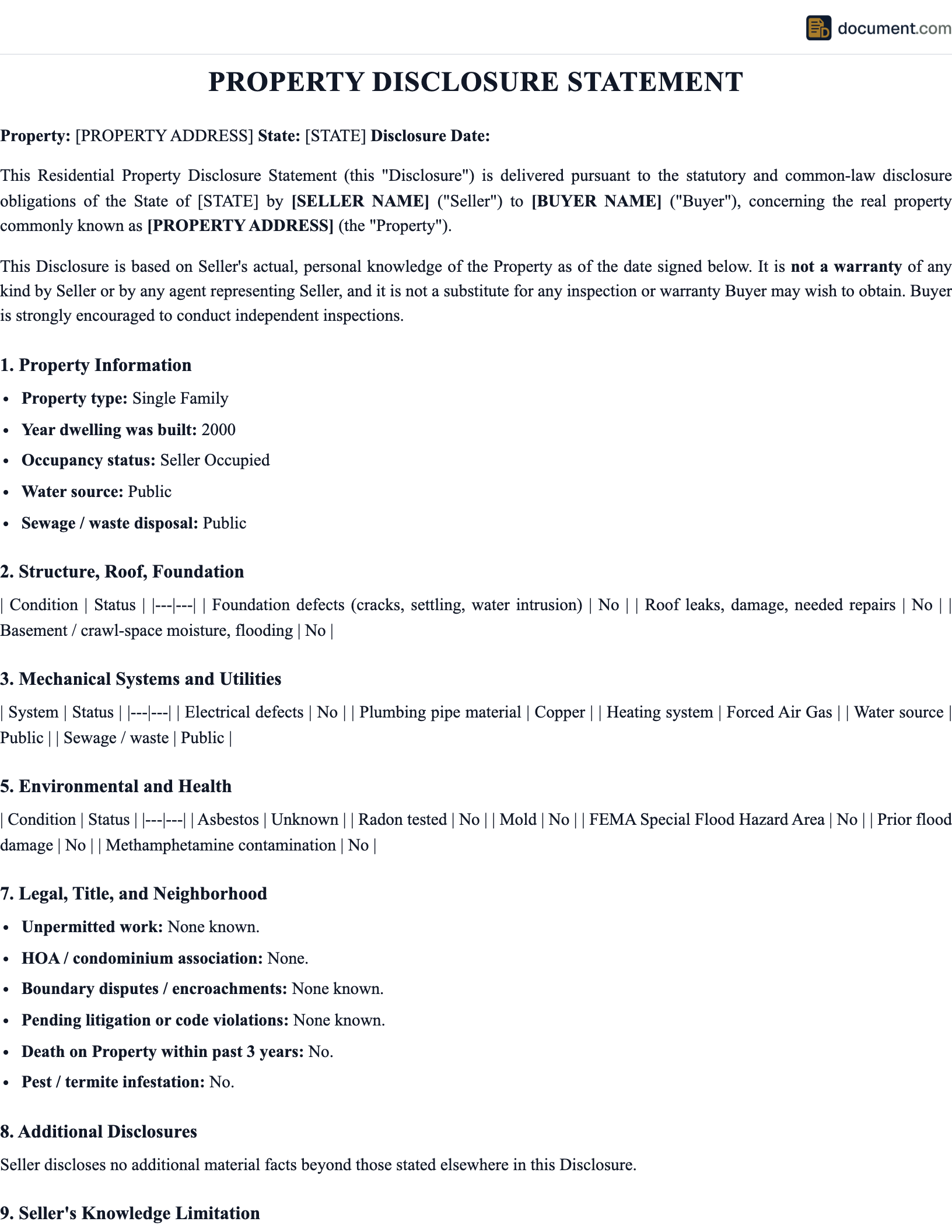
Sample Alabama Disclosure Statement
Preview of our Alabama-specific template. Your document will include all fields required for recording in any Alabama county.
PROPERTY DISCLOSURE STATEMENT
STATE OF ALABAMA
Legal Document
PARTY INFORMATION
Name: [Full Legal Name]
Address: [Alabama Address]
County: [County]
PROPERTY DESCRIPTION
County: [County] State: Alabama
Legal Description: [Per Recorded Plat]
Parcel No.: [APN]
Alabama Disclosure Statement FAQ
Common questions about filing in Alabama, including requirements, fees, and tax implications.
Official Alabama Resources
Official state resources for verifying requirements and finding your local recording office.
Important Considerations for Alabama Sellers
Alabama's caveat emptor framework is not a reason to be careless. Sellers who understand the boundaries of what the doctrine protects, and what it does not, will handle their transactions with far less post-closing risk. The critical distinction is between staying silent about a discoverable condition versus actively hiding one. Courts will not rescue sellers on the wrong side of that line.
Termite and wood-destroying organism damage deserves special attention in Alabama. The state's warm, humid climate creates persistent pest pressure, and hidden termite damage is one of the most common post-closing disputes in the state. Sellers who have had termite treatment or damage repairs should keep documentation of that work and, in many cases, share it proactively.
Federal disclosure requirements apply regardless of Alabama's state law. All sellers of pre-1978 residential properties must provide a lead-based paint disclosure under federal law, along with an EPA pamphlet. This requirement applies in every state, including Alabama, and carries its own penalties for non-compliance.
Attorney Review Recommended
Given Alabama's unusual legal landscape, sellers in higher-value transactions or those with known property issues should consult a real estate attorney before listing. An attorney can advise on what to disclose, how to phrase disclosures accurately, and how to structure a sale to minimize post-closing exposure.
Related Documents
Depending on your situation, you may need additional documents alongside this one. Below are commonly related documents that are frequently used together in real estate transactions.
What Alabama Buyers Should Know
In Alabama, you cannot count on the seller to hand you a comprehensive property history. The law does not require it. Your strongest protection is a thorough independent home inspection by a licensed Alabama home inspector before you commit to purchasing. Do not skip this step based on a seller's verbal assurances or a clean-looking property.
Beyond the general home inspection, Alabama buyers should strongly consider a separate termite and pest inspection. Many purchase contracts in Alabama already require a termite clearance letter, but a separate wood-destroying organism report provides more detailed information about current activity, past damage, and treatment history.
If a seller does provide a voluntary disclosure form, read it carefully and follow up on anything that raises questions. A disclosure form is a starting point for your due diligence, not a substitute for it. Ask for documentation of any repairs the seller mentions, and consider having a specialist inspect any system or area the seller flags as a known issue.
Professional Recommendation
Alabama buyers in caveat emptor transactions carry more risk than buyers in disclosure states. If you have questions about what a seller did or did not tell you before closing, or if you discover a significant defect after closing, consulting an Alabama real estate attorney early gives you the best chance to understand your options before the statute of limitations runs.
Related Documents
Depending on your situation, you may need additional documents alongside this one. Below are commonly related documents that are frequently used together in real estate transactions.
Create your Alabama Property Disclosure Statement in under 5 minutes.
Answer a few questions and download a Alabama-compliant document, ready for the state agency.