
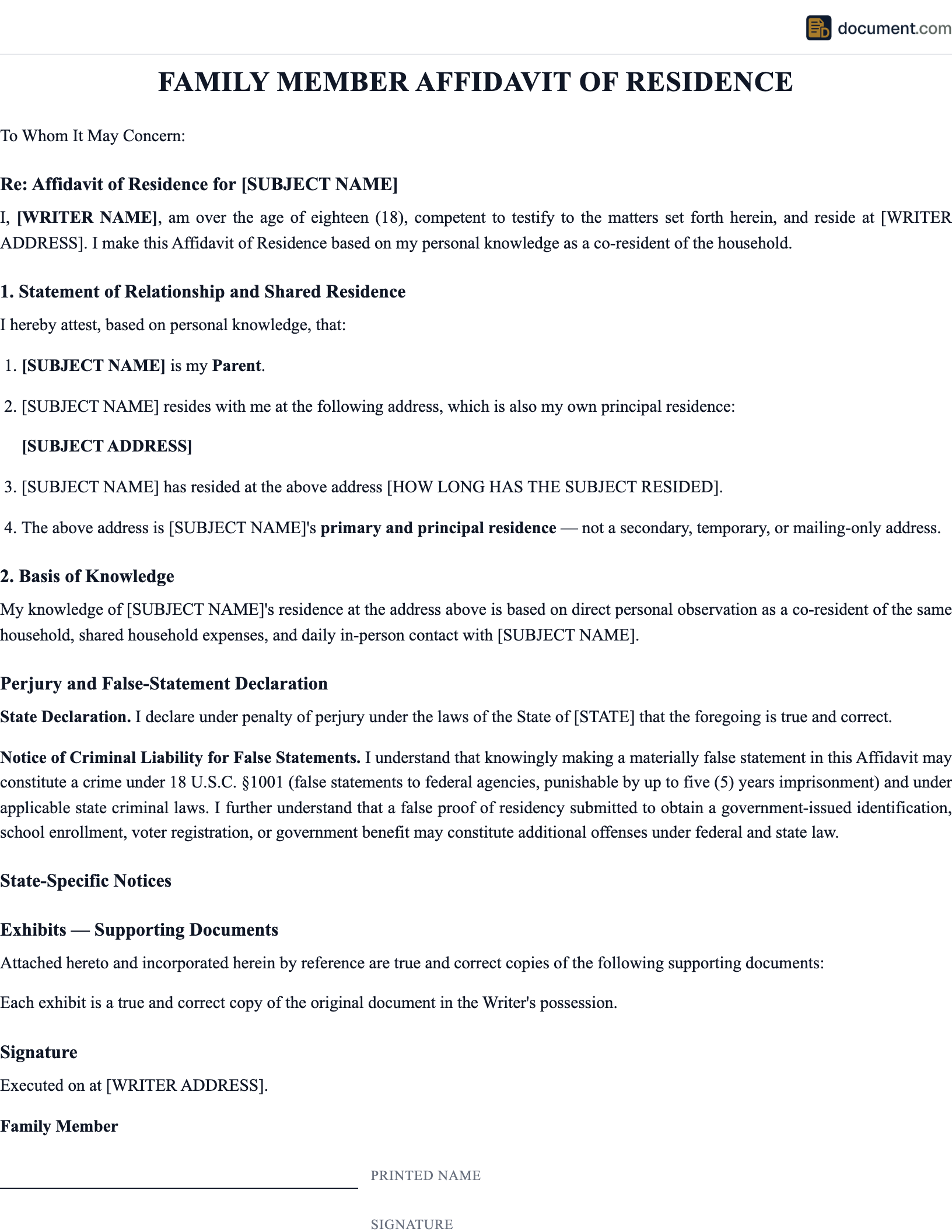



What Is a Proof of Residency Letter?
A proof of residency letter is a written statement from a third party that confirms a specific person lives at a specific address. The letter is used when the person needing to prove their address cannot do so through standard documents like utility bills, a lease agreement, or bank statements — either because those documents are not in their name, because they recently moved and have not yet established accounts at the new address, or because they live with someone else and are not the account holder or leaseholder.
The letter is written by someone with firsthand knowledge of the person's living situation — typically a landlord, property manager, homeowner, or family member. The writer states under their own name and reputation (and often under oath, if notarized) that the named individual resides at the specified address. This creates a verifiable chain of accountability: the institution receiving the letter can contact the writer to confirm the information, and if the letter is notarized, the writer has sworn to its accuracy under penalty of perjury.
Proof of residency letters serve a critical function in modern life because many essential services and legal processes require address verification. Government agencies need your address to issue identification documents, determine voting eligibility, and administer benefits. Schools need to verify that a student lives within the district boundaries. Courts need to confirm the jurisdiction in which a party resides. Banks need address verification to comply with federal anti-money laundering regulations. In each case, a properly prepared proof of residency letter fills the gap when other forms of documentation are unavailable.
While the format and requirements vary depending on who is requesting the letter, the core elements remain consistent: the writer's identity and relationship to the resident, the resident's full name, the property address, the duration of residency, the writer's contact information, the date, and the writer's signature. Many institutions also require the letter to be notarized or accompanied by supporting documentation.
Address Verification
Confirm where someone lives when standard documents are unavailable or not in their name
Widely Accepted
Recognized by DMVs, schools, courts, banks, insurance companies, and government agencies
Simple to Create
A straightforward one-page letter that can be prepared and signed in minutes
Proof of Residency by State
Proof of residency requirements vary by state for DMV, voter registration, in-state tuition, and benefits eligibility. Select your state below for a letter template that meets local notarization and documentation standards.
Who Writes a Proof of Residency Letter?
The letter must be written by someone who has direct, personal knowledge that the individual lives at the stated address. The credibility of the letter depends on the writer's relationship to the resident and their ability to independently verify the living arrangement. The following people are the most commonly accepted writers.
Landlords & Property Managers
The most authoritative source. Landlords and property managers have a direct contractual relationship with the tenant (the lease agreement) and can confirm the tenant's address with high credibility. Many institutions specifically prefer or require a letter from the landlord.
Homeowners (for Family Members)
When an adult child, parent, sibling, or other family member lives in the homeowner's residence, the homeowner can write a letter confirming the arrangement. This is common for young adults living with parents, elderly parents living with adult children, or family members staying temporarily after a move.
Roommates (on the Lease)
A roommate who is named on the lease can write a letter verifying that another person also lives at the address. This is useful when one occupant is on the lease but the other is not, or when both roommates need proof of residency and one has documents in their name while the other does not.
Authorized Representatives
In some situations, employers, school officials, clergy, social workers, or shelter directors may write proof of residency letters based on their personal knowledge of the individual's living situation. These letters are typically accepted for specific purposes like school enrollment or social services rather than for government ID.
Common Uses for a Proof of Residency Letter
Proof of residency is required in a surprisingly wide range of everyday situations. Here are the most common scenarios where you may need a formal letter confirming your address.
DMV / Driver's License
State DMVs require proof of residency to issue or renew a driver's license or state identification card. When you cannot provide utility bills or a lease in your name, a notarized proof of residency letter from someone you live with is typically accepted as an alternative. Some states have specific DMV residency affidavit forms.
School Enrollment
School districts verify residency to ensure students attend schools within their district boundaries. When a family lives with relatives or the parent is not the leaseholder, a proof of residency letter from the homeowner or leaseholder is used to confirm the child lives within the district.
Voter Registration
Voter registration requires proof that you live in the precinct or district where you are registering. A proof of residency letter can serve as address verification when other documents are not available. Requirements vary by state, and some states accept a wider range of residency documentation than others.
Government Benefits
Federal and state benefit programs — including Medicaid, SNAP (food assistance), housing assistance, and unemployment insurance — require address verification as part of the application process. A proof of residency letter is accepted when the applicant cannot provide standard documentation.
Court Proceedings
Courts may require proof of residency to establish jurisdiction, verify a party's address for service of process, or confirm residency requirements for divorce filings (many states require a minimum residency period before filing). Courts typically require notarized affidavits rather than simple letters.
Banking & Insurance
Banks require address verification when opening accounts to comply with the USA PATRIOT Act and Customer Identification Program (CIP) requirements. Insurance companies need your address to determine coverage areas and premium rates. Both will accept a proof of residency letter in combination with government-issued identification.
Immigration Proceedings
USCIS and immigration courts frequently require proof of residency as part of applications for visas, green cards, naturalization, and other immigration benefits. A notarized affidavit of residency from a U.S. citizen or permanent resident who can confirm the applicant's address is a commonly accepted document.
Change of Address
When you move to a new address and need to update your information with government agencies, utility companies, or financial institutions before new mail or bills arrive in your name, a proof of residency letter from the homeowner or leaseholder bridges the gap until you establish your own documentation trail.
Types of Proof of Residency
There are several ways to prove where you live, and the right option depends on your situation and what the requesting institution will accept. A formal proof of residency letter is needed when the other, more common forms of documentation are not available or not in your name.
Proof of Residency Letter (from a Third Party)
When to Use
- - You live with someone and no bills are in your name
- - You recently moved and have no new address documentation
- - You are a dependent living with a parent or guardian
- - You are temporarily staying with someone
Strength
Moderate when unnotarized. Strong when notarized and accompanied by supporting documentation (such as the writer's utility bill or lease). Accepted by most institutions when other options are unavailable.
Utility Bills
When to Use
- - Electric, gas, water, or internet bills in your name
- - Must show your current address
- - Usually must be dated within 30 to 60 days
- - Often the preferred form of proof
Strength
Strong. Utility bills are among the most widely accepted forms of address verification because they are issued by regulated companies and tied to a physical service location.
Lease Agreement
When to Use
- - You have a signed lease agreement in your name
- - The lease must be current (not expired)
- - Shows your name and the property address
- - Signed by both tenant and landlord
Strength
Strong. A signed lease is a legally binding contract that directly ties your name to a specific address. However, it does not prove you currently live there — only that you have a right to occupy the property.
Government Mail & Bank Statements
When to Use
- - Tax returns, IRS correspondence, or Social Security statements
- - Bank or credit card statements showing your address
- - Must be recent (typically within 30 to 60 days)
- - Official government mail carries more weight
Strength
Strong. Government-issued correspondence is highly credible because the sender is a trusted institution. Bank statements are also strong because financial institutions verify addresses as part of account opening.
When a formal letter is needed: A proof of residency letter from a third party is necessary when none of the above documents are in your name. This commonly happens when you live with a family member, recently moved, are a dependent, or are staying temporarily with someone. The letter fills the documentation gap by having a credible person vouch for your address.
Proof of Residency Letter Preview
Below is a visual preview of the sections and fields included in a standard proof of residency letter. This mockup illustrates the structure and level of detail our templates provide. Your completed letter will be fully formatted and ready for signature and optional notarization.
Proof of Residency Letter
Verification of Address
Section 1: Writer Information
Section 2: Resident Information
Section 3: Verification Statement
Section 4: Execution
Writer's Signature
Notary Public (if required)
What to Include in a Proof of Residency Letter
A complete proof of residency letter must contain specific information to be accepted by the requesting institution. Missing any of these elements is the most common reason letters are rejected. Include all of the following in your letter.
| Element | Description |
|---|---|
| Writer's Full Name | The full legal name of the person writing and signing the letter |
| Writer's Relationship | How the writer knows the resident — landlord, parent, roommate, property manager, etc. |
| Resident's Full Name | The full legal name of the person whose residency is being confirmed |
| Property Address | The complete street address, including apartment or unit number, city, state, and ZIP code |
| Duration of Residency | How long the person has lived at the address — either a specific move-in date or an approximate duration |
| Writer's Contact Info | Phone number and/or email address so the institution can contact the writer to verify the letter |
| Date | The date the letter was written and signed — most institutions require the letter to be within 30 to 60 days |
| Signature | The writer's handwritten signature (not a typed or digital signature in most cases) |
| Notarization (if required) | Notary's signature, seal, and commission expiration date — required by DMVs, courts, and many government agencies |
Notarization: When It's Required vs Recommended
Notarization adds a significant layer of credibility to a proof of residency letter because it means a licensed notary public has verified the identity of the person signing the letter and witnessed their signature. When a letter is notarized, the signer is effectively swearing under oath that the statements in the letter are true, and making a false notarized statement constitutes perjury — a criminal offense in every state.
Notarization Required
- •DMV / state identification applications in most states
- •Court filings and legal proceedings
- •Immigration and USCIS applications
- •Some government benefit applications
- •Residency affidavits for divorce filings
Notarization Recommended (but May Not Be Required)
- •School enrollment residency verification
- •Bank account opening
- •Insurance applications
- •Voter registration (varies by state)
- •Employer address verification
Best practice: Even when notarization is not strictly required, having the letter notarized increases the likelihood that it will be accepted on the first submission. Notarization typically costs $5 to $15 per signature and can be done at most banks, UPS stores, FedEx locations, and through mobile notary services. Many states also now accept remote online notarization (RON), allowing the letter to be notarized via video conference.
Common Mistakes and How to Avoid Rejection
Proof of residency letters are frequently rejected by institutions because of avoidable errors. Understanding the most common mistakes helps you prepare a letter that is accepted on the first attempt.
Missing Contact Information
Institutions need to be able to reach the writer to verify the letter. Always include a phone number and email address.
Outdated Letter
Most agencies require the letter to be dated within 30 to 60 days. An older letter will be rejected regardless of how well it is written.
No Relationship Stated
The letter must explain how the writer knows the resident lives at the address — landlord, parent, roommate, etc.
Missing Notarization
If the institution requires notarization and the letter is not notarized, it will be rejected. Check requirements before submitting.
Incomplete Address
Include the full street address with apartment or unit number, city, state, and ZIP code. A partial address is insufficient.
No Duration of Residency
Many institutions need to know how long the person has lived at the address, not just that they currently live there.
Typed Signature Only
Most institutions require a handwritten (wet) signature. A typed name at the bottom of the letter is not a valid signature.
Wrong Writer
Some agencies only accept letters from certain people (e.g., the DMV may only accept letters from a parent, spouse, or landlord). Verify who is acceptable.
How to Create a Proof of Residency Letter
Follow these three steps to create a proof of residency letter that will be accepted by the institution requesting it.
Check the Institution's Requirements
Before writing the letter, contact the institution that is requesting proof of residency and ask specifically what they require. Find out whether they have their own form (many DMVs and school districts do), whether the letter must be notarized, how recent it must be, who is allowed to write it (some agencies restrict acceptable writers to certain categories such as landlords or immediate family members), and whether any supporting documents are needed (such as a copy of the writer's ID, utility bill, or lease).
Getting this information upfront prevents rejection and the frustration of having to redo the letter. If the institution has its own specific form, use that form instead of a general letter. If they do not have their own form, our template covers all the elements that most institutions require.
Complete the Letter with All Required Details
Use our template to fill in all required information: the writer's full legal name, the writer's relationship to the resident, the resident's full legal name, the complete property address, how long the resident has lived at the address, and the writer's contact information (phone number and email). The statement should be clear, specific, and factual — avoid vague language like "I think" or "to the best of my knowledge." Use definitive language: "I confirm that [Name] resides at [Address] and has lived here since [Date]."
If the institution requires supporting documentation, prepare those documents alongside the letter. Common supporting documents include a copy of the writer's government-issued photo ID, a utility bill showing the writer's name at the same address, or a copy of the lease agreement.
Sign, Notarize (if Needed), and Submit
Print the letter and have the writer sign it by hand in ink. If notarization is required or recommended, bring the unsigned letter and a valid government-issued photo ID to a notary public. The writer must sign the letter in the notary's presence — do not sign the letter before arriving at the notary. The notary will verify the writer's identity, witness the signature, and apply their official seal and signature.
Submit the completed letter along with any required supporting documents to the requesting institution. Keep a copy for your records. If the letter is time-sensitive (most institutions require it to be within 30 to 60 days), submit it as soon as possible after it is signed and notarized.
Tip: If you anticipate needing proof of residency for multiple institutions, ask the writer to sign several copies at the notary. This saves time and money compared to making multiple trips to the notary for the same letter.
Sample Proof of Residency Letter
Below is a condensed preview of our proof of residency letter template. This sample shows the structure, language, and content included in our attorney-reviewed documents. Your completed letter will be customized with your specific information and formatted for professional presentation.
PROOF OF RESIDENCY LETTER
Verification of Address
Date: [Date]
To Whom It May Concern:
I, [Writer's Full Legal Name], hereby confirm that [Resident's Full Legal Name] currently resides at the following address:
[Street Address, Apt/Unit #]
[City, State, ZIP Code]
[Resident's Name] has resided at this address since [Move-in Date or Approximate Date]. I am the [homeowner/landlord/leaseholder] of this property, and [Resident's Name] is my [relationship: son/daughter/tenant/roommate].
I can be contacted at [Phone Number] or[Email Address] to verify this information.
I declare under penalty of perjury that the foregoing is true and correct.
Signature
Printed Name:
Date:
Notary Public (if applicable)
Commission Exp:
Seal:
Frequently Asked Questions
Find answers to common questions about proof of residency letters, notarization requirements, acceptable writers, and how to avoid rejection.
Official Resources
For additional information on residency verification requirements, identification documents, and address verification standards, consult these official and reputable resources.
USA.gov — Vital Documents
Federal guide to replacing and obtaining vital identification documents
DMV.org — State ID Requirements
State-by-state guide to identification card and driver's license requirements
U.S. Dept. of Education — McKinney-Vento
Federal law ensuring school enrollment for homeless and displaced students
USCIS — Acceptable Documents
U.S. Citizenship and Immigration Services guide to acceptable identity and residency documents
Vote.org — Registration Rules
State-by-state voter registration requirements and accepted proof of residency
CFPB — Bank Account Guide
Consumer Financial Protection Bureau guide to opening bank accounts and required documentation
Nolo — Proof of Residency
Free legal encyclopedia covering residency verification and documentation
National Notary Association
Find a notary, understand notarization requirements, and learn about remote online notarization
Create your Proof of Residency in under 10 minutes.
Answer a few questions and download a compliant, attorney-drafted document ready for your state.