



What Is a Military Power of Attorney?
A military power of attorney is a legal document executed under 10 U.S.C. § 1044b that allows an active-duty service member, reservist on orders, or eligible dependent to authorize an agent (the attorney-in-fact) to act on their behalf in financial, legal, or personal matters. The document derives its authority from federal statute rather than from any state's POA act, which gives it nationwide and overseas reach without the formality variations that complicate civilian POAs moved across state lines.
The legal foundation is two-part. Section 1044b(a) requires every state, the District of Columbia, every U.S. territory, every Indian tribe, and every commonwealth to recognize a military POA as valid. Section 1044b(b) provides the operative preemption: a military POA is exempt from any state requirement of form, format, recital, witness signatures, or recording, and shall be given the same legal effect as a POA prepared and executed under that state's law. The accompanying notary authority is set out separately at 10 U.S.C. § 1044a, which empowers JAG officers and authorized civilian attorneys at military legal-assistance offices to perform notarial acts using the official Department of Defense seal.
Service members typically request a military POA at three life moments. The first is before deployment, when a spouse or other agent will need to manage the household, joint finances, the family vehicle, and the residential lease in the service member's absence. The second is before a permanent change of station (PCS) or long temporary duty assignment (TDY), when sale of the current home, purchase of a new one, or storage of household goods will happen while the service member is in transit. The third is in connection with invocation of the Servicemembers Civil Relief Act, particularly the lease-termination provisions of 50 U.S.C. § 3955 and the interest-rate cap of 50 U.S.C. § 3902.
Installation legal assistance offices prepare military POAs at no cost as part of the JAG mission under 10 U.S.C. § 1044. Eligibility extends to active-duty members, reservists on Title 10 orders, retirees, and certain family members. The standard appointment runs 30 to 60 minutes and produces a notarized original ready for distribution. Pre-deployment Soldier Readiness Processing (SRP) under DoD Instruction 1342.19 typically batches POA preparation alongside will execution, beneficiary updates, and Family Care Plan certification.
Federally pre-emptive 10 U.S.C. § 1044b
The preemption is unconditional and self-executing. A state cannot require additional witness signatures (avoiding Florida's two-witness rule under Fla. Stat. § 709.2105 and Connecticut's parallel rule under Conn. Gen. Stat. § 1-352). A state cannot require a state-licensed notary (the JAG officer's authority under § 1044a substitutes). A state cannot require recital of a state-specific durability clause or a state-specific warning notice. A state cannot deny full faith and credit because the principal has no domicile in the state. The Department of Defense Standard Forms used by JAG offices include a § 1044b citation block on the face of the document, and any reliance party who refuses recognition can be referred to the federal statute and to DoD Directive 1350.4.
Jurisdictions that must accept the military POA, and scope limits
All 50 states, the District of Columbia, Puerto Rico, Guam, the U.S. Virgin Islands, the Northern Mariana Islands, American Samoa, and every federally recognized Indian tribe must recognize the military POA on its face. Recognition extends to overseas installations under SOFA agreements with NATO members, Japan, and South Korea. Foreign nations are not bound; transactions in non-treaty jurisdictions may require an apostilled document or a separate locally executed POA. Within recognized jurisdictions, scope limits remain governed by state and federal law on the underlying transaction. Real-estate POAs typically still require recording in county land records under state recording acts. Federal firearms transactions under 18 U.S.C. § 922 require principal completion of Form 4473. Some lenders impose institution-specific verification regardless of POA origin. The military POA controls recognition; substantive transactional rules continue to govern what the agent may actually do.
Types of Military Powers of Attorney
| Type | Best For | Typical Term |
|---|---|---|
| General Military POA | Broad financial authority during deployment | 6 to 12 months |
| Special Military POA | One transaction (vehicle sale, real-estate closing) | 30 to 90 days |
| Medical POA | Health-care decisions for principal or dependents | Until revoked |
| Family Care POA | Childcare and school authority for guardian | Length of deployment |
| SCRA Lease Termination POA | Ending residential lease under 50 USC §3955 | Single use |
How to Create a Military POA
Schedule a JAG Appointment
Contact your installation legal assistance office. Bring your military ID and any documents the agent will need to handle.
Choose Your Agent
Select a trusted spouse, parent, or friend. Discuss responsibilities and obtain their consent before the appointment.
Define the Powers
Decide whether you need a general POA, a special POA for one transaction, or a medical POA. JAG attorneys can advise on scope.
Set the Term
Pick an expiration date, typically your projected return date plus 30 to 90 days for cleanup transactions.
Sign Before the JAG Officer
Sign in person; the JAG officer will notarize and apply the federal authority block under 10 U.S.C. § 1044a.
Distribute Originals
Give the agent the signed original. Keep a copy in your records and send copies to your bank, landlord, or other institutions.
Key Components
Principal & Agent
Service member's full legal name, rank, branch, DoD ID, and agent's full name and address.
Federal Authority Statement
Citation to 10 U.S.C. § 1044a confirming preemption of state formalities.
Scope of Powers
Specific list of granted authorities including banking, real estate, vehicles, household goods, family care.
Effective & Termination Dates
Start date and an explicit expiration, often tied to deployment end plus a buffer.
Successor Agent
Backup agent if the primary cannot serve, common for spouses temporarily unavailable.
JAG Notarization Block
Signature, seal, and authority statement of the military legal assistance officer.
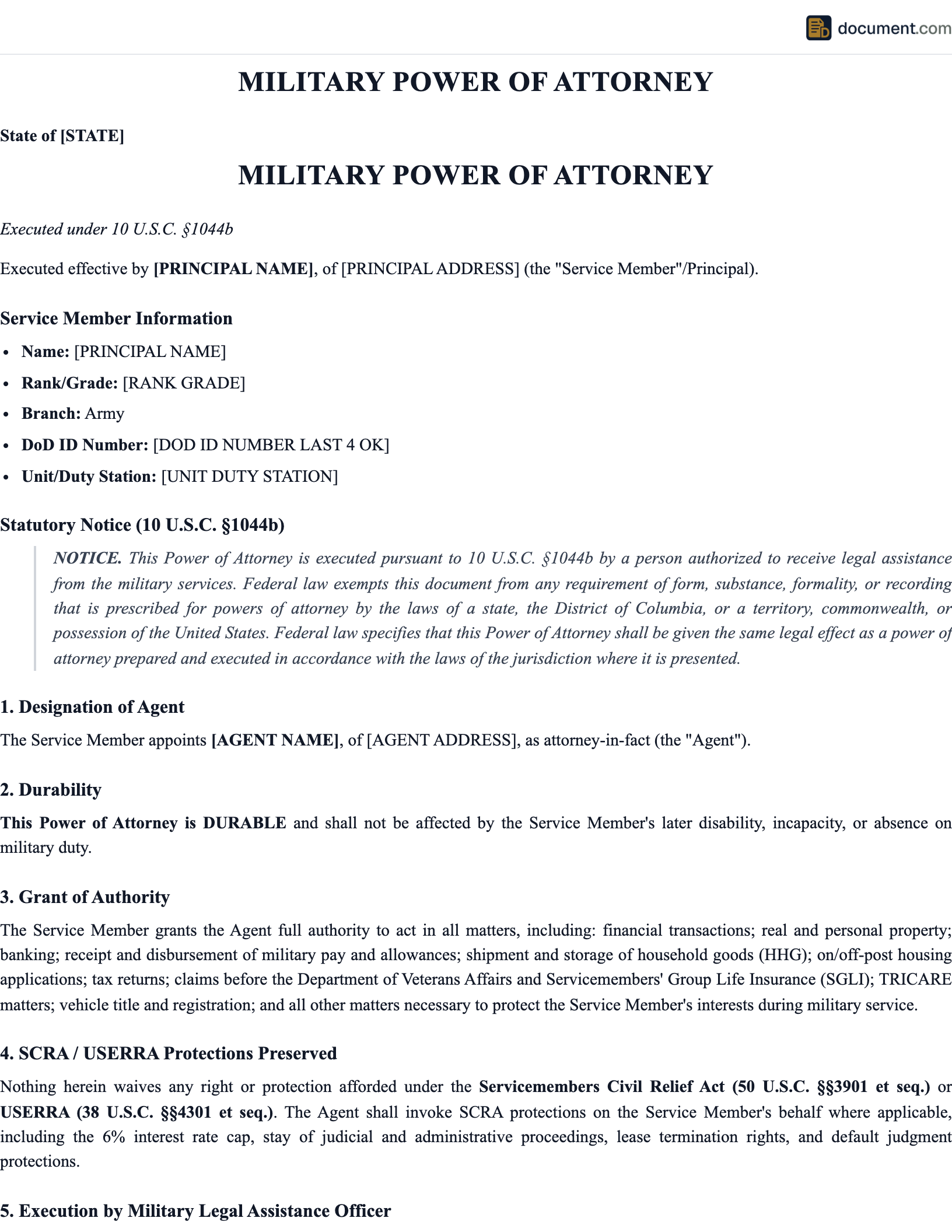
Form Preview
MILITARY POWER OF ATTORNEY
Executed under the authority of 10 U.S.C. §1044a
I, [SERVICE MEMBER NAME], [RANK], [BRANCH], DoD ID [####], hereby appoint [AGENT NAME] of [AGENT ADDRESS] as my true and lawful attorney-in-fact...
This POA shall become effective on [DATE] and shall expire on [DATE] unless sooner revoked.
Witness my hand this ___ day of ____, 20__.
_____________________________ (Principal Signature)
Acknowledged before me this ___ day of ___, 20__, by the above-named principal, who is personally known to me. I am authorized to perform notarial acts under 10 U.S.C. §1044a.
Frequently Asked Questions
Official Resources
Get Your Military POA Today
Free, JAG-ready, valid in all 50 states.