
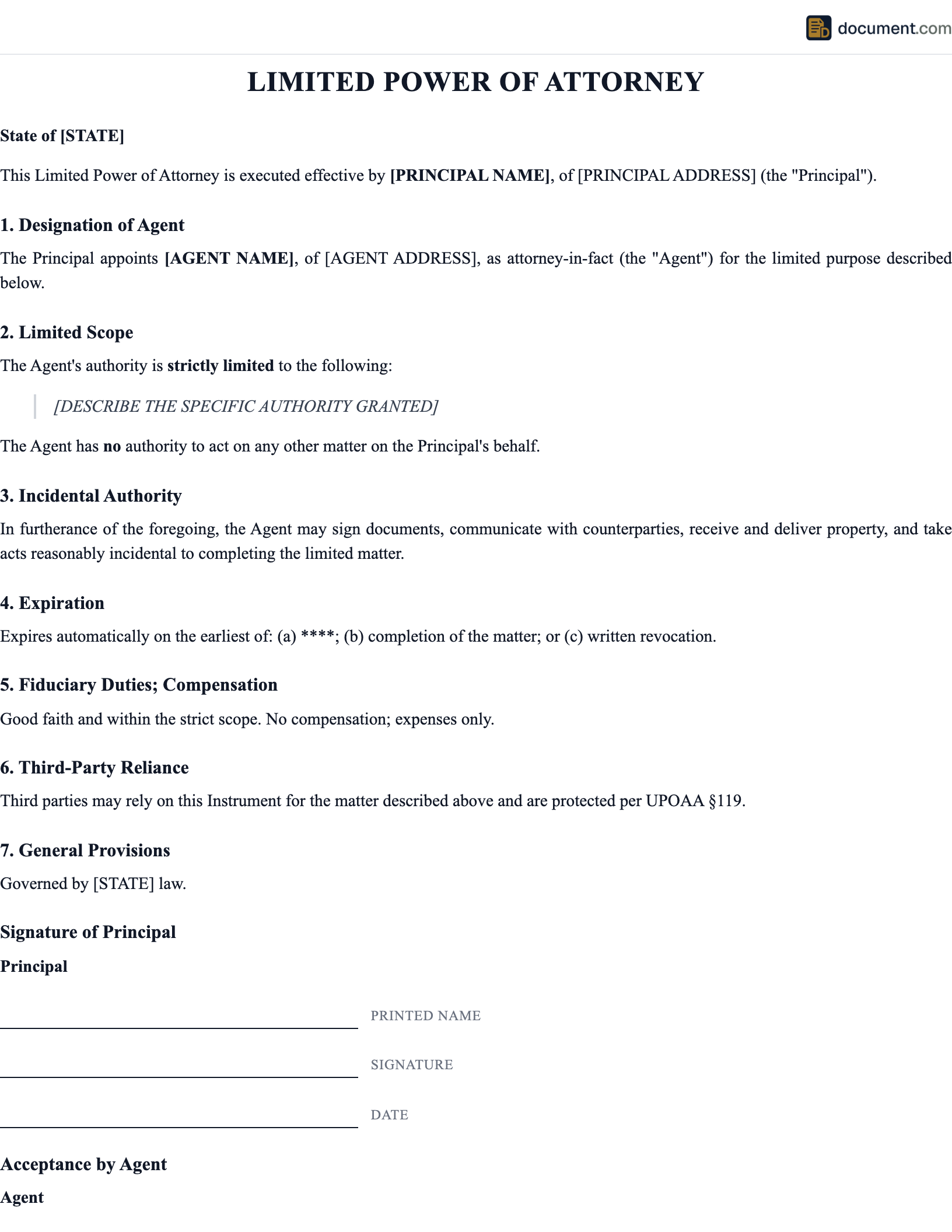



What Is a Limited Power of Attorney?
A limited power of attorney — sometimes called a special power of attorney — is a legal document that grants an agent the authority to act on the principal's behalf for one specific purpose and nothing else. Unlike a general POA, which sweeps broadly across banking, real estate, taxes, investments, and business affairs, a limited POA is surgically narrow. It identifies a particular transaction, account, property, or task, defines the agent's authority within that boundary, and stops there. Anything not expressly authorized in the document is not covered.
The narrowness is the entire point. A limited POA is the right tool when you need to delegate a single act — closing a real estate transaction while you are out of state, representing yourself before the IRS for one tax year, signing a vehicle title transfer at the DMV, depositing checks at one specific bank, or executing a settlement agreement in one specific lawsuit. By limiting the scope, you minimize the risk that your agent could overreach, and you make it easier to satisfy third parties who may otherwise want to scrutinize a broad POA.
Limited POAs are also routinely time-bound. Most include an expiration date — often triggered by a specific calendar date, the completion of the underlying transaction, or a fixed window such as 90 or 180 days. This automatic termination ensures that the document does not outlive its usefulness and cannot be misused months or years after the original need has passed. Combined with a tight scope, an expiration date makes the limited POA one of the safest delegation tools in legal practice.
Because limited POAs are designed for single transactions, they are usually presented to a single third party — a title company, a bank, a DMV office, the IRS, an insurance carrier, or a county recorder. Each of these institutions has its own expectations for what the document must say. Title companies want the property described by legal description. The DMV wants the vehicle identified by VIN. The IRS uses its own form (Form 2848). Banks want specific account numbers and dollar limits. Our templates include the right language for the most common third-party recipients so you do not arrive at a closing or counter only to be turned away.
By default, a limited POA is non-durable, which means it terminates automatically if the principal becomes mentally incapacitated. This is appropriate for most limited POAs because they are meant for short-term, present-tense use. If you need a limited POA to span a period during which incapacity is possible — for example, an extended hospital stay or a long deployment — you can add a durability clause to keep the document in effect.
Narrow Scope
Authority limited to one specific transaction or task.
Time-Bound
Built-in expiration date prevents indefinite authority.
Dollar Caps
Optional financial limits for transactions and authorizations.
Limited POA Form Preview
Below is a structural preview of our limited power of attorney template. Notice the precise scope description, dollar cap, and expiration date — the three features that define a well-drafted limited POA.
Limited (Special) Power of Attorney
Single Transaction Authorization
1. Principal & Agent
2. Specific Authority Granted
3. Dollar Cap
Maximum authority: $487,500
4. Expiration
This Power of Attorney expires on the earlier of:
- Completion of the authorized transaction, or
- October 31, 2026 (30 days after scheduled closing)
5. Excluded Powers
My Agent has NO authority to:
- Act on any other property or transaction
- Modify the purchase price or material terms
- Receive sale proceeds (to be wired to Principal directly)
- Sign any document not directly related to this closing
6. Execution
Principal Signature
Notary Public & Seal
Common Uses for a Limited POA
Limited POAs solve a familiar problem: you need to be in two places at once, or you need someone else to act on a single matter. The flexibility of the limited POA makes it the workhorse of one-time delegations.
Real Estate Closings
The single most common use. A buyer or seller who cannot attend a closing in person authorizes someone to sign the deed, mortgage, and closing documents on their behalf.
Vehicle Transfers
Authorize someone to sign the title, complete DMV paperwork, and transfer registration of one specific vehicle without granting any other authority.
Banking Transactions
Deposit a check, close a single account, or sign one specific loan document while you are out of the country or unable to visit the branch.
IRS & Tax Matters
Authorize a CPA or attorney to represent you before the IRS for one specific year or one specific issue using IRS Form 2848.
Legal Settlements
Authorize someone to sign a single settlement agreement or release on your behalf without involving them in any other legal matter.
Insurance Claims
Authorize someone to file a claim, accept a settlement, or sign a release for one specific insurance matter.
Limited POA vs General POA
Choosing between a limited POA and a general POA comes down to scope. The wrong choice either gives away too much authority or fails to give away enough.
Limited POA vs General POA
Limited (Special) POA
- - One specific task or transaction
- - Built-in expiration date
- - Optional dollar caps
- - Lower risk of agent overreach
- - Easier to get accepted by third parties
General POA
- - Broad financial & legal authority
- - Usually no expiration
- - No transaction limits
- - Higher trust requirements
- - Designed for ongoing delegation
Limited POA vs Durable POA
Limited POA
- - Short-term, present-tense delegation
- - Usually non-durable by default
- - Specific transactional purpose
Durable POA
- - Long-term incapacity planning
- - Survives mental incapacity
- - Broad ongoing authority
How to Create a Limited Power of Attorney
A good limited POA is a tightly drafted document. Each step below is designed to make the scope unambiguous and the document acceptable to the third party who will receive it.
Identify the Specific Task or Transaction
Describe in concrete terms what the agent is being authorized to do — sign a deed for a particular property, deposit a particular check, file a particular tax return, sign a particular settlement agreement. The more specific, the better.
Identify the Third Party Who Will Receive the POA
Different recipients have different expectations. A title company wants legal descriptions. The DMV wants VINs. The IRS uses its own form. Drafting for the recipient up front avoids rejection later.
Set a Dollar Cap Where Appropriate
If the transaction has a definable size, include a maximum dollar amount. This protects the principal and signals to third parties that the document was carefully prepared.
Choose an Expiration Trigger
Set the POA to expire either on a specific date (the closing date plus a buffer), upon completion of the authorized transaction, or both. Avoid open-ended limited POAs.
List Excluded Powers Explicitly
Even a tightly scoped POA benefits from a paragraph stating what the agent may NOT do. This forecloses creative interpretation by an aggressive agent.
Decide Whether to Make It Durable
Most limited POAs should be non-durable. Add durability only if you specifically need the document to survive a period of possible incapacity.
Sign Before a Notary
Even when notarization is not strictly required, it makes the document much more likely to be accepted. For real estate, vehicle, and recording-related POAs, notarization is mandatory.
Deliver Original to the Third Party
Limited POAs are usually presented as originals or certified copies. Title companies, the DMV, and the IRS often demand the original. Keep your own copy.
Revoke Promptly After the Transaction
Once the authorized task is complete, send a written revocation to the agent and to the third party. This is belt-and-suspenders, but it eliminates any lingering ambiguity.
Key Components of a Limited POA
The clarity of a limited POA comes from a small number of well-drafted clauses.
Principal & Agent Identification
Full legal names, addresses, and relationship of both parties.
Specific Scope Clause
Precise description of the authorized task, transaction, or property.
Dollar Cap
Optional maximum amount the agent may commit on behalf of the principal.
Expiration Date or Trigger
Calendar date, transaction completion, or fixed window.
Excluded Powers
Explicit list of what the agent may NOT do.
Identification Details
VINs, account numbers, legal descriptions, case numbers, etc.
Durability Clause (Optional)
Add only if the POA must survive incapacity.
Notarization & Witnesses
Required for most third-party recipients.
Legal Requirements
Limited POAs are governed by the same state-law framework that applies to general and durable POAs — primarily the Uniform Power of Attorney Act in adopting states, and state-specific statutes elsewhere. The limited nature of the document does not relax any of the execution formalities; if your state requires notarization for a financial POA, your limited POA needs notarization too.
For real estate transactions, the limited POA must comply with the recording requirements of the state where the property sits, including any margin and acknowledgment requirements. Some states require the POA to be recorded in the same county as the deed; others allow it to be presented at closing without recording. Title companies almost always require the original or a certified copy.
For vehicle transactions, most state DMVs accept a notarized limited POA but each has its own form preferences. Some states have an official DMV power of attorney form that is preferred over a generic POA. Our templates either use the official state DMV form where available or include language that satisfies the state's requirements.
For IRS matters, a limited POA must use IRS Form 2848 (Power of Attorney and Declaration of Representative) and identify the specific tax matters and tax periods covered. The IRS will not accept a generic limited POA in place of Form 2848 for representation before the agency.
Limited POA Requirements by State
Every state recognizes limited (special) powers of attorney. The list below shows the 50 states for which our templates apply state-specific execution rules.
Sample Limited Power of Attorney
Below is a condensed preview of our limited POA template, drafted for a real estate closing.
LIMITED (SPECIAL) POWER OF ATTORNEY
Single Transaction Authorization
I, [Principal], of [Address], do hereby appoint [Agent] as my Agent for the limited purpose described below.
1. SPECIFIC AUTHORITY
My Agent is authorized solely to [describe specific transaction], and to execute any documents necessary or incidental to that purpose.
2. DOLLAR LIMIT
The maximum amount my Agent may commit on my behalf in connection with this authority is $[Cap].
3. EXPIRATION
This Power of Attorney expires on the earlier of: (a) completion of the authorized transaction; or (b) [Date].
4. EXCLUDED POWERS
My Agent has no authority to act on any matter not expressly authorized in Section 1 above. This Power of Attorney does not grant any general or ongoing authority over my financial or legal affairs.
5. NON-DURABILITY
This Power of Attorney is non-durable and terminates automatically if I become mentally incapacitated, unless the durability box below is initialed.
Frequently Asked Questions
Common questions about limited and special powers of attorney, scope, expiration, real estate closings, and banking authorization.
Official Resources
Authoritative resources on limited powers of attorney, IRS authorization, real estate closings, and recording requirements.
IRS Form 2848 - Power of Attorney
Federal IRS form for tax representation authority.
ABA Real Property & Trust Section
American Bar Association resources on real estate POA practice.
ALTA - American Land Title Association
Title industry resources on POAs at closing.
ULC - Uniform Power of Attorney Act
Model statute that governs POAs in most states.
CFPB - Managing Someone Else's Money
Federal guides for agents acting under a POA.
Nolo - POA Encyclopedia
Free legal information on limited and special POAs.
Create your Limited Power of Attorney in under 10 minutes.
Answer a few questions and download a compliant, attorney-drafted document ready for your state.