
Free Agent Authorization Letter Forms
Delegate a one-time task like picking up a passport, collecting records, or signing for a package with a simple, clear authorization letter.
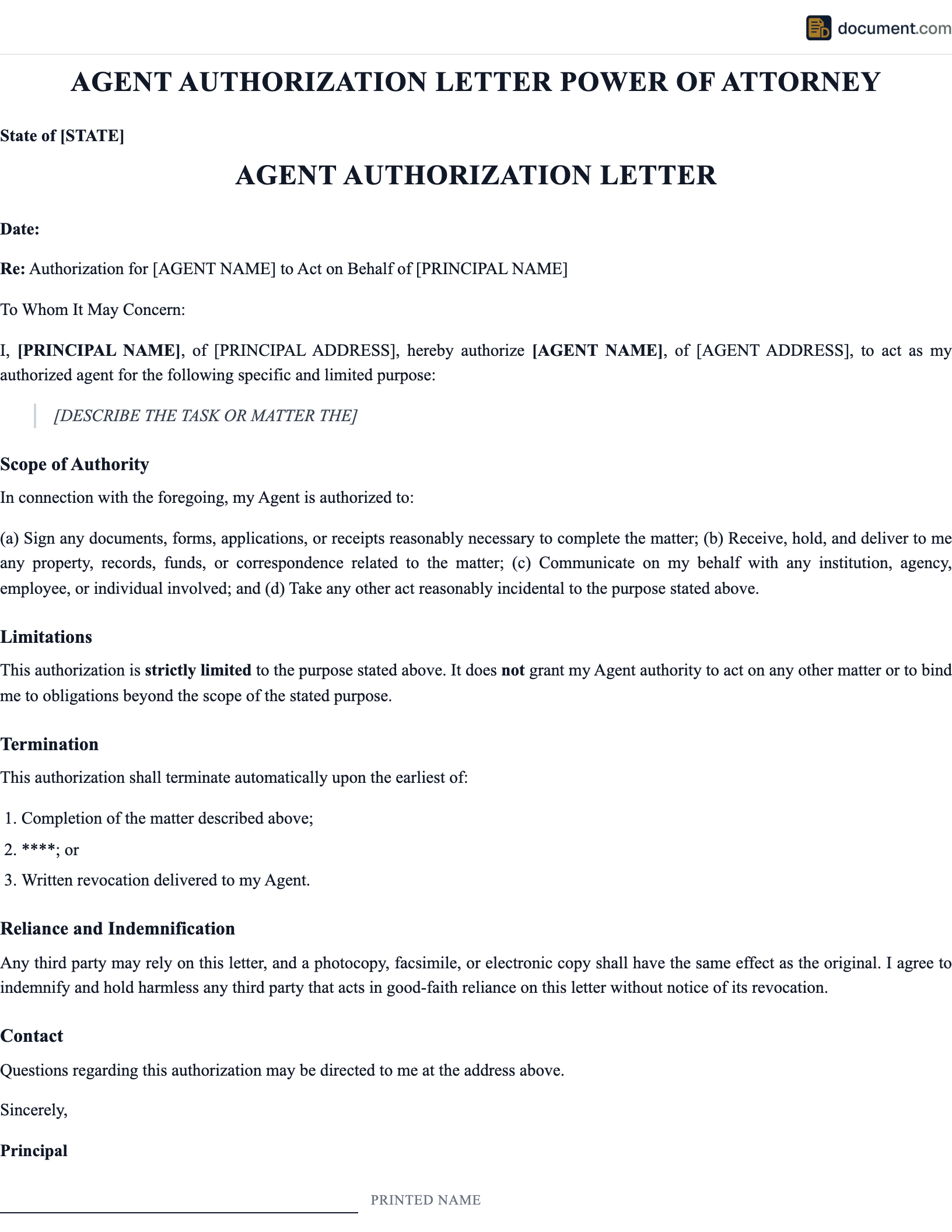



Last updated April 24, 2026
What Is an Agent Authorization Letter?
An agent authorization letter is a written, dated statement in which a principal delegates a single concrete task to a named agent. It sits on the lighter end of the delegation spectrum: above a verbal favor, below a notarized power of attorney executed under the Uniform Power of Attorney Act or a state POA statute. The legal weight comes from common-law agency principles codified in Restatement (Third) of Agency § 1.01 (creation of agency) and § 2.01 (actual authority granted by the principal's manifestation), not from any state's POA registration framework.
Typical use cases: a relative picking up a passport at the regional U.S. State Department office, a courier signing for a restricted delivery, a non-parent adult collecting a child from school under district pickup procedures, an assistant retrieving vital records from a county clerk, or an employee handling a routine vendor account transaction. Each context relies on the receiving institution's willingness to accept a written manifestation of agency without requiring the formality of a notarized POA. Most institutions accept the letter; some (banks for withdrawals, county recorders for real-estate transactions, IRS for tax matters, healthcare providers for HIPAA-protected records) do not.
Because the authority granted is narrow and temporary, no state regulates these letters under power-of-attorney statutes. The Uniform Power of Attorney Act applies only to documents that purport to grant general or specified authority of the kind the act enumerates; a single-task authorization letter falls outside the act's scope. UPOAA § 102 explicitly excludes from its definition of power of attorney certain narrow agency arrangements that are governed by other law (employer-employee delegations, insurance company appointments, fiduciary appointments under trust documents). Authorization letters for routine errands fit comfortably outside the POA framework.
The upside is speed. A principal can draft, sign, and deliver an authorization letter in 10 minutes without notarization, witness signatures, or recording. The downside is limited reach. Banks, brokerage firms, healthcare providers under HIPAA, and any institution with a defined verification protocol typically reject letters and require formal documentation. The right way to think about it: use a letter for the task an institution will accept on the strength of common-law agency principles, and use a POA for any context where the institution has its own form (Form 2848, IRS; FTB 3520, California; SSA-1696, Social Security; HHS-compliant HIPAA authorization, healthcare).
Distinguished from a formal POA, with third-party reliance considerations
The legal distinctions track three dimensions. Scope: an authorization letter typically grants authority for one defined task; a POA grants general or specifically enumerated authority across categories (real estate, banking, taxes, healthcare, business). Duration: an authorization letter terminates on completion of the task or on the stated expiration; a POA continues until revoked, with durable POAs surviving incapacity under UPOAA § 104. Fiduciary duties: an authorization letter creates only the common-law duty of honest performance; a POA imposes the statutory fiduciary duties of UPOAA § 114 (loyalty, good faith, accounting). Third-party reliance: a properly drafted authorization letter on principal letterhead with ID copy attached typically satisfies routine reliance contexts; institutional protocols for high-value transactions require POA documentation regardless of the letter's formality.
Common uses (DMV, school pickup, medical), durability, and revocation
DMV: most states accept a notarized authorization letter on the registered owner's letterhead for routine transactions (registration renewal, title pickup, plate transfer); California REG 256 is the formal alternative. School pickup: most districts accept a written authorization on file in the school office naming the alternate adult; some districts require photo ID and a verification call to the registered parent. Medical records: HIPAA at 45 C.F.R. § 164.508 requires six elements in any authorization (description of information, purpose, recipient, expiration date or event, signature, statement of right to revoke); a generic authorization letter without these elements is insufficient to compel release of protected health information. Durability: authorization letters are not durable; they terminate on the principal's death and typically on the principal's incapacity (institutional practice varies). Revocation: a written revocation served on the agent and the institution suffices under Restatement (Third) of Agency § 3.10; acts performed by the agent before revocation remain binding on the principal under § 2.01 actual-authority and § 2.03 apparent-authority rules.
Common Use Cases
| Scenario | Sufficient? | Alternative |
|---|---|---|
| Passport pickup | Yes | N/A |
| Package signing | Yes | N/A |
| Medical records release | Sometimes | HIPAA authorization |
| Bank withdrawal | No | Financial POA |
| Real-estate closing | No | Special POA |
How to Write an Authorization Letter
A vague letter is a rejected letter. The receiving institution's clerk has no incentive to interpret ambiguous language in the agent's favor. Be specific about the task, the agent, the duration, and the supporting identification. Six steps below.
Identify the Task
Be precise about what the agent is being authorized to do, vague letters are rejected.
Name the Agent
List the agent's full legal name exactly as it appears on their photo ID.
State the Duration
Include a clear start date and an end date or single-event scope.
Attach Supporting ID
Include a photocopy of the principal's government ID for verification.
Sign and Date
Sign by hand in blue or black ink; electronic signatures are acceptable for some recipients.
Deliver
Give the signed letter to the agent and call the recipient to confirm acceptance.
Required Components
Date
Clear issuance date of the letter.
Recipient
Name and address of the institution or person accepting the letter.
Principal Details
Full legal name, address, and contact information.
Agent Details
Full legal name and ID of the person authorized to act.
Scope of Authority
Specific task, document, or transaction being authorized.
Duration
Effective date and expiration or single-use instruction.
Sample Letter
[Date]
To: [Recipient Name / Institution]
Re: Authorization to Act on My Behalf
I, [Principal Name], hereby authorize [Agent Name], bearer of ID #[____], to [specific task, e.g., pick up my United States passport, Application #____] on my behalf.
This authorization is valid from [start date] through [end date]. A copy of my government-issued ID is attached for verification.
Sincerely,
_____________________________
[Principal Name]
[Phone] [Email]
Frequently Asked Questions
Official Resources
Draft Your Letter in Minutes
Free, professional template, just add names and dates.