
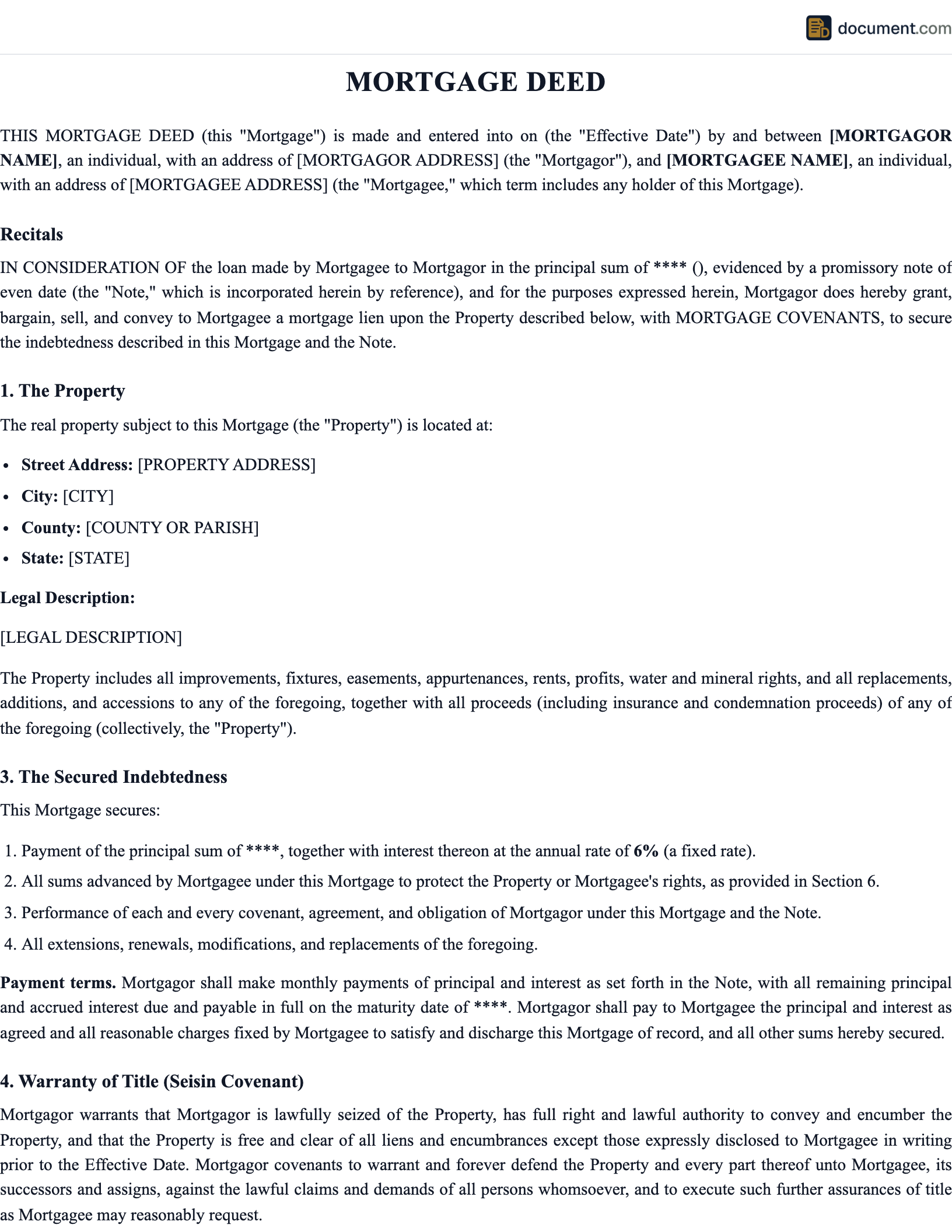



Wyoming Mortgage Deed Overview
Wyoming keeps real estate law uncomplicated by design. Deeds of trust are recorded with the county clerk, enforcement follows a non-judicial trustee's sale process, and the state imposes no income tax, no transfer tax, and no mortgage tax. Wyoming's 23 county clerks handle land records straightforwardly, and the state's recording requirements are among the least burdensome in the country. For private lenders and out-of-state investors, Wyoming is genuinely one of the simpler jurisdictions to work with.
The primary complexity in Wyoming real estate is mineral rights. Wyoming is a significant energy-producing state, and in counties like Campbell (coal and coalbed methane), Sublette (natural gas), and Fremont (oil and uranium), surface and mineral ownership have often been separated through historical conveyances. This means a surface owner may have no legal interest in the resources beneath their land, and a deed of trust on that property only encumbers what the borrower actually owns. Wyoming LLCs and trusts are also commonly used to hold property here, partly because the state's LLC statute offers strong privacy and asset protection features that attract investors from across the country.
$12
Recording fee
None
Transfer tax
Required
Notarization
0
Witnesses required
Wyoming Requirements
Wyoming county clerks follow standard recording requirements under Wyoming statutes. Documents must be properly formatted, clearly legible, and accompanied by an acknowledged signature block. Wyoming does not impose unusual formatting mandates beyond the basics that any professional document should already meet. For out-of-state parties using Wyoming property as collateral, the absence of transfer tax and mortgage tax means there are no additional levy computations to work through at the time of recording.
Wyoming Specific Note
If the property is held in a Wyoming LLC or trust, which is common given Wyoming's strong asset protection statutes, the authorized representative of the entity signs on behalf of the entity. Confirm that the entity's operating agreement or trust document authorizes the representative to encumber real property. Lenders financing LLC-owned or trust-held property should obtain and review the governing documents before closing to verify this authority and avoid a title defect.
Document Requirements
- Notarization: Must be notarized by a Wyoming notary public or authorized notary
- Witnesses: Wyoming requires 0 additional witness(es)
- Legal Description: Complete legal description as it appears on the current deed of record
- Parcel Number: Assessor's parcel number or tax ID
- Return Address: Mailing address for returning the recorded document
- Formatting: Standard formatting with adequate margins, black ink, minimum 10-point font
How to File in Wyoming
Wyoming's recording process is refreshingly simple. No transfer tax, no mortgage tax, low per-page fees, and county clerks that generally process documents without delay. Here is the complete workflow.
Verify Ownership and Entity Authority
Confirm exactly what the grantor owns. If the property has severed mineral rights, determine whether those are included in the collateral or excluded. If property is held by a Wyoming LLC or trust, review the governing documents to confirm the signatory has authority to encumber real property on the entity's behalf.
Prepare the Deed of Trust
Complete all fields: names of the grantor, trustee, and beneficiary (lender); the full legal description from the existing deed; the county; the parcel number; the loan amount; and a return address. Describe the collateral clearly, specifying whether surface rights, mineral rights, or both are being encumbered.
Execute Before a Notary
The grantor (or the entity's authorized representative) signs before a Wyoming notary public or a notary in the state where they are located. Wyoming recognizes out-of-state notarizations and also permits remote online notarization (RON). The notary completes the acknowledgment block. No additional witnesses are required.
Record with the County Clerk
Submit the notarized original to the county clerk in the county where the property is located. In person, by mail, or through e-recording where available. Pay the recording fee (starting around $12 for the first page). There is no transfer tax, mortgage tax, or excise tax owed at this step.
Retain the Recorded Document
The county clerk stamps and returns the original document to the return address on the filing. Store it with the promissory note and any title insurance policies. When the loan is repaid, record a Release of Deed of Trust or Reconveyance to clear the lien from the public record.
Wyoming Fees & Costs
Typical costs for filing in Wyoming. Actual fees may vary by county.
| Fee / Tax | Amount |
|---|---|
| Recording Fee | $12 |
| Transfer Tax | None |
| Notarization | $5 - $25 per signature |
| Certified Copy | $1 - $10 per page |
| Attorney Review (optional) | $150 - $500 |
Wyoming Tax Implications
Wyoming imposes no state income tax, no real estate transfer tax, no mortgage tax, and no state estate tax. That makes Wyoming one of the cleanest states in the country for real estate transactions from a tax cost perspective. Capital gains from Wyoming property sales are taxed only at the federal level. For most primary residence sellers, the federal Section 121 exclusion reduces or eliminates the taxable gain. For investors and second-home owners, federal capital gains rates apply without any state overlay.
Property taxes in Wyoming are managed at the county level and are generally moderate compared to the national average. Teton County is a notable exception, with high assessed values tied to the Jackson Hole real estate market that result in significant property tax bills even at Wyoming's relatively low mill rates. In energy-producing counties, mineral rights are assessed separately from surface rights, and the values can swing dramatically with commodity prices. A surface owner in Campbell or Sublette County may see their mineral rights assessments fluctuate substantially from year to year depending on oil and gas market conditions.
Wyoming's favorable tax environment and strong LLC privacy statutes make the state popular for investment property holding structures. Out-of-state investors frequently use Wyoming LLCs to hold real estate both inside and outside Wyoming, taking advantage of the state's charging order protections. When Wyoming LLC-held property is mortgaged, the deed of trust must be executed by an authorized person on behalf of the LLC, and lenders should confirm that the operating agreement grants that authority before funding.
Sample Wyoming Mortgage Deed
Preview of our Wyoming-specific template. Your document will include all fields required for recording in any Wyoming county.
MORTGAGE DEED
STATE OF WYOMING
Legal Document
PARTY INFORMATION
Name: [Full Legal Name]
Address: [Wyoming Address]
County: [County]
PROPERTY DESCRIPTION
County: [County] State: Wyoming
Legal Description: [Per Recorded Plat]
Parcel No.: [APN]
Wyoming Mortgage Deed FAQ
Common questions about filing in Wyoming, including requirements, fees, and tax implications.
Official Wyoming Resources
Official state resources for verifying requirements and finding your local recording office.
Important Considerations
Wyoming is one of the most straightforward states for real estate lending and security instrument recording. No income tax, no transfer tax, no mortgage tax, a non-judicial foreclosure process, and county clerks that process documents efficiently. For lenders who work across multiple states, Wyoming stands out as a low-friction jurisdiction. The main substantive issue to watch is the same one that matters in West Virginia and Colorado: mineral rights.
In Wyoming's energy counties, it is entirely normal for surface and mineral ownership to be completely separate. A rancher may own thousands of surface acres while oil and gas companies hold the mineral rights under long-standing leases dating back to the mid-20th century. A deed of trust on that ranch encumbers the surface only, and the lender's security interest does not include the subsurface mineral value. For transactions in Campbell, Sublette, Converse, Fremont, or Sweetwater counties, a mineral title review is not optional, it is prudent due diligence.
Wyoming LLC and trust structures are common for property ownership, and a deed of trust on LLC-held property requires the authorized representative to sign in their entity capacity. Lenders should obtain and review the operating agreement or trust document before closing to verify that the signatory has been granted authority to encumber real property. Wyoming's charging order protections make Wyoming LLCs attractive for holding investment real estate, but that same protection framework means the lender's remedies in a default scenario run against the LLC's property rather than the individual members personally.
Teton County: A Different Market
Teton County (Jackson Hole) operates at a different price point than the rest of Wyoming. Median home values there rival those of coastal cities, and the combination of limited land, conservation easements, and resort demand creates a real estate market that requires local expertise. Out-of-state buyers and lenders working in Teton County should engage a Wyoming attorney or local title company familiar with the county's specific title issues, conservation restrictions, and HOA structures, which are considerably more complex than in most of the state.
Related Documents
Depending on your situation, you may need additional documents alongside this one. Below are commonly related documents that are frequently used together in real estate transactions.
Important Considerations
Wyoming is one of the simplest states for real estate lending: no income tax, no transfer tax, no mortgage tax, non-judicial foreclosure, and straightforward county recording. The main substantive issue to watch for is mineral rights, which are frequently severed from surface ownership in energy-producing counties.
In energy counties such as Campbell, Sublette, Converse, Fremont, and Sweetwater, it is normal for surface and mineral ownership to be entirely separate. A deed of trust on a surface-only parcel does not encumber the subsurface resources. Lenders who fail to investigate mineral ownership may end up with a security interest in less than they expected.
Wyoming LLC and trust structures are commonly used for investment property ownership. When a deed of trust is executed on behalf of an entity, the authorized signatory must have actual authority to encumber real property under the entity's governing documents. Lenders should verify this before funding by reviewing the operating agreement or trust document.
Teton County: A Different Market
Teton County (Jackson Hole) operates at a different price point than the rest of Wyoming, with property values rivaling major coastal markets. Conservation easements, HOA restrictions, and limited land availability create title complexity not found elsewhere in the state. Out-of-state buyers and lenders working in Teton County should engage local Wyoming title and legal professionals with specific familiarity with that market.
Related Documents
Depending on your situation, you may need additional documents alongside this one. Below are commonly related documents that are frequently used together in real estate transactions.
Create your Wyoming Mortgage Deed in under 5 minutes.
Answer a few questions and download a Wyoming-compliant document, ready for the state agency.