



Wisconsin Mortgage Deed Overview
Wisconsin is a traditional mortgage state, which sets it apart from most of its neighboring states that use deeds of trust. Mortgages here are recorded with the Register of Deeds in the county where the property is located. Wisconsin's Marital Property Act treats spouses as co-owners of property acquired during marriage, and that has direct consequences for mortgage execution: both spouses must sign any mortgage encumbering a homestead property, regardless of whose name appears on the title. This requirement is not discretionary, and a mortgage that lacks the required signatures can be unenforceable against the non-signing spouse's homestead interest.
Wisconsin uses judicial foreclosure, meaning that if a borrower defaults, the lender must file a lawsuit in circuit court to foreclose. This is different from the non-judicial trustee's sale process available in deed of trust states. Wisconsin also provides a statutory redemption period after a foreclosure judgment, during which the borrower can pay off the debt and recover the property. For non-agricultural residential properties, that redemption period is six months. Agricultural land gets 12 months. The judicial process and the redemption right together make Wisconsin foreclosure slower than in most deed of trust states, a factor that affects how lenders and borrowers approach default situations.
$30
Recording fee
$0.30 per $100
Transfer tax
Required
Notarization
0
Witnesses required
Wisconsin Requirements
Wisconsin's Register of Deeds offices apply formatting and acknowledgment standards before accepting documents for recording. Each county may have slightly different submission processes, so it is worth calling ahead or checking the county website if you are submitting in person or by mail. Many Wisconsin counties participate in e-recording, which is faster and reduces the chance of a rejected submission due to formatting issues caught after mailing.
Wisconsin Specific Note
Wisconsin's Marital Property Act requires both spouses to sign any mortgage encumbering a homestead, even if only one spouse is the borrower and only one name appears on the title. This applies regardless of whether the property is held as marital property or separate property, as long as it serves as the family homestead. A lender who fails to obtain both signatures may find the mortgage unenforceable against the non-signing spouse's homestead interest. Always confirm marital status and whether the property is a homestead before finalizing the document.
Document Requirements
- Notarization: Must be notarized by a Wisconsin notary public or authorized notary
- Witnesses: Wisconsin requires 0 additional witness(es)
- Legal Description: Complete legal description as it appears on the current deed of record
- Parcel Number: Assessor's parcel number or tax ID
- Return Address: Mailing address for returning the recorded document
- Formatting: Standard formatting with adequate margins, black ink, minimum 10-point font
How to File in Wisconsin
Recording a mortgage in Wisconsin follows a clear sequence. The process differs from deed of trust states because Wisconsin uses a traditional mortgage instrument and judicial foreclosure, but for the recording step itself, the workflow is straightforward.
Confirm Homestead and Marital Status
Determine whether the property is the borrower's homestead and whether the borrower is married. If both conditions apply, both spouses must sign the mortgage under Wisconsin's Marital Property Act, even if only one is the borrower. Skipping this step creates an enforceable defect in the lien.
Prepare the Mortgage
Complete all required fields: full legal names of all mortgagors (borrowers who must sign), the mortgagee (lender), the complete legal description from the current deed of record, the county, the parcel identification number, the loan amount, and a return address for the recorded document.
Execute Before a Notary
All required mortgagors sign in person before a Wisconsin notary public. If both spouses must sign (homestead rule), both must appear before the notary. The notary completes the acknowledgment. No additional witnesses are required beyond the notary.
Submit to the Register of Deeds
Deliver the notarized original to the Register of Deeds in the county where the property is located. Many Wisconsin counties accept e-recording. Pay the recording fee, typically around $30 for a standard mortgage. The real estate transfer fee of $0.30 per $100 applies to ownership conveyances, not to standard mortgage recordings securing a loan.
Retain the Recorded Mortgage
The Register of Deeds returns the stamped original or a conformed copy to the return address. Keep this with the promissory note. When the mortgage is paid off, record a satisfaction of mortgage with the Register of Deeds to clear the lien from the public record.
Wisconsin Fees & Costs
Typical costs for filing in Wisconsin. Actual fees may vary by county.
| Fee / Tax | Amount |
|---|---|
| Recording Fee | $30 |
| Transfer Tax | $0.30 per $100 |
| Notarization | $5 - $25 per signature |
| Certified Copy | $1 - $10 per page |
| Attorney Review (optional) | $150 - $500 |
Wisconsin Tax Implications
Wisconsin does not impose a mortgage recording tax. The real estate transfer fee of $0.30 per $100 applies to conveyances of ownership interests, such as sales and gifts of property, rather than to mortgages securing a debt. When a lender records a mortgage, no transfer fee is due on that recording. When the underlying property eventually sells, the transfer fee is calculated on the sale price and is typically the seller's responsibility. In higher-value markets like the Madison or Milwaukee suburbs, the transfer fee adds meaningful closing costs on the sell side.
Wisconsin imposes a state income tax, and real property gains are generally taxable to the same extent as at the federal level. Wisconsin conforms to the federal primary residence exclusion under IRC Section 121, which allows most homeowners to exclude up to $250,000 in gains ($500,000 for married couples filing jointly) from a home sale. Capital gains from investment properties or second homes are fully taxable at Wisconsin's applicable income tax rate. Wisconsin's Department of Revenue (DOR) is the authoritative source for state income tax questions related to real estate transactions.
Wisconsin's property tax system is administered at the municipal level and can vary significantly across the state. Property is assessed at full market value for tax purposes, with assessments updated by local assessors. Transfers of ownership generally trigger reassessment in the next assessment cycle. Mortgage recordings do not trigger reassessment since no change of ownership occurs. For agricultural properties enrolled in farmland preservation programs, special tax treatment may apply, and transferring such land out of the program can have significant tax consequences.
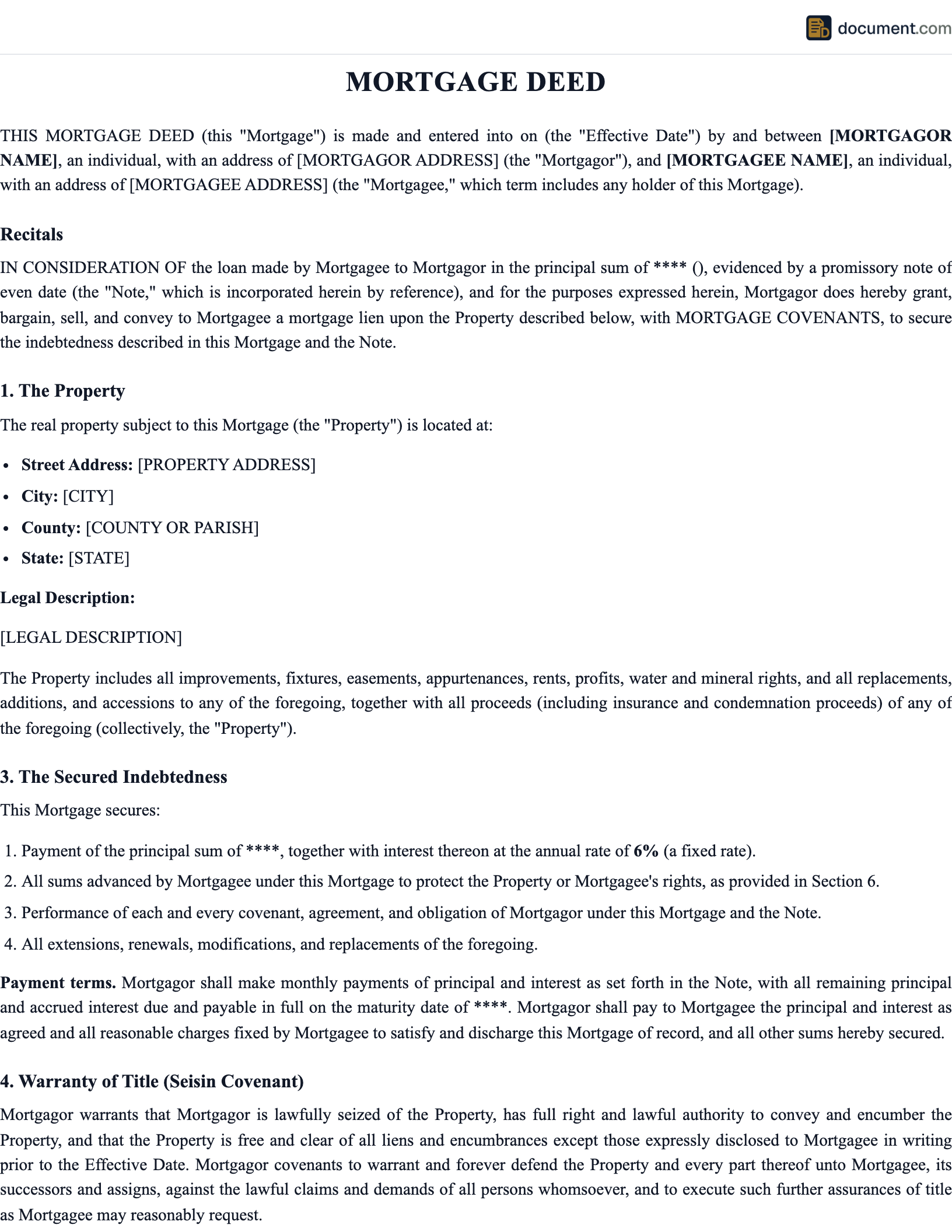
Sample Wisconsin Mortgage Deed
Preview of our Wisconsin-specific template. Your document will include all fields required for recording in any Wisconsin county.
MORTGAGE DEED
STATE OF WISCONSIN
Legal Document
PARTY INFORMATION
Name: [Full Legal Name]
Address: [Wisconsin Address]
County: [County]
PROPERTY DESCRIPTION
County: [County] State: Wisconsin
Legal Description: [Per Recorded Plat]
Parcel No.: [APN]
Wisconsin Mortgage Deed FAQ
Common questions about filing in Wisconsin, including requirements, fees, and tax implications.
Official Wisconsin Resources
Official state resources for verifying requirements and finding your local recording office.
Important Considerations
Wisconsin's Marital Property Act is the first thing to understand when preparing a Wisconsin mortgage. Unlike many states where a non-borrowing spouse simply needs to sign a quitclaim or spousal consent addendum, Wisconsin requires both spouses to be mortgagors (signers on the mortgage itself) when the property is a homestead. This is not a lender requirement that can be waived; it flows from state law and affects the enforceability of the lien against the non-signing spouse's interest.
Wisconsin's judicial foreclosure process and mandatory redemption period make mortgage enforcement significantly slower here than in deed of trust states. A lender considering a private loan secured by Wisconsin real estate should understand that if the borrower defaults, the path to recovering collateral runs through the circuit court and can take a year or more from default to final sale. Deficiency judgment limitations are also relevant in Wisconsin: courts have discretion to limit or deny deficiency judgments in foreclosure proceedings, so lenders cannot always assume full recovery of the loan balance.
Agricultural land in Wisconsin has a longer redemption period of 12 months (versus 6 months for residential property), and farmland enrolled in Wisconsin's farmland preservation program carries additional considerations. If you are financing agricultural land, confirm the property's enrollment status and understand how the program restrictions interact with the mortgage terms.
Judicial Foreclosure and Lender Risk
Wisconsin lenders accept longer foreclosure timelines as a cost of doing business in the state. The mandatory redemption period, combined with the court process, means that from the date of default to the date a lender can take clear possession of a property can easily exceed 18 months. Private lenders should factor this timeline into their loan underwriting and ensure their mortgage contains appropriate acceleration, default, and attorney's fees provisions that comply with Wisconsin law.
Related Documents
Depending on your situation, you may need additional documents alongside this one. Below are commonly related documents that are frequently used together in real estate transactions.
Important Considerations
Wisconsin's Marital Property Act is the first thing to understand when preparing a Wisconsin mortgage. Both spouses must sign any mortgage on a homestead property, regardless of whose name is on the title or who is the sole borrower. A mortgage that omits a required signature can be unenforceable against the non-signing spouse's homestead interest, which leaves the lender with an incomplete lien.
Wisconsin's judicial foreclosure process and mandatory redemption period make mortgage enforcement significantly slower here than in deed of trust states. Lenders should factor this timeline into their underwriting and ensure the mortgage contains appropriate acceleration and default provisions that comply with Wisconsin law.
Agricultural land in Wisconsin has a 12-month redemption period following foreclosure, and farmland enrolled in Wisconsin's farmland preservation program carries additional restrictions. If you are financing agricultural land, confirm enrollment status and how program restrictions interact with the mortgage terms before closing.
Judicial Foreclosure and Lender Risk
Wisconsin lenders accept longer foreclosure timelines as part of doing business in the state. From the date of default to clear possession of the property can easily exceed 18 months when accounting for the court process and redemption period. Private lenders in particular should understand this timeline before committing to a Wisconsin real estate loan.
Related Documents
Depending on your situation, you may need additional documents alongside this one. Below are commonly related documents that are frequently used together in real estate transactions.
Create your Wisconsin Mortgage Deed in under 5 minutes.
Answer a few questions and download a Wisconsin-compliant document, ready for the state agency.