



West Virginia Mortgage Deed Overview
West Virginia primarily uses deeds of trust to secure real estate loans, and these instruments are recorded with the county clerk in whichever of the state's 55 counties the property is located. The state has a non-judicial foreclosure process by trustee's sale, which means lenders can enforce their security interest without going to court if a borrower defaults. One feature West Virginia retains that distinguishes it from states like Washington is the availability of deficiency judgments after a trustee's sale, so borrowers whose property sells for less than the outstanding loan balance can still owe the difference.
What makes West Virginia real estate genuinely different from most states is the prevalence of severed mineral estates. Coal, oil, natural gas, and other mineral rights in West Virginia were frequently separated from surface ownership through transactions dating back to the late 19th and early 20th century. As a result, a surface owner may have no ownership of what lies beneath the land, and vice versa. This affects how mortgage deeds are prepared and what collateral is actually being pledged. In active energy-producing counties, title searches routinely go back 60, 80, or even 100 years to trace the mineral chain of title.
$20
Recording fee
$1.10 per $500
Transfer tax
Required
Notarization
0
Witnesses required
West Virginia Requirements
West Virginia county clerks are the gatekeepers of the land records. They verify that documents meet formatting and acknowledgment requirements before accepting them for recording. Documents that are incomplete or improperly acknowledged are returned without being recorded, so preparation matters. Many county clerks in West Virginia still operate primarily on paper, and recording turnaround can be slower in rural counties than in the state's more urbanized areas like Kanawha or Monongalia.
West Virginia Specific Note
West Virginia has extensive severed mineral estate history. If you are preparing a deed of trust on property in a coal or natural gas county (Mingo, Logan, Wyoming, McDowell, Wetzel, and others), confirm whether mineral rights have been severed from the surface before finalizing the collateral description. Your deed of trust should specify exactly what the grantor owns and is pledging, whether that is surface only, minerals only, or the full fee interest. Lenders who fail to address this issue can end up with a security interest in less than they expected.
Document Requirements
- Notarization: Must be notarized by a West Virginia notary public or authorized notary
- Witnesses: West Virginia requires 0 additional witness(es)
- Legal Description: Complete legal description as it appears on the current deed of record
- Parcel Number: Assessor's parcel number or tax ID
- Return Address: Mailing address for returning the recorded document
- Formatting: Standard formatting with adequate margins, black ink, minimum 10-point font
How to File in West Virginia
Filing a deed of trust in West Virginia is more straightforward procedurally than in some other states, but the mineral rights question makes thorough preparation especially important here. Complete the following steps carefully, and engage a local attorney if your transaction involves energy-producing property.
Determine What the Grantor Actually Owns
Before drafting the deed of trust, confirm whether the borrower owns the surface, the mineral rights, or both. In many West Virginia counties, these have been severed. Review the existing deed and the prior chain of title for any mineral reservations or severances. Your deed of trust should encumber whatever the borrower actually owns, described precisely.
Prepare the Deed of Trust
Complete all required fields: full legal names of grantor (borrower), trustee, and beneficiary (lender); the legal description as it appears on the existing deed; the county; the parcel identification number; the loan amount; and a return address. If the property includes mineral rights, state that explicitly in the legal description or the granting clause.
Execute Before a Notary
The grantor signs in person before a West Virginia notary public or other authorized officer. The notary completes the acknowledgment block on the document. No additional witnesses are required. All grantors with an ownership interest must sign for the lien to attach to their interest.
Record with the County Clerk
Submit the notarized original to the county clerk's office in the county where the property is located. Pay the recording fee (approximately $20 for the first page) and the privilege tax of $1.10 per $500 of the secured debt. Ask whether e-recording is available; Kanawha and Monongalia counties, among others, accept it.
Retain Recorded Originals
The clerk returns the stamped document to the designated return address. Keep the recorded original with the promissory note and any title insurance policies. When the loan is paid off, file a release or satisfaction with the county clerk to clear the lien from the land records.
West Virginia Fees & Costs
Typical costs for filing in West Virginia. Actual fees may vary by county.
| Fee / Tax | Amount |
|---|---|
| Recording Fee | $20 |
| Transfer Tax | $1.10 per $500 |
| Notarization | $5 - $25 per signature |
| Certified Copy | $1 - $10 per page |
| Attorney Review (optional) | $150 - $500 |
West Virginia Tax Implications
West Virginia imposes a privilege tax on the transfer of real property interests at a rate of $1.10 per $500 of consideration. For deeds of trust, the tax is generally applied to the amount of the loan being secured. There is no separate mortgage recording tax. The privilege tax is paid at the time of recording at the county clerk's office. West Virginia does not have a state income tax on real property gains in the same manner as states with a comprehensive income tax, though the state does impose an income tax generally and conformity with federal capital gains treatment applies to most real property sales.
Property taxes in West Virginia are assessed at the county level and are based on assessed value, which has historically lagged market value in many counties. A 2023 constitutional amendment reduced or eliminated property taxes on machinery, equipment, and inventory for businesses, but residential and commercial real estate assessments remained under the traditional framework. Transactions involving severed mineral interests carry their own property tax obligations, since mineral rights are separately assessed in counties where active production exists.
If a real property transfer in West Virginia involves a gift, the federal gift tax rules apply to amounts above the annual exclusion. The recipient takes the donor's original cost basis, which can result in capital gains tax exposure when the property is eventually sold. For energy-producing properties with significant mineral rights value, the difference between basis and fair market value can be substantial, making professional tax planning worthwhile before any gift or estate-related transfer is completed.
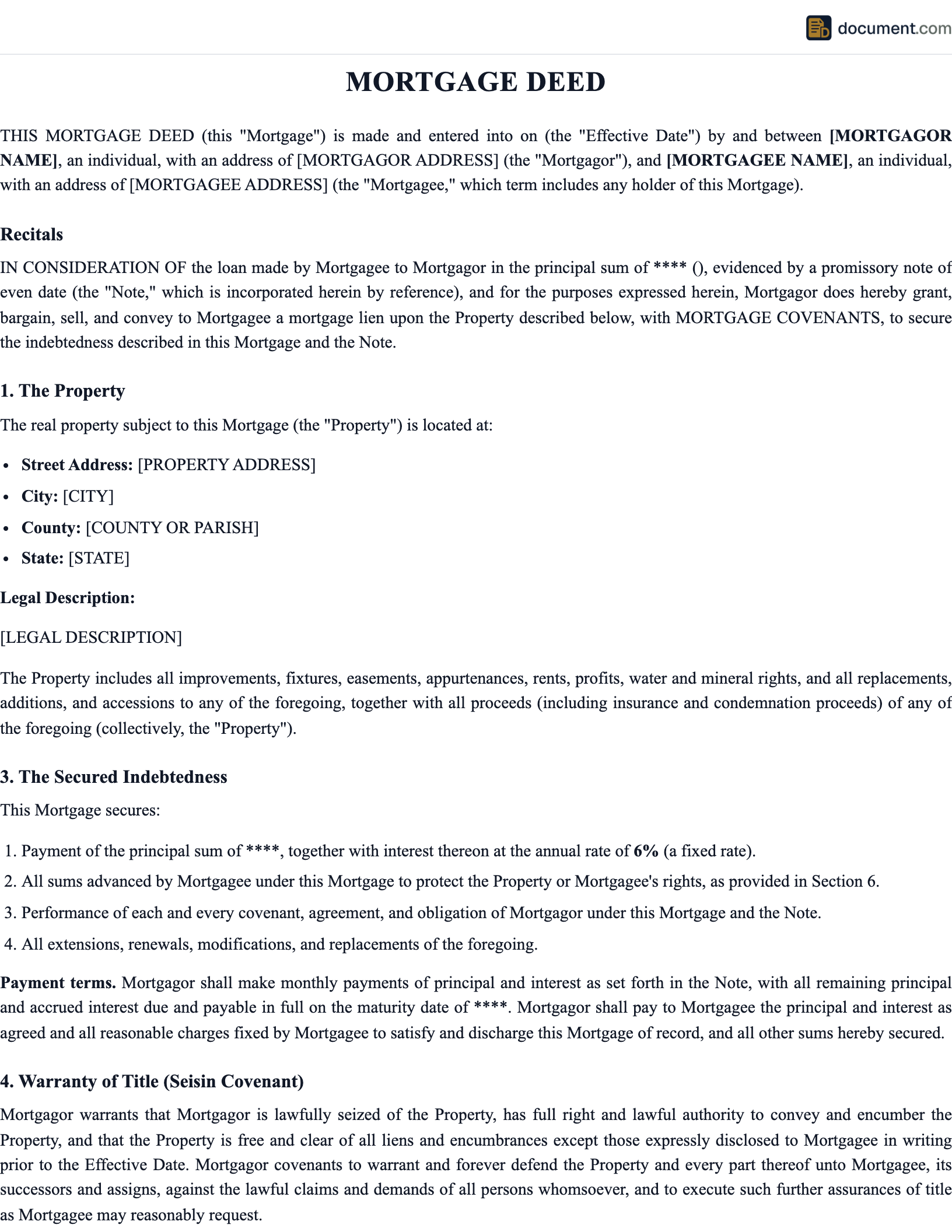
Sample West Virginia Mortgage Deed
Preview of our West Virginia-specific template. Your document will include all fields required for recording in any West Virginia county.
MORTGAGE DEED
STATE OF WEST VIRGINIA
Legal Document
PARTY INFORMATION
Name: [Full Legal Name]
Address: [West Virginia Address]
County: [County]
PROPERTY DESCRIPTION
County: [County] State: West Virginia
Legal Description: [Per Recorded Plat]
Parcel No.: [APN]
West Virginia Mortgage Deed FAQ
Common questions about filing in West Virginia, including requirements, fees, and tax implications.
Official West Virginia Resources
Official state resources for verifying requirements and finding your local recording office.
Important Considerations
The single most important thing to understand about West Virginia real estate is the severed mineral estate. West Virginia was one of the most heavily targeted states during the late 19th century land rush by coal, oil, and gas companies. Broad form deeds and wholesale mineral purchases left a legacy of split ownership that persists today across dozens of counties. When a lender takes a deed of trust on West Virginia property, confirming what the borrower actually owns, surface rights, mineral rights, or both, is a basic due diligence step that can't be skipped.
West Virginia allows deficiency judgments after a trustee's sale. This is in contrast to states like Washington where non-judicial foreclosure extinguishes the right to pursue a deficiency. In West Virginia, if a lender completes a trustee's sale and the proceeds do not cover the outstanding debt, the lender can seek a judgment for the remaining balance. Borrowers should understand this exposure before defaulting or negotiating a payoff, and lenders should include this right in their loan documentation to preserve it.
West Virginia's non-judicial foreclosure process is faster than court-supervised foreclosure but still requires proper statutory notice to the borrower. The trustee must follow specific notice procedures under West Virginia Code before conducting a sale, and failure to comply with those procedures can expose the lender to a lawsuit challenging the sale.
Mineral Rights and Title Insurance
In West Virginia's energy counties, a standard title search may not uncover all mineral right severances without going back well into the 20th century or earlier. Owner's title insurance is particularly valuable here because it protects against title defects discovered after closing, including prior mineral conveyances that were overlooked in the search. If the property has any history of coal or gas leasing, or sits in a county with significant energy production, a thorough mineral title review is strongly recommended before closing.
Related Documents
Depending on your situation, you may need additional documents alongside this one. Below are commonly related documents that are frequently used together in real estate transactions.
Important Considerations
The severed mineral estate is the defining challenge of West Virginia real estate law. Coal, oil, gas, and other mineral rights across much of the state were separately conveyed generations ago, and tracing who owns what beneath the ground requires careful title research going well beyond the standard 30 or 40 year search period used in other states. Anyone taking a mortgage or deed of trust on West Virginia property should know whether their collateral includes mineral rights, surface only, or both.
West Virginia allows deficiency judgments after trustee's sale foreclosures, which means borrowers remain personally exposed if the sale price does not cover the debt. This is worth factoring into any negotiation about loan modification, short sale, or deed in lieu of foreclosure before a sale occurs.
Non-judicial foreclosure in West Virginia requires proper notice to the borrower and other interested parties. If the trustee fails to follow the statutory notice requirements, the borrower or a junior lienholder may have grounds to challenge the sale. Lenders relying on the trustee's sale process should confirm that the trustee understands and will comply with West Virginia Code's notice provisions.
Mineral Rights and Title Insurance
In West Virginia's energy counties, a standard title search may not uncover all mineral right severances without going back well into the 20th century or earlier. Owner's title insurance is particularly valuable here because it protects against title defects discovered after closing, including prior mineral conveyances that were overlooked in the search. If the property has any history of coal or gas leasing, or sits in a county with significant energy production, a thorough mineral title review is strongly recommended before closing.
Related Documents
Depending on your situation, you may need additional documents alongside this one. Below are commonly related documents that are frequently used together in real estate transactions.
Create your West Virginia Mortgage Deed in under 5 minutes.
Answer a few questions and download a West Virginia-compliant document, ready for the state agency.