



Washington Mortgage Deed Overview
Washington is a deed of trust state, and virtually all residential and commercial mortgage lending here uses a deed of trust rather than a traditional mortgage instrument. The lender's security interest is recorded with the county auditor in the county where the property is located. The Washington Deed of Trust Act (RCW Chapter 61.24) governs how these instruments are executed, recorded, and, if necessary, enforced through a trustee's sale. One feature that sets Washington apart is the Foreclosure Fairness Act, which gives borrowers on owner-occupied properties the right to request mediation before a non-judicial foreclosure can proceed.
Washington is also a community property state. That means property acquired during marriage is generally owned equally by both spouses, and both must sign a deed of trust even if only one spouse is the borrower on the underlying loan. Lenders and title companies in Washington are accustomed to this requirement and typically flag it during the loan process, but it is worth understanding before you reach the closing table. Washington imposes no mortgage tax and no state income tax, making the overall tax environment simpler than many states, though the Real Estate Excise Tax on property sales uses a graduated rate that reaches 3% on high-value transactions.
$73
Recording fee
1.1%-3%
Transfer tax
Required
Notarization
0
Witnesses required
Washington Requirements
Washington county auditors follow uniform recording standards, but each county sets its own fee schedule and may have specific submission preferences. King County, which includes Seattle, accepts e-recording and processes high volumes daily. Smaller counties like Ferry or Lincoln may still operate primarily on paper submissions with slower turnaround. The legal requirements are statewide, but the practical logistics of getting a document recorded efficiently vary by location.
Washington Specific Note
Washington is a community property state. If the property being mortgaged is community property, both spouses must sign the deed of trust regardless of who is the borrower. Failing to obtain both signatures can result in a lien that is unenforceable against one co-owner's interest. This is one of the most common technical errors in Washington deed of trust preparation. Confirm marital status and how title is held before finalizing the document.
Document Requirements
- Notarization: Must be notarized by a Washington notary public or authorized notary
- Witnesses: Washington requires 0 additional witness(es)
- Legal Description: Complete legal description as it appears on the current deed of record
- Parcel Number: Assessor's parcel number or tax ID
- Return Address: Mailing address for returning the recorded document
- Formatting: Standard formatting with adequate margins, black ink, minimum 10-point font
How to File in Washington
Washington deed of trust recording is generally handled by title companies at the closing table, but for private loans or seller-financed transactions, the parties manage it directly. Here is what the process looks like from start to finish.
Confirm Community Property Status
Determine whether the property is community property (acquired during marriage) or separate property. If community property, both spouses must sign the deed of trust. Ask a title professional or attorney if you are uncertain, because getting this wrong creates a defective lien.
Prepare the Deed of Trust
Complete all fields: names of the grantor(s), trustee, and beneficiary (lender); the full legal description; the county; the assessor parcel number; the loan amount; and a return mailing address. Washington law requires that the trustee be a Washington resident, domestic corporation, or title insurance company licensed in the state.
Execute with Notarization
All required grantors sign before a Washington notary public with valid photo ID. The notary completes the acknowledgment block. If community property is involved, both spouses must appear and sign before the notary.
Record with the County Auditor
Submit the original notarized document to the county auditor in the county where the property is located. E-recording is available in most counties and provides a faster turnaround. Pay the recording fee, which starts at $73 for the first page. The Real Estate Excise Tax (REET) applies to ownership transfers, not to deeds of trust securing loans.
Store the Recorded Document
The county auditor returns the stamped original or a conformed copy to the return address. Keep it with the promissory note in a secure location. When the loan is paid off, the lender or trustee records a Deed of Reconveyance releasing the lien from the public record.
Washington Fees & Costs
Typical costs for filing in Washington. Actual fees may vary by county.
| Fee / Tax | Amount |
|---|---|
| Recording Fee | $73 |
| Transfer Tax | 1.1%-3% |
| Notarization | $5 - $25 per signature |
| Certified Copy | $1 - $10 per page |
| Attorney Review (optional) | $150 - $500 |
Washington Tax Implications
Washington imposes no state income tax and no mortgage tax, which keeps the direct tax costs of a deed of trust transaction relatively simple. The primary tax on property sales is the Real Estate Excise Tax, which applies to the sale price using a graduated structure: 1.1% on the first $525,000, 1.28% on the next $1 million, 2.75% on amounts between $1.525 million and $3.025 million, and 3% above that. REET is the seller's obligation in most transactions. Deeds of trust securing a loan against property you already own, such as a refinance or equity loan, do not trigger REET because there is no sale of ownership.
Washington does not impose a state-level capital gains tax on real estate sales. However, the state enacted a capital gains tax that took effect in 2023 on certain long-term gains above $250,000. Its application to real estate has been litigated, and the state Supreme Court upheld the tax while confirming it applies to gains from the sale of assets other than real estate used in business or held as investment property. For most homeowners selling a primary residence, the federal exclusion under IRC Section 121 reduces or eliminates taxable gain, and Washington conformity means no separate state tax computation is required.
Property taxes in Washington are assessed by county assessors and paid to the county treasurer. Deed of trust transactions do not automatically trigger reassessment, but sales of ownership interests do. If you are transferring property by gift, federal gift tax rules apply to amounts above the annual exclusion, and the recipient generally inherits the donor's original cost basis for future capital gains calculations.
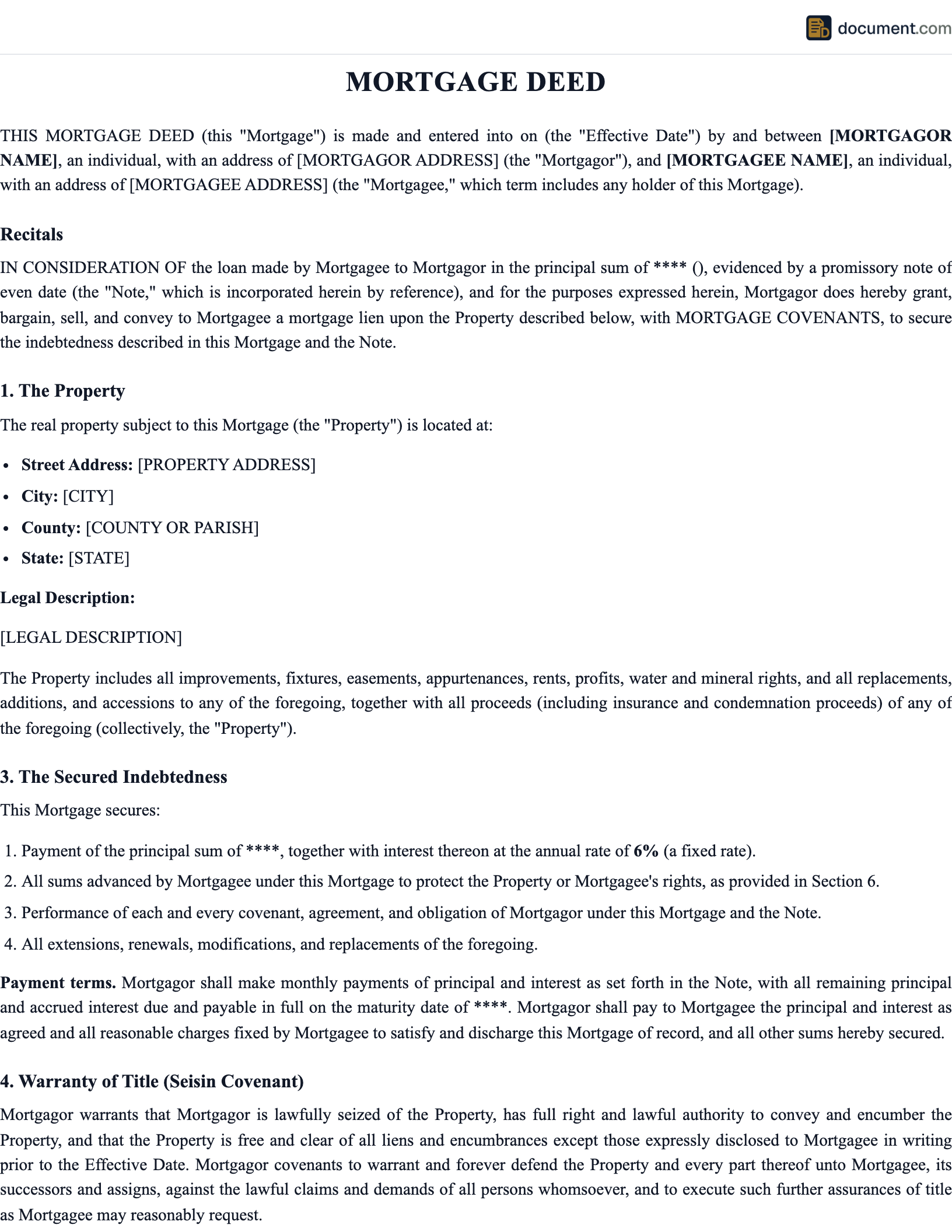
Sample Washington Mortgage Deed
Preview of our Washington-specific template. Your document will include all fields required for recording in any Washington county.
MORTGAGE DEED
STATE OF WASHINGTON
Legal Document
PARTY INFORMATION
Name: [Full Legal Name]
Address: [Washington Address]
County: [County]
PROPERTY DESCRIPTION
County: [County] State: Washington
Legal Description: [Per Recorded Plat]
Parcel No.: [APN]
Washington Mortgage Deed FAQ
Common questions about filing in Washington, including requirements, fees, and tax implications.
Official Washington Resources
Official state resources for verifying requirements and finding your local recording office.
Important Considerations
Washington's community property rules are the most practically significant consideration for anyone preparing a deed of trust in this state. Even if only one spouse is applying for the loan, the lender's security interest in community property requires both spouses to sign. This is not just a lender preference but a legal requirement that flows from Washington's community property statutes. Title companies are familiar with this and routinely require both spouse signatures at closing, but in private lending situations it is easy to overlook.
The Foreclosure Fairness Act mediation program is a genuine procedural right worth understanding. Homeowners who receive a notice of default on an owner-occupied residential property can request mediation through the Washington State Housing Finance Commission. The process requires the lender to engage in good-faith negotiations before a trustee's sale can proceed. This protection has no direct equivalent in most other deed of trust states and has helped many Washington borrowers avoid foreclosure or negotiate more favorable resolution terms.
Washington also prohibits deficiency judgments following a non-judicial trustee's sale. If a lender forecloses through the trustee's sale process and the sale proceeds do not cover the full loan balance, the lender cannot sue the borrower for the difference. This protection applies specifically to non-judicial foreclosures. Lenders who choose the slower judicial foreclosure route may retain the right to seek a deficiency, which is one reason non-judicial foreclosure is by far the more common path in Washington.
Trustee Eligibility in Washington
Washington law restricts who can serve as trustee on a deed of trust. The trustee must be a Washington resident, a domestic corporation, or a title insurance company licensed in the state. Using an out-of-state individual or entity as trustee can render the deed of trust defective and undermine the lender's ability to use the non-judicial foreclosure process. This is a detail that institutional lenders handle automatically but that private lenders sometimes miss.
Related Documents
Depending on your situation, you may need additional documents alongside this one. Below are commonly related documents that are frequently used together in real estate transactions.
Important Considerations
Washington's community property rules are the most practically significant consideration for anyone preparing a deed of trust in this state. Even if only one spouse is on the loan, the lender's security interest in community property requires both spouses to sign. This is not just a lender preference but a legal requirement under Washington's community property statutes.
The Foreclosure Fairness Act mediation program is a genuine procedural right worth understanding. Homeowners who receive a notice of default on an owner-occupied residential property can request mediation through the Washington State Housing Finance Commission before a trustee's sale can proceed.
Washington prohibits deficiency judgments following a non-judicial trustee's sale, which means lenders cannot sue borrowers for the remaining balance if the sale proceeds fall short. This protection applies specifically to non-judicial foreclosures and is a meaningful financial protection for Washington homeowners.
Trustee Eligibility in Washington
Washington law restricts who can serve as trustee on a deed of trust. The trustee must be a Washington resident, a domestic corporation, or a title insurance company licensed in the state. Using an out-of-state individual or entity as trustee can render the deed of trust defective and undermine the lender's ability to use the non-judicial foreclosure process.
Related Documents
Depending on your situation, you may need additional documents alongside this one. Below are commonly related documents that are frequently used together in real estate transactions.
Create your Washington Mortgage Deed in under 5 minutes.
Answer a few questions and download a Washington-compliant document, ready for the state agency.