



Virginia Mortgage Deed Overview
Virginia is a deed of trust state, meaning that most residential and commercial loans are secured not by a traditional mortgage but by a deed of trust that conveys title to a trustee until the debt is satisfied. Real property security instruments are recorded with the Circuit Court Clerk in the county or independent city where the property sits. Virginia's 38 independent cities are a genuine quirk of the state's geography: each functions as its own jurisdiction entirely separate from surrounding counties, so confirming the correct Clerk's office before filing is not just bureaucratic detail, it's legally essential.
The governing statute is Virginia Code Title 55.1, which establishes execution, acknowledgment, and recordation requirements for deeds of trust and related instruments. Virginia imposes a recordation tax on deeds of trust based on the amount of the secured obligation at a state rate of $0.25 per $100, with some localities adding a small surcharge. There is no separate mortgage tax. Northern Virginia markets, particularly Fairfax, Arlington, and Loudoun counties, see some of the highest average loan amounts in the state, which means recordation tax can be a meaningful closing cost line item.
$25
Recording fee
$0.25 per $100
Transfer tax
Required
Notarization
0
Witnesses required
Virginia Requirements
Virginia Circuit Court Clerks are strict about document formatting and acknowledgment requirements. A document rejected for technical deficiency must be corrected and resubmitted, which delays the recording date and can create gaps in the chain of title. Getting it right the first time matters, particularly in high-volume Northern Virginia markets where closing timelines are tight.
Virginia Specific Note
Virginia has 38 independent cities that function as separate jurisdictions from surrounding counties. Filing in the wrong Clerk's office means your document will not appear in the correct land records index. Always verify which Circuit Court Clerk has jurisdiction over your property's location before submitting. The recordation tax on deeds of trust is based on the secured loan amount, not the property value, and applies at the state rate of $0.25 per $100.
Document Requirements
- Notarization: Must be notarized by a Virginia notary public or authorized notary
- Witnesses: Virginia requires 0 additional witness(es)
- Legal Description: Complete legal description as it appears on the current deed of record
- Parcel Number: Assessor's parcel number or tax ID
- Return Address: Mailing address for returning the recorded document
- Formatting: Standard formatting with adequate margins, black ink, minimum 10-point font
How to File in Virginia
Virginia deeds of trust follow a well-established closing process. Most residential transactions are handled by a licensed title company or settlement agent who coordinates the entire recording workflow. For private or non-institutional loans, here is how the process works step by step.
Confirm the Correct Jurisdiction
Identify whether the property is in a county or one of Virginia's 38 independent cities. The Circuit Court Clerk's office for that specific jurisdiction handles recording. A property in the City of Fairfax files with a different Clerk than one in Fairfax County, even if they share a zip code.
Prepare the Deed of Trust
Complete all required fields: full legal names of the grantor (borrower), trustee, and beneficiary (lender); the complete legal description pulled from the existing deed; the parcel identification number; the principal loan amount; and a return address for the recorded document.
Execute Before a Notary
The grantor must sign the deed of trust before a Virginia notary public or other officer authorized to take acknowledgments under Virginia Code Title 55.1. The notary completes the acknowledgment block, which certifies the signer's identity and voluntary execution. No additional witnesses are required.
Submit to the Circuit Court Clerk
Deliver the notarized original to the appropriate Circuit Court Clerk's office in person, by mail, or through an e-recording service such as Simplifile or CSC. Most Northern Virginia Clerks accept e-recording. Pay the recording fee plus the recordation tax of $0.25 per $100 of the secured debt.
Retain the Recorded Copy
The Clerk's office will return the stamped original or a conformed copy to the return address on the document. Keep this in a secure location alongside the promissory note and any title insurance policies. Once recorded, the instrument is part of the permanent public land records.
Virginia Fees & Costs
Typical costs for filing in Virginia. Actual fees may vary by county.
| Fee / Tax | Amount |
|---|---|
| Recording Fee | $25 |
| Transfer Tax | $0.25 per $100 |
| Notarization | $5 - $25 per signature |
| Certified Copy | $1 - $10 per page |
| Attorney Review (optional) | $150 - $500 |
Virginia Tax Implications
Virginia does not impose a separate mortgage tax, but it does levy a recordation tax on deeds of trust based on the amount of the debt being secured. The state rate is $0.25 per $100 of the secured obligation. Some localities add a small additional local tax on top of the state rate, so check with the specific Circuit Court Clerk before closing. On a $600,000 loan, the state recordation tax alone comes to $1,500, which in Northern Virginia is a routine closing cost given the region's median home prices.
When a deed of trust is released after payoff, Virginia uses a certificate of satisfaction or deed of release recorded with the same Clerk's office. There is no tax on the release. If a property secures a home equity line of credit, the recordation tax is typically paid on the maximum credit limit at origination, not the drawn balance. Transfers of real property through gift or inheritance are separate transactions governed by their own recording fees and, at the federal level, by gift or estate tax rules depending on value.
Virginia has no inheritance tax, and the state does not impose a separate real estate transfer tax on the underlying property sale beyond the recordation tax framework. Capital gains from the eventual sale of a principal residence may qualify for federal exclusion under IRC Section 121, but Virginia conformity with federal tax law means that same exclusion generally applies for state income tax purposes. For investment properties or commercial real estate, consult a Virginia CPA familiar with state-level treatment of depreciation recapture and installment sales.
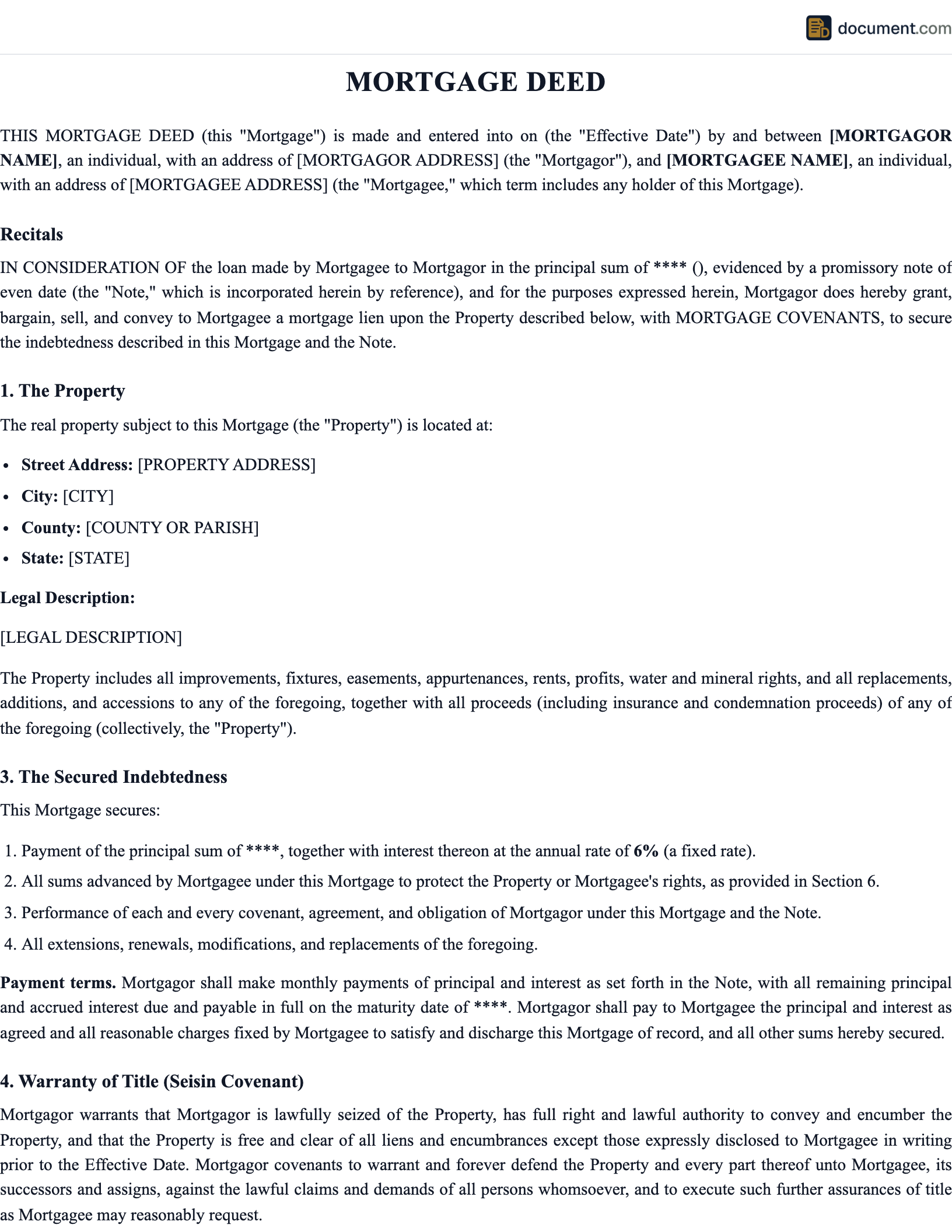
Sample Virginia Mortgage Deed
Preview of our Virginia-specific template. Your document will include all fields required for recording in any Virginia county.
MORTGAGE DEED
STATE OF VIRGINIA
Legal Document
PARTY INFORMATION
Name: [Full Legal Name]
Address: [Virginia Address]
County: [County]
PROPERTY DESCRIPTION
County: [County] State: Virginia
Legal Description: [Per Recorded Plat]
Parcel No.: [APN]
Virginia Mortgage Deed FAQ
Common questions about filing in Virginia, including requirements, fees, and tax implications.
Official Virginia Resources
Official state resources for verifying requirements and finding your local recording office.
Important Considerations
Virginia's independent city structure is genuinely unusual among American states and creates real filing pitfalls. A deed of trust recorded in the Clerk's office for Fairfax County will not appear in the land records for the City of Fairfax, even though those jurisdictions are geographically interleaved. If you are working in Northern Virginia, the Shenandoah Valley, or any area where city and county boundaries are not obvious from the street address, confirm jurisdiction with the Commissioner of Revenue's office or a local title professional before you prepare the document.
Deeds of trust in Virginia typically name a trustee, who may be a title company officer, attorney, or even the lender in some private transactions. The trustee must be a different party than the borrower, and institutional lenders generally specify their preferred trustee. If you are structuring a private loan, choose a trustee who is willing and able to act if a foreclosure becomes necessary, since the trustee conducts the sale under Virginia's non-judicial foreclosure process.
Non-judicial foreclosure in Virginia proceeds by trustee's sale after the borrower receives proper notice under Virginia Code Title 55.1-321. The lender does not need to go to court, which makes enforcement faster than in judicial foreclosure states. This efficiency benefits lenders but means borrowers who fall behind on payments have limited time to resolve a default before a sale occurs. Virginia also allows deficiency judgments after foreclosure, so the financial exposure does not necessarily end at the trustee's sale.
Note on Northern Virginia Transactions
Northern Virginia has some of the highest residential property values in the country, and the combination of large loan amounts, complex ownership structures (LLCs, trusts, family partnerships), and the independent city filing quirk makes attorney or settlement agent involvement particularly valuable in that market. For transactions in Fairfax, Loudoun, Arlington, Prince William, and the surrounding independent cities, professional title and legal review is standard practice rather than optional.
Related Documents
Depending on your situation, you may need additional documents alongside this one. Below are commonly related documents that are frequently used together in real estate transactions.
Important Considerations
Virginia's independent city structure is genuinely unusual among American states and creates real filing pitfalls. A deed of trust recorded in the Clerk's office for Fairfax County will not appear in the land records for the City of Fairfax, even though those jurisdictions are geographically interleaved. If you are working in Northern Virginia, the Shenandoah Valley, or any area where city and county boundaries are not obvious from the street address, confirm jurisdiction with the Commissioner of Revenue's office or a local title professional before you prepare the document.
Deeds of trust in Virginia typically name a trustee, who may be a title company officer, attorney, or even the lender in some private transactions. The trustee must be a different party than the borrower, and institutional lenders generally specify their preferred trustee. If you are structuring a private loan, choose a trustee who is willing and able to act if a foreclosure becomes necessary, since the trustee conducts the sale under Virginia's non-judicial foreclosure process.
Non-judicial foreclosure in Virginia proceeds by trustee's sale after the borrower receives proper notice under Virginia Code Title 55.1-321. The lender does not need to go to court, which makes enforcement faster than in judicial foreclosure states. Virginia also allows deficiency judgments after foreclosure, so the borrower's financial exposure does not necessarily end at the trustee's sale.
Note on Northern Virginia Transactions
Northern Virginia has some of the highest residential property values in the country, and the combination of large loan amounts, complex ownership structures (LLCs, trusts, family partnerships), and the independent city filing quirk makes attorney or settlement agent involvement particularly valuable in that market. For transactions in Fairfax, Loudoun, Arlington, Prince William, and the surrounding independent cities, professional title and legal review is standard practice rather than optional.
Related Documents
Depending on your situation, you may need additional documents alongside this one. Below are commonly related documents that are frequently used together in real estate transactions.
Create your Virginia Mortgage Deed in under 5 minutes.
Answer a few questions and download a Virginia-compliant document, ready for the state agency.