



Vermont Mortgage Deed Overview
Vermont is one of a handful of states that still exclusively uses the traditional mortgage deed structure for secured lending, requiring judicial foreclosure when a borrower defaults. Vermont courts manage the entire process, which is thorough but slow. The judicial foreclosure timeline in Vermont typically runs 12 to 18 months from filing to judgment, and borrowers have an additional six-month redemption period after judgment. Lenders entering Vermont's market need to account for this extended timeline when pricing and structuring loans.
Vermont records real property at the town level, not the county level. Each of Vermont's 255 towns and cities maintains its own land records independently through the town clerk's office. This decentralized structure means there is no single county recorder you file with; you must identify the specific town where the property sits. Vermont imposes a real property transfer tax ranging from 1.25% to 1.45% of the purchase price, and a separate Land Gains Tax applies when improved or unimproved land is sold within six years of purchase. Vermont also has Act 250 environmental permitting requirements for certain types of development, which can affect the usability and value of mortgaged property.
$15
Recording fee
1.25%-1.45%
Transfer tax
Required
Notarization
0
Witnesses required
Vermont Requirements
Vermont recording requirements are governed by 27 V.S.A. and municipal land records statutes. A mortgage deed must be acknowledged (notarized) before a Vermont notary or authorized officer. No witnesses are required. The instrument must include the town of the property (not merely the county), the complete legal description, and the return address. Vermont town clerks may have varying local requirements for margin sizes and page formatting; it is worth calling the specific town clerk's office before submitting a document for the first time.
Vermont Specific Note
Vermont imposes both a real property transfer tax (1.25% to 1.45% of purchase price) and a Land Gains Tax on properties sold within six years of acquisition. The Land Gains Tax is the seller's obligation, but it can create complications in a transaction if the seller's holding period is short and the gain is large. Lenders should be aware that a Vermont borrower who purchased recently and is selling or refinancing at a gain may have a Land Gains Tax obligation that affects net proceeds available to pay off the existing mortgage. The Vermont Department of Taxes administers both taxes and provides guidance on applicable rates and exemptions.
Document Requirements
- Notarization: Must be notarized by a Vermont notary public or authorized notary
- Witnesses: Vermont requires 0 additional witness(es)
- Legal Description: Complete legal description as it appears on the current deed of record
- Parcel Number: Assessor's parcel number or tax ID
- Return Address: Mailing address for returning the recorded document
- Formatting: Standard formatting with adequate margins, black ink, minimum 10-point font
How to File in Vermont
Vermont closings are typically handled by real estate attorneys, who conduct the title examination and manage the recording process. For private transactions not involving a lender, the following steps will guide you through recording a mortgage deed with the town clerk.
Prepare the Document
Complete all required fields including the full legal names and addresses of both mortgagor and mortgagee, the complete legal description exactly as it appears in the current chain of title recorded with the town clerk, the name of the town where the property is located, the principal loan amount and maturity date, and the return mailing address. Verify the legal description against the most recent recorded deed before finalizing.
Execute Before a Vermont Notary
Sign in the presence of a Vermont-commissioned notary public with valid government-issued identification. No witnesses are required beyond the notary's acknowledgment. Remote online notarization is permitted in limited circumstances in Vermont; confirm with the specific town clerk's office that electronically notarized instruments will be accepted before proceeding.
Submit to the Town Clerk
Bring or mail the original notarized instrument to the town clerk's office in the specific town where the property is located. Vermont recording is at the town level, not the county level. If the property sits in the Town of Stowe, you file with the Stowe Town Clerk; if it is in Burlington, you file with the Burlington City Clerk. Call ahead to confirm hours and accepted payment methods, as town clerk offices vary significantly in staffing and operations.
Pay the Recording Fee and Transfer Tax
The recording fee is $15 for the first page and $4 for each additional page. The real property transfer tax (1.25% or 1.45% of consideration, depending on transaction type and primary residence status) is also typically remitted at or before recording through a Vermont Property Transfer Tax Return filed with the Department of Taxes. The town clerk will require evidence that the transfer tax return has been filed or that an exemption applies before recording the deed.
Retain the Recorded Original
After indexing and recording, the town clerk returns the original stamped with the volume and page reference in the town land records. Keep the recorded original in a secure location. Vermont land records are public records, and most towns have made their indices searchable online, but the original recorded instrument is your authoritative copy of the transaction.
Vermont Fees & Costs
Typical costs for filing in Vermont. Actual fees may vary by county.
| Fee / Tax | Amount |
|---|---|
| Recording Fee | $15 |
| Transfer Tax | 1.25%-1.45% |
| Notarization | $5 - $25 per signature |
| Certified Copy | $1 - $10 per page |
| Attorney Review (optional) | $150 - $500 |
Vermont Tax Implications
Vermont's real property transfer tax is one of the more significant transaction costs in the state. The standard rate is 1.25% of the purchase price, though it drops to a blended rate that includes a 0.5% rate on the first $100,000 for owner-occupied primary residences that meet the applicable statutory conditions. For second homes, vacation properties, and investment real estate, the full 1.45% rate applies. These rates are paid by the buyer at closing through a Vermont Property Transfer Tax Return filed with the Department of Taxes. The town clerk will not record a deed or mortgage without confirmation that the transfer tax return has been filed or that a valid exemption applies.
Vermont's Land Gains Tax is a separate and distinct obligation that catches many sellers off guard. If you sell or convey real property within six years of acquiring it, the state imposes a gains tax on the profit. The rate is steeply graduated based on the gain percentage and the holding period: at the extreme, a sale within one year of purchase with a gain exceeding 200% of the purchase price is taxed at 80% of that gain. By the time the property has been held five to six years, the rate approaches zero. The Land Gains Tax is a seller-side cost but it affects lenders indirectly, since a seller with a large Land Gains Tax obligation may have reduced net proceeds available to satisfy the mortgage at payoff.
Vermont also has a state income tax, and rental income from Vermont properties is subject to Vermont income tax for both resident and non-resident owners. Non-resident sellers of Vermont real property are subject to withholding at closing under the Vermont non-resident withholding rules. Vermont capital gains are generally taxed as ordinary income at the state level. The interplay between the Land Gains Tax and the federal and state income tax treatment of the same gain can result in complex calculations for short-term investors; consulting a Vermont tax professional before acquiring investment property with a short expected holding period is prudent.
Sample Vermont Mortgage Deed
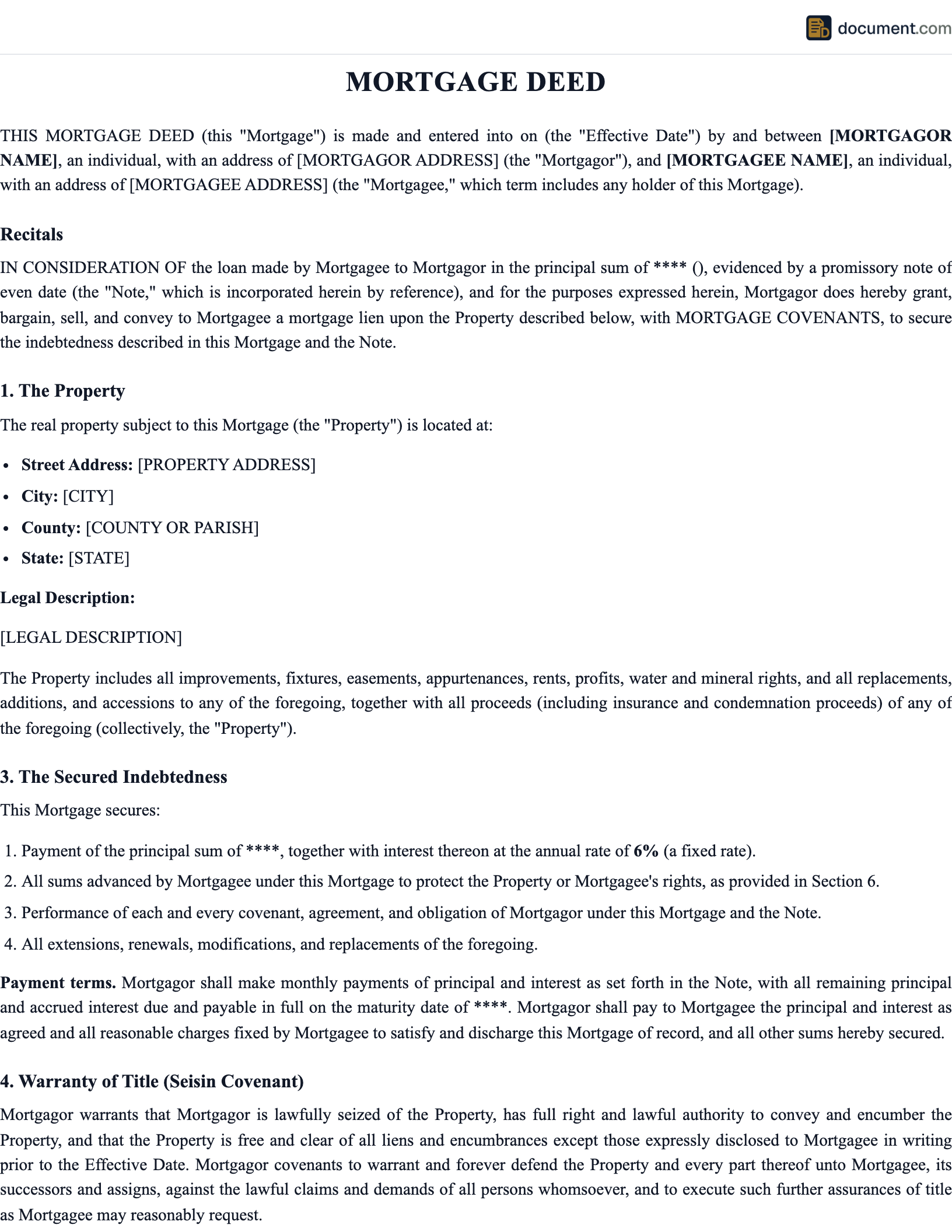
Preview of our Vermont-specific template. Your document will include all fields required for recording in any Vermont county.
MORTGAGE DEED
STATE OF VERMONT
Legal Document
PARTY INFORMATION
Name: [Full Legal Name]
Address: [Vermont Address]
County: [County]
PROPERTY DESCRIPTION
County: [County] State: Vermont
Legal Description: [Per Recorded Plat]
Parcel No.: [APN]
Vermont Mortgage Deed FAQ
Common questions about filing in Vermont, including requirements, fees, and tax implications.
Official Vermont Resources
Official state resources for verifying requirements and finding your local recording office.
Important Considerations
Vermont's town-based land records system is genuinely different from the county-based recording systems used in the other 49 states. If you are coming from out of state and assuming you can search records at a county courthouse, you will need to adjust. Vermont's land records are distributed across 255 separate municipal offices. Title searches require identifying the correct town and then searching that town's index independently. For properties that cross town boundaries, which is rare but does happen in Vermont, separate searches in each town are required.
Vermont's Act 250 environmental review process creates a layer of due diligence that has no equivalent in most other states. Before acquiring or financing development property in Vermont, determine whether the property or any planned use requires an Act 250 permit. If one exists, the permit conditions run with the land and bind future owners. A lender whose collateral is subject to an Act 250 permit with restrictive conditions may find that the property's value as developed collateral is significantly constrained compared to what the purchase price suggests.
Vermont's judicial foreclosure process, with its 12 to 18 month timeline and six-month redemption period, is among the most borrower-protective in the country. For lenders, this is a material underwriting factor. Vermont real estate tends to be illiquid compared to urban markets, and a lender who must manage a delinquent Vermont property through a lengthy foreclosure can face significant carrying costs. Vermont lenders frequently price this risk into their rates and underwriting standards, and lender's title insurance is particularly important given the extended exposure period.
Attorney Recommendation
Vermont has a strong tradition of attorney-managed closings, and for good reason. The combination of town-based recording, Act 250 permits, Land Gains Tax obligations, and the non-standard transfer tax return process creates more complexity than most title company paralegals handle in other states. For any Vermont mortgage transaction, whether you are the borrower or the lender, working with a Vermont-licensed real estate attorney who knows the local land records and municipal practices is the most reliable way to ensure the mortgage deed is properly prepared, executed, and recorded.
Related Documents
Depending on your situation, you may need additional documents alongside this one. Below are commonly related documents that are frequently used together in real estate transactions.
Related Documents
Depending on your situation, you may need additional documents alongside this one. Below are commonly related documents that are frequently used together in real estate transactions.
Create your Vermont Mortgage Deed in under 5 minutes.
Answer a few questions and download a Vermont-compliant document, ready for the state agency.