



Utah Mortgage Deed Overview
Utah is a deed-of-trust state where lenders rely on non-judicial foreclosure through a trustee's sale rather than a court process. The trustee's sale route is efficient: after a default, the borrower has three months to cure, followed by a three-week published notice of sale period. Critically, a lender who uses non-judicial foreclosure in Utah waives any right to pursue a deficiency judgment, a trade-off that favors borrowers after the fact even though the foreclosure itself is fast.
Utah is a common law property state, not a community property state, so each spouse owns property in proportion to their named interest in the title. Utah imposes no real estate transfer tax and no mortgage recording tax, making the cost of recording a security instrument among the lowest in the country. Documents are recorded with the County Recorder in the county of the property. Utah's population growth along the Wasatch Front has made Salt Lake and Utah County recorder offices high-volume operations with generally efficient turnaround, and e-recording is widely available.
$15
Recording fee
None
Transfer tax
Required
Notarization
0
Witnesses required
Utah Requirements
Utah recording requirements are governed by the Utah Code Title 57. Any instrument affecting title to real property must be acknowledged before a notary public or authorized officer before it can be recorded. No additional witnesses are required. The instrument must include the correct legal description of the property (a street address is not a legal description), the county of location, and a return address for delivery of the recorded original.
Utah Specific Note
Utah does not charge a transfer tax or a mortgage recording tax. However, the choice between a deed of trust and a traditional mortgage deed has significant legal consequences in Utah. A deed of trust permits non-judicial foreclosure but bars deficiency judgments. A traditional mortgage deed requires judicial foreclosure but preserves the lender's right to seek a deficiency. This is not just a technical distinction: it changes the economic calculus of lending in Utah. Confirm with your lender which instrument is required and understand what rights each option preserves or forfeits.
Document Requirements
- Notarization: Must be notarized by an Utah notary public or authorized notary
- Witnesses: Utah requires 0 additional witness(es)
- Legal Description: Complete legal description as it appears on the current deed of record
- Parcel Number: Assessor's parcel number or tax ID
- Return Address: Mailing address for returning the recorded document
- Formatting: Standard formatting with adequate margins, black ink, minimum 10-point font
How to File in Utah
Utah mortgage deeds and deeds of trust are recorded with the County Recorder. Most major Wasatch Front counties (Salt Lake, Utah, Davis, Weber) support e-recording and process submissions within one to two business days. The steps below apply whether you are recording in person or through an e-recording provider.
Prepare the Document
Complete all required fields including the full legal names and addresses of all borrowers and the lender, the trustee's information if using a deed of trust, the complete legal description from the current title (plat reference or metes-and-bounds), the property's serial number from the county assessor, the principal loan amount, the maturity date, and the return address for the recorded original.
Execute Before a Notary
Sign before a Utah notary public with valid government-issued photo identification. No witnesses are required beyond the notary. Utah permits remote online notarization, so the signing can often occur without an in-person meeting. Confirm with your county recorder that the office accepts remotely notarized instruments before proceeding.
Submit to the County Recorder
Take the original notarized instrument to the County Recorder in the county where the property is located. If the recorder participates in e-recording (most Wasatch Front counties do), you can submit electronically through an approved provider such as Simplifile. For rural counties, mail or in-person submission is typical.
Pay the Recording Fee
Utah charges a recording fee of approximately $15 for the first page and an additional per-page fee for subsequent pages. There is no transfer tax and no mortgage recording tax in Utah. No tax affidavit or transfer disclosure form is required as a condition of recording.
Retain the Recorded Instrument
After recording, the County Recorder stamps the instrument with a serial number and entry number and returns it to the address listed on the document. Store the recorded original with your other real property documents. For deeds of trust, the trustee also receives a copy, and the original promissory note should be kept secure by the lender until payoff and reconveyance.
Utah Fees & Costs
Typical costs for filing in Utah. Actual fees may vary by county.
| Fee / Tax | Amount |
|---|---|
| Recording Fee | $15 |
| Transfer Tax | None |
| Notarization | $5 - $25 per signature |
| Certified Copy | $1 - $10 per page |
| Attorney Review (optional) | $150 - $500 |
Utah Tax Implications
Utah imposes neither a real estate transfer tax nor a mortgage recording tax, which keeps the direct recording costs for mortgage instruments low. Utah does have a state income tax, currently a flat rate that applies to ordinary income including rental income from investment properties. Capital gains from the sale of real property are taxed as ordinary income in Utah with no separate capital gains preference, unlike at the federal level.
Utah property taxes are administered by county assessors and are based on fair market value. Residential properties occupied as primary residences benefit from a primary residential exemption that reduces the taxable value. The exemption does not require the property to be mortgage-free; a mortgaged primary residence still qualifies. Investment and rental properties do not qualify for the primary residential exemption and are taxed at the full assessed value.
If a lender forgives a deficiency balance after a short sale or post-foreclosure settlement, the cancelled amount may be treated as taxable income for federal purposes. Utah would tax this at the state income tax rate as well, since Utah conforms closely to federal income definitions. However, the most common Utah scenario of non-judicial foreclosure does not result in a deficiency judgment and thus does not create cancellation-of-debt income in the same way, since the lender has forfeited the right to pursue any shortfall.
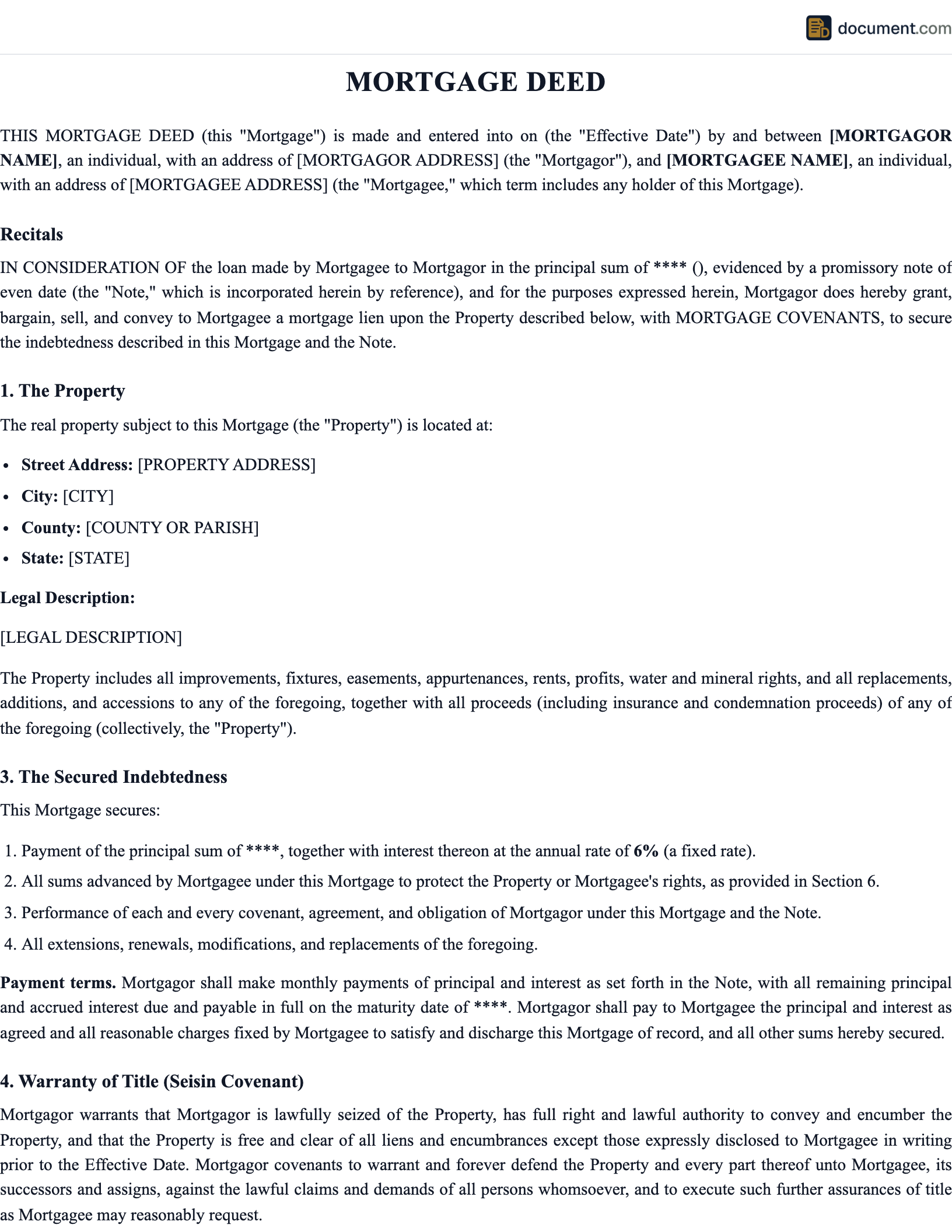
Sample Utah Mortgage Deed
Preview of our Utah-specific template. Your document will include all fields required for recording in any Utah county.
MORTGAGE DEED
STATE OF UTAH
Legal Document
PARTY INFORMATION
Name: [Full Legal Name]
Address: [Utah Address]
County: [County]
PROPERTY DESCRIPTION
County: [County] State: Utah
Legal Description: [Per Recorded Plat]
Parcel No.: [APN]
Utah Mortgage Deed FAQ
Common questions about filing in Utah, including requirements, fees, and tax implications.
Official Utah Resources
Official state resources for verifying requirements and finding your local recording office.
Important Considerations
The trade-off between non-judicial and judicial foreclosure in Utah is real and worth understanding before you sign a security instrument. Lenders who foreclose non-judicially through a trustee's sale get a fast, inexpensive process but give up the ability to recover any deficiency from the borrower. Lenders who sue for judicial foreclosure preserve the deficiency remedy but face a longer, more expensive court process. Most institutional lenders in Utah use deeds of trust and accept the loss of deficiency rights because the speed advantage outweighs the credit risk in most transactions.
Utah is not a community property state. Married couples who want to hold property jointly in Utah should do so by listing both names on the deed as joint tenants or tenants in common. If only one spouse holds title to the marital home, a lender or title company may require the non-titled spouse to sign a quitclaim deed or spousal consent at closing to clear any potential homestead or elective share claims. Failing to address the non-titled spouse's interest is a common source of title defects in Utah.
Utah's rapid growth has increased the frequency of subdivision and lot-line adjustments, particularly along the Wasatch Front. When recording a mortgage deed or deed of trust on recently subdivided or newly platted property, confirm that the legal description in the instrument matches the recorded plat exactly. A mismatch in lot or unit numbers is one of the most common errors that delays recording or creates title complications later.
Attorney Recommendation
For standard residential purchase transactions in Utah, a title company can handle the closing efficiently without attorney involvement. For seller-financed notes, commercial mortgages, property held in LLCs or trusts, or any transaction where the choice between a deed of trust and a mortgage deed is genuinely in question, a Utah real estate attorney's input is valuable. The deficiency judgment implications of each instrument type are real, and understanding them before signing protects both parties.
Related Documents
Depending on your situation, you may need additional documents alongside this one. Below are commonly related documents that are frequently used together in real estate transactions.
Related Documents
Depending on your situation, you may need additional documents alongside this one. Below are commonly related documents that are frequently used together in real estate transactions.
Create your Utah Mortgage Deed in under 5 minutes.
Answer a few questions and download a Utah-compliant document, ready for the state agency.