



Texas Mortgage Deed Overview
Texas stands apart from most states because of its constitutional homestead protections. Under Article XVI, Section 50 of the Texas Constitution, a homestead property can only be mortgaged for specific enumerated purposes: purchase money, home equity loans meeting strict constitutional standards, home improvement loans, and refinances of qualifying prior liens. A lender cannot simply take a consensual lien on a Texas homestead for general purposes. This makes mortgage deed drafting in Texas inherently constitutional work, not just a routine recording exercise.
Texas uses deeds of trust rather than traditional mortgage deeds for virtually all lending transactions, enabling non-judicial foreclosure by a trustee. Foreclosure sales must occur on the first Tuesday of the month, and there is no post-sale redemption right for residential properties. Texas has no real estate transfer tax and no mortgage recording tax, making recording costs among the lowest in the country. Documents are recorded with the County Clerk, and most major Texas counties support e-recording for fast turnaround.
$16
Recording fee
None
Transfer tax
Required
Notarization
0
Witnesses required
Texas Requirements
Texas recording requirements are governed by the Texas Property Code. Any instrument affecting title to real property must be acknowledged (notarized) before a notary public or other officer authorized by law to take acknowledgments. Texas does not require additional witnesses for standard real property instruments. The instrument must identify the county of the property and include a return address. Texas law requires that the legal description be sufficient to identify the property, which means a street address alone is never acceptable.
Texas Specific Note
The Texas homestead restrictions under Article XVI, Section 50 of the Texas Constitution are among the most complex constitutional mortgage rules in the country. If the property being secured is the borrower's homestead, the instrument must be carefully reviewed to confirm it falls within a permissible lien category. A mortgage that does not satisfy the constitutional requirements is unenforceable against a Texas homestead. Texas also mandates specific disclosure timing and procedures for home equity loans that differ from standard mortgage closing practices.
Document Requirements
- Notarization: Must be notarized by a Texas notary public or authorized notary
- Witnesses: Texas requires 0 additional witness(es)
- Legal Description: Complete legal description as it appears on the current deed of record
- Parcel Number: Assessor's parcel number or tax ID
- Return Address: Mailing address for returning the recorded document
- Formatting: Standard formatting with adequate margins, black ink, minimum 10-point font
How to File in Texas
Texas closings are typically conducted by title companies, which handle execution, notarization, and recording as part of the settlement process. For seller-financed transactions or private loans where no title company is involved, follow these steps carefully.
Prepare the Document
Complete all required fields including the full legal names and addresses of all borrowers and the lender, the trustee's information if using a deed of trust, the complete legal description as it appears in the current title records, the county of the property, the loan amount, and the maturity date. For homestead property, confirm the loan type falls within a permitted category under Texas Article XVI Section 50.
Execute Before a Texas Notary
Sign before a commissioned Texas notary public with valid government-issued photo identification. Texas does not require additional witnesses beyond the notary. For home equity loans, Texas law requires specific timing: the loan cannot be closed until 12 days after the borrower's written loan application, and the closing cannot occur at the borrower's home, workplace, or at a location other than the lender's office or a title company.
Record with the County Clerk
Submit the original notarized instrument to the County Clerk in the county where the property is located. Large Texas county clerk offices (Harris, Dallas, Tarrant, Bexar, Travis) support e-recording through providers like Simplifile. For rural counties, in-person or certified mail submission is typical. Include a self-addressed stamped envelope if mailing and requesting the recorded copy by return mail.
Pay the Recording Fee
Texas imposes no transfer tax and no mortgage recording tax. The recording fee is typically $16 for the first page and $4 for each additional page, though county schedules vary. There are no other state-level taxes triggered by recording a mortgage instrument in Texas.
Retain All Executed Copies
Keep the recorded original along with all related loan documents, the promissory note, and any required Texas-specific disclosures (particularly for home equity loans). For real property in Texas, the mineral rights situation should also be documented, as mineral interests are frequently severed from surface ownership and affect collateral value.
Texas Fees & Costs
Typical costs for filing in Texas. Actual fees may vary by county.
| Fee / Tax | Amount |
|---|---|
| Recording Fee | $16 |
| Transfer Tax | None |
| Notarization | $5 - $25 per signature |
| Certified Copy | $1 - $10 per page |
| Attorney Review (optional) | $150 - $500 |
Texas Tax Implications
Texas imposes no state income tax and no real estate transfer tax, which significantly reduces the tax friction associated with mortgage transactions. There is also no mortgage recording tax. Property taxes in Texas are levied by local taxing authorities (county, city, school district, and special districts), not the state, and Texas property tax rates are among the highest in the country on a millage basis, largely because the state does not collect income tax and relies heavily on local property taxes to fund public services.
Texas homestead exemptions provide meaningful property tax relief for owner-occupied primary residences. The school district homestead exemption removes $100,000 of appraised value from the tax base for school taxes, and many counties and cities offer additional exemptions. A property that is mortgaged but occupied as the borrower's primary residence qualifies for these exemptions, and lenders cannot require borrowers to waive homestead tax exemption rights as a condition of financing.
For investment properties and commercial real estate in Texas, there is no special tax incentive from a mortgage standpoint, but the absence of any state income tax on rental income or capital gains provides a significant advantage compared to high-income-tax states. If a lender forgives a deficiency balance after foreclosure, the cancelled debt may be taxable as ordinary income for federal purposes under IRC Section 61, though insolvency and other exclusions may apply. There is no state tax to compound this liability in Texas.
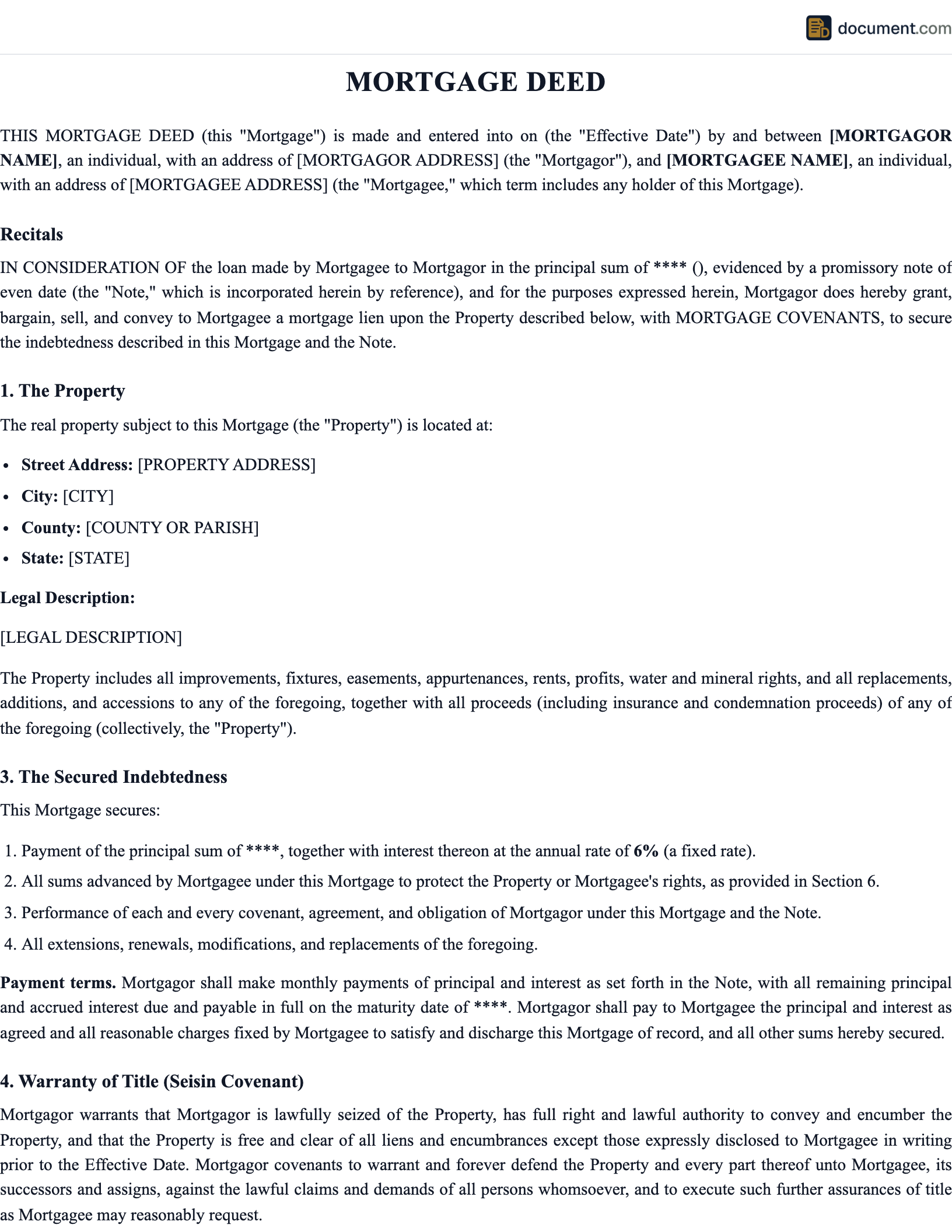
Sample Texas Mortgage Deed
Preview of our Texas-specific template. Your document will include all fields required for recording in any Texas county.
MORTGAGE DEED
STATE OF TEXAS
Legal Document
PARTY INFORMATION
Name: [Full Legal Name]
Address: [Texas Address]
County: [County]
PROPERTY DESCRIPTION
County: [County] State: Texas
Legal Description: [Per Recorded Plat]
Parcel No.: [APN]
Texas Mortgage Deed FAQ
Common questions about filing in Texas, including requirements, fees, and tax implications.
Official Texas Resources
Official state resources for verifying requirements and finding your local recording office.
Important Considerations
The Texas homestead restrictions are not merely procedural; they are constitutional, and courts enforce them strictly. A lender who takes a lien that does not qualify under Article XVI Section 50 cannot foreclose on the homestead. The practical consequence is that any uncertainty about whether a mortgage qualifies for homestead enforcement needs to be resolved before closing, not afterward. Borrowers should never sign a mortgage or deed of trust on their Texas homestead without confirming the loan type fits squarely within a permitted category.
Texas's first-Tuesday-of-the-month foreclosure rule creates a predictable calendar that both lenders and investors follow closely. For borrowers facing default, this schedule is useful because it makes it easier to anticipate when a sale will occur and to plan accordingly. Texas has a relatively active post-foreclosure market, and investors frequently purchase properties at the courthouse steps. Borrowers who lose a home to foreclosure in Texas have no statutory right to reclaim it afterward.
Mineral rights in Texas deserve special attention in any real property transaction. It is common in Texas for subsurface mineral interests to be severed from surface ownership, meaning a landowner may not own the oil, gas, or other minerals beneath their property. A mortgage deed or deed of trust typically only encumbers the surface estate unless the instrument expressly includes mineral interests. Lenders and borrowers should confirm what mineral interests, if any, are included in the collateral before closing.
Attorney Recommendation
Any transaction involving a Texas homestead, a home equity loan, or seller-financed real estate should be reviewed by a Texas real estate attorney before closing. The constitutional requirements for homestead lending are precise and non-negotiable. Texas title companies are highly experienced with standard purchase-money transactions, but constitutional home equity compliance issues are best handled with attorney involvement. The cost of a legal review is minor compared to the consequence of an unenforceable lien on a Texas homestead.
Related Documents
Depending on your situation, you may need additional documents alongside this one. Below are commonly related documents that are frequently used together in real estate transactions.
Related Documents
Depending on your situation, you may need additional documents alongside this one. Below are commonly related documents that are frequently used together in real estate transactions.
Create your Texas Mortgage Deed in under 5 minutes.
Answer a few questions and download a Texas-compliant document, ready for the state agency.