
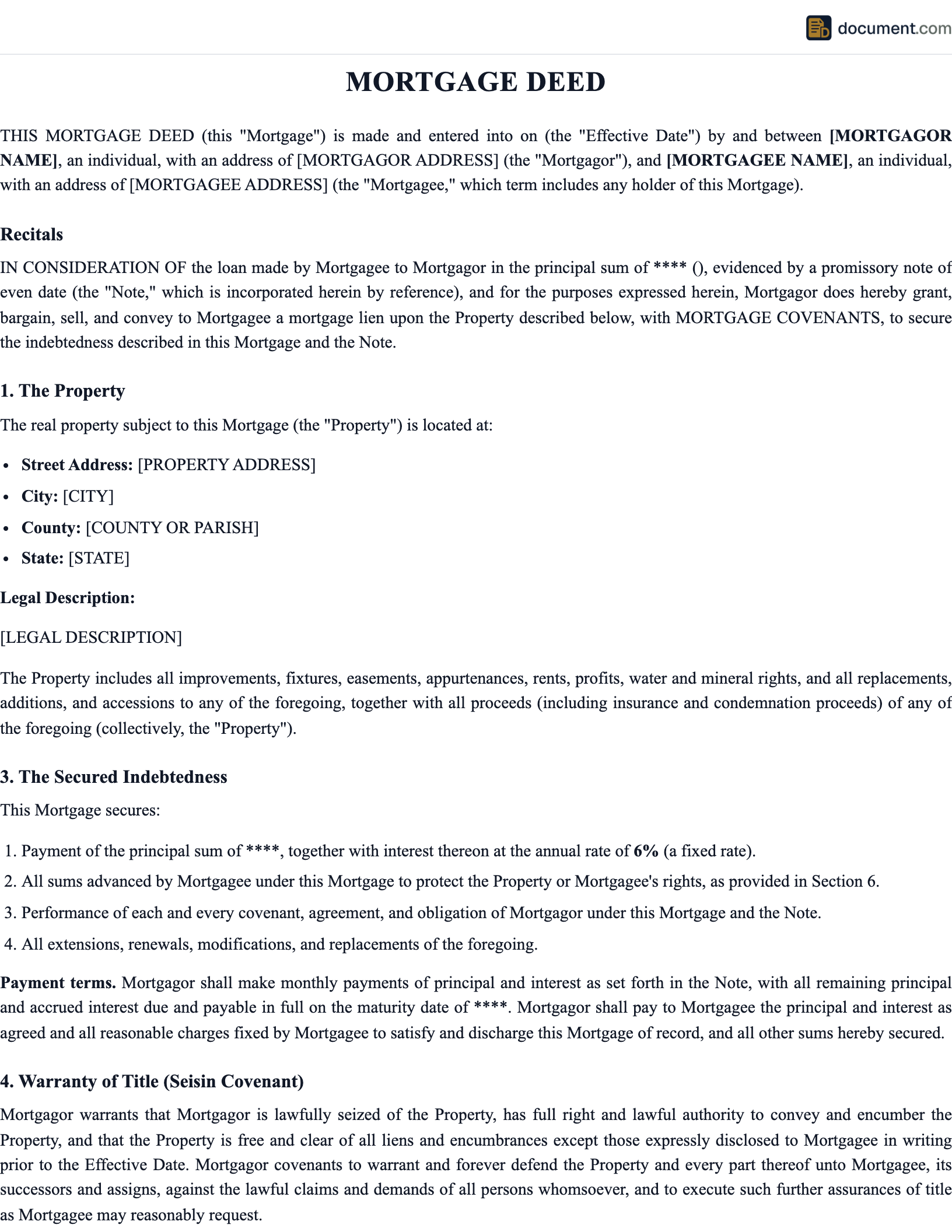



Tennessee Mortgage Deed Overview
Tennessee is functionally a deed-of-trust state, even though traditional mortgage deeds remain valid under state law. Nearly every lender doing business in Tennessee uses a deed of trust rather than a mortgage deed because it enables non-judicial foreclosure. The trustee's sale process can move from first default notice to completed sale in as few as 21 days after published notice, making Tennessee one of the fastest foreclosure states in the country. If your lender specifies a mortgage deed, understand that the foreclosure timeline reverts to the slower judicial process.
Mortgage instruments in Tennessee are recorded with the County Register of Deeds. Tennessee imposes both a realty transfer tax ($0.37 per $100 of consideration) and a separate mortgage tax on the principal amount of the debt. The mortgage tax has a state component and a local-option county component, and can add up to a meaningful closing cost on larger loans. There is no right of redemption after a non-judicial trustee's sale, and lenders may pursue deficiency judgments within two years of the foreclosure sale date.
$10
Recording fee
$0.37 per $100
Transfer tax
Required
Notarization
0
Witnesses required
Tennessee Requirements
Tennessee's recording requirements apply to any instrument affecting title to real property. A mortgage deed must be properly executed, acknowledged before a notary, and submitted to the County Register of Deeds in the county where the property is located. The instrument must state the preparer's name and address on its face. Tennessee also requires that the county of the property be identified in the instrument, and that the instrument include the tax parcel ID for the property.
Tennessee Specific Note
Tennessee is one of the few states that imposes both a realty transfer tax AND a separate mortgage tax. The mortgage tax applies to the principal amount of the debt secured by the instrument at a combined state and county rate that can reach up to $0.395 per $100. On a $400,000 mortgage, budget for approximately $1,580 in mortgage tax alone, before accounting for recording fees and the transfer tax on the purchase price. Confirm the exact county-level mortgage tax rate with the applicable County Register of Deeds before closing.
Document Requirements
- Notarization: Must be notarized by a Tennessee notary public or authorized notary
- Witnesses: Tennessee requires 0 additional witness(es)
- Legal Description: Complete legal description as it appears on the current deed of record
- Parcel Number: Assessor's parcel number or tax ID
- Return Address: Mailing address for returning the recorded document
- Formatting: Standard formatting with adequate margins, black ink, minimum 10-point font
How to File in Tennessee
Tennessee closings are most commonly handled by title companies, which manage recording as part of the settlement process. If you are handling a private transaction without a title company, follow these steps carefully, and budget extra time if you are submitting to a smaller rural county office.
Prepare the Document
Complete all required fields: full legal names and addresses of mortgagor and mortgagee, the complete legal description exactly as it appears in the current title, the property's tax parcel ID, the county of location, the principal loan amount and maturity date, and the preparer's name and address. Tennessee requires the preparer information to appear on the face of the instrument.
Execute Before a Notary
Sign in front of a Tennessee notary public with valid photo identification. No additional witnesses are required beyond the notary acknowledgment. Tennessee does not yet broadly permit remote online notarization for real property instruments, so confirm current rules with your county Register of Deeds before attempting a remote signing.
Submit to the County Register of Deeds
Present the original notarized instrument to the Register of Deeds in the county where the property is located. Major counties such as Davidson, Shelby, and Knox accept e-recorded submissions through approved providers. Bring or include the completed realty transfer tax affidavit, which is required even if an exemption applies.
Pay All Applicable Taxes and Fees
Pay the per-page recording fee, the realty transfer tax ($0.37 per $100 of consideration), and the mortgage tax on the principal amount of the debt (state rate $0.115 per $100 plus up to $0.28 per $100 in local county tax). The Register of Deeds will calculate the amounts owed at the time of recording.
Retain the Recorded Instrument
After recording, the original is stamped with a book and page or instrument number and returned to the address specified in the document. Store the recorded original in a safe location. For purchase transactions, this instrument should be preserved alongside the warranty deed conveying title and your title insurance policy.
Tennessee Fees & Costs
Typical costs for filing in Tennessee. Actual fees may vary by county.
| Fee / Tax | Amount |
|---|---|
| Recording Fee | $10 |
| Transfer Tax | $0.37 per $100 |
| Notarization | $5 - $25 per signature |
| Certified Copy | $1 - $10 per page |
| Attorney Review (optional) | $150 - $500 |
Tennessee Tax Implications
Tennessee's tax structure for mortgage transactions involves several layers. The realty transfer tax of $0.37 per $100 applies to the purchase price when ownership transfers. The mortgage tax applies separately to the principal debt amount and is one of the higher combined rates in the Southeast when you add the state and county components together. Tennessee eliminated its state income tax on wages and salary, but the Hall Income Tax on investment income was also phased out as of 2021, meaning there is no longer any Tennessee state income tax at all. This affects how rental income from mortgaged investment properties is taxed at the state level.
After foreclosure, if a lender pursues a deficiency judgment, any debt forgiven by the lender may constitute cancellation-of-debt income for federal tax purposes. Tennessee no longer imposes a state income tax to compound this, but the federal tax liability can still be significant. Borrowers who receive a Form 1099-C from a lender after a short sale, deed in lieu, or post-foreclosure settlement should speak with a tax professional about whether the insolvency exclusion under IRC Section 108 applies.
Property tax assessments in Tennessee are set by county assessors and reappraisal cycles vary by county. A sale at market value can trigger reassessment if the assessed value was substantially below the transaction price. Tennessee also has a greenbelt program for agricultural and forestry land that can reduce property taxes significantly, but a transfer of qualifying land may trigger rollback taxes covering the prior three years if the agricultural use designation is lost.
Sample Tennessee Mortgage Deed
Preview of our Tennessee-specific template. Your document will include all fields required for recording in any Tennessee county.
MORTGAGE DEED
STATE OF TENNESSEE
Legal Document
PARTY INFORMATION
Name: [Full Legal Name]
Address: [Tennessee Address]
County: [County]
PROPERTY DESCRIPTION
County: [County] State: Tennessee
Legal Description: [Per Recorded Plat]
Parcel No.: [APN]
Tennessee Mortgage Deed FAQ
Common questions about filing in Tennessee, including requirements, fees, and tax implications.
Official Tennessee Resources
Official state resources for verifying requirements and finding your local recording office.
Important Considerations
The speed of Tennessee's foreclosure process is a double-edged sword. For lenders, it reduces carrying costs and uncertainty. For borrowers, it means there is very little time to cure a default, negotiate a modification, or arrange a short sale once the foreclosure machinery has started. If you are a borrower in Tennessee who anticipates payment difficulty, reaching out to your servicer before missing a payment is especially important given the compressed timeline.
The mortgage tax in Tennessee is one of the more significant transaction costs that catches first-time buyers off guard. Unlike the realty transfer tax, which is typically a seller's cost, the mortgage tax is generally paid by the borrower at closing. On a $500,000 loan in Shelby County, the combined mortgage tax can approach $2,000 or more. Build this into your cash-to-close calculations early in the process.
Tennessee law does not require a licensed attorney to close a real estate transaction, and many closings are handled entirely by title companies. However, for commercial loans, construction loans, or any transaction with unusual title issues or seller-financing arrangements, having a Tennessee real estate attorney review the mortgage deed before signing is advisable. The absence of a redemption period after a non-judicial sale in Tennessee makes getting the document right the first time especially important for lenders.
Attorney Recommendation
Tennessee title companies handle the vast majority of residential closings competently without attorney involvement. For seller-financed notes, land contracts, or any situation where a traditional mortgage deed rather than a deed of trust is being used, consult a Tennessee real estate attorney. The choice of instrument has significant consequences for foreclosure rights and timing, and an attorney can confirm which instrument is appropriate for your specific transaction.
Related Documents
Depending on your situation, you may need additional documents alongside this one. Below are commonly related documents that are frequently used together in real estate transactions.
Related Documents
Depending on your situation, you may need additional documents alongside this one. Below are commonly related documents that are frequently used together in real estate transactions.
Create your Tennessee Mortgage Deed in under 5 minutes.
Answer a few questions and download a Tennessee-compliant document, ready for the state agency.