



South Dakota Mortgage Deed Overview
South Dakota is one of the few states that still uses the traditional mortgage deed structure rather than a deed of trust. When you grant a mortgage on South Dakota real property, you retain title while giving the lender a lien. If you default, the lender must pursue a judicial foreclosure action in circuit court rather than using a streamlined trustee's sale process. That distinction matters because South Dakota also provides a 180-day post-sale redemption period, one of the most borrower-protective in the country.
Documents are recorded with the county Register of Deeds in the county where the property sits. South Dakota charges a real estate transfer tax of $0.50 per $500 of consideration, but imposes no separate mortgage tax, keeping recording costs modest. A notarized acknowledgment is required for recording; no additional witnesses are needed. South Dakota has also embraced remote online notarization, so closings can often be handled entirely without an in-person meeting.
$10
Recording fee
$0.50 per $500
Transfer tax
Required
Notarization
0
Witnesses required
South Dakota Requirements
South Dakota's recording requirements are set out under SDCL Title 43. To be accepted by the Register of Deeds, a mortgage deed must carry a proper notarized acknowledgment, include the grantor's marital status (required for homestead purposes), state the legal description exactly as it appears in the current chain of title, and include a return address on the face of the document. The county may reject documents that do not conform to formatting standards or that have incomplete execution.
South Dakota Specific Note
South Dakota does not impose a mortgage tax on recorded security instruments, but the real estate transfer tax of $0.50 per $500 of consideration still applies to the underlying conveyance. If the mortgage arises from a purchase transaction, the transfer tax is assessed on the purchase price, not the loan amount. For refinances and pure lien grants with no transfer of ownership, confirm with the Register of Deeds whether a transfer tax affidavit is needed.
Document Requirements
- Notarization: Must be notarized by a South Dakota notary public or authorized notary
- Witnesses: South Dakota requires 0 additional witness(es)
- Legal Description: Complete legal description as it appears on the current deed of record
- Parcel Number: Assessor's parcel number or tax ID
- Return Address: Mailing address for returning the recorded document
- Formatting: Standard formatting with adequate margins, black ink, minimum 10-point font
How to File in South Dakota
South Dakota mortgage deeds are recorded at the county level, and the process is generally straightforward once your document is properly prepared and notarized. Many South Dakota counties now accept e-recorded submissions, which can shorten turnaround considerably.
Prepare the Document
Complete all required fields including the full legal names and addresses of both mortgagor and mortgagee, the complete legal description from the current deed of record, the parcel ID from the county director of equalization, and the loan amount and maturity date. State the grantor's marital status as required under South Dakota homestead law.
Execute Before a Notary
Sign in front of a commissioned South Dakota notary public. Bring government-issued photo ID. No additional witnesses are required. Remote online notarization is permitted in South Dakota if an in-person signing is not convenient.
Submit to the Register of Deeds
Take or mail the notarized original to the Register of Deeds in the county where the property is located. If the office participates in e-recording, you may be able to submit electronically through an approved provider. Call ahead to confirm current submission options.
Pay the Recording Fee and Transfer Tax
The base recording fee is $10 for the first page plus $2 per additional page. If the mortgage arises from a purchase transaction, the real estate transfer tax of $0.50 per $500 of purchase price is also due at recording. No separate mortgage tax applies in South Dakota.
Retain the Recorded Copy
After recording, the Register of Deeds will return the original with a book and page or instrument number stamped on it. Keep this in a secure location. For purchase transactions, also retain the title commitment and any closing disclosures alongside the recorded mortgage deed.
South Dakota Fees & Costs
Typical costs for filing in South Dakota. Actual fees may vary by county.
| Fee / Tax | Amount |
|---|---|
| Recording Fee | $10 |
| Transfer Tax | $0.50 per $500 |
| Notarization | $5 - $25 per signature |
| Certified Copy | $1 - $10 per page |
| Attorney Review (optional) | $150 - $500 |
South Dakota Tax Implications
South Dakota has no state income tax, which eliminates one layer of complexity that affects mortgage-related transactions in many other states. There is no state-level capital gains tax on the sale of mortgaged property, and no personal income tax on cancellation-of-debt income at the state level (though federal COD income rules still apply if a lender forgives debt after foreclosure or a short sale).
The real estate transfer tax at $0.50 per $500 of purchase price is low compared to most states. South Dakota does not impose a separate mortgage recording tax, so lenders recording a security instrument do not pay an additional tax on the loan amount. Property taxes are administered by each county director of equalization and reassessment can follow a transfer if the sale price reflects market value substantially different from the assessed value.
For borrowers using South Dakota's recognized community property trust structure, the tax treatment of a mortgaged property placed in such a trust can carry significant federal income tax benefits, including a full step-up in basis on the first spouse's death. The interplay between the mortgage's due-on-sale clause and the trust transfer should be reviewed with a tax advisor and lender before proceeding.
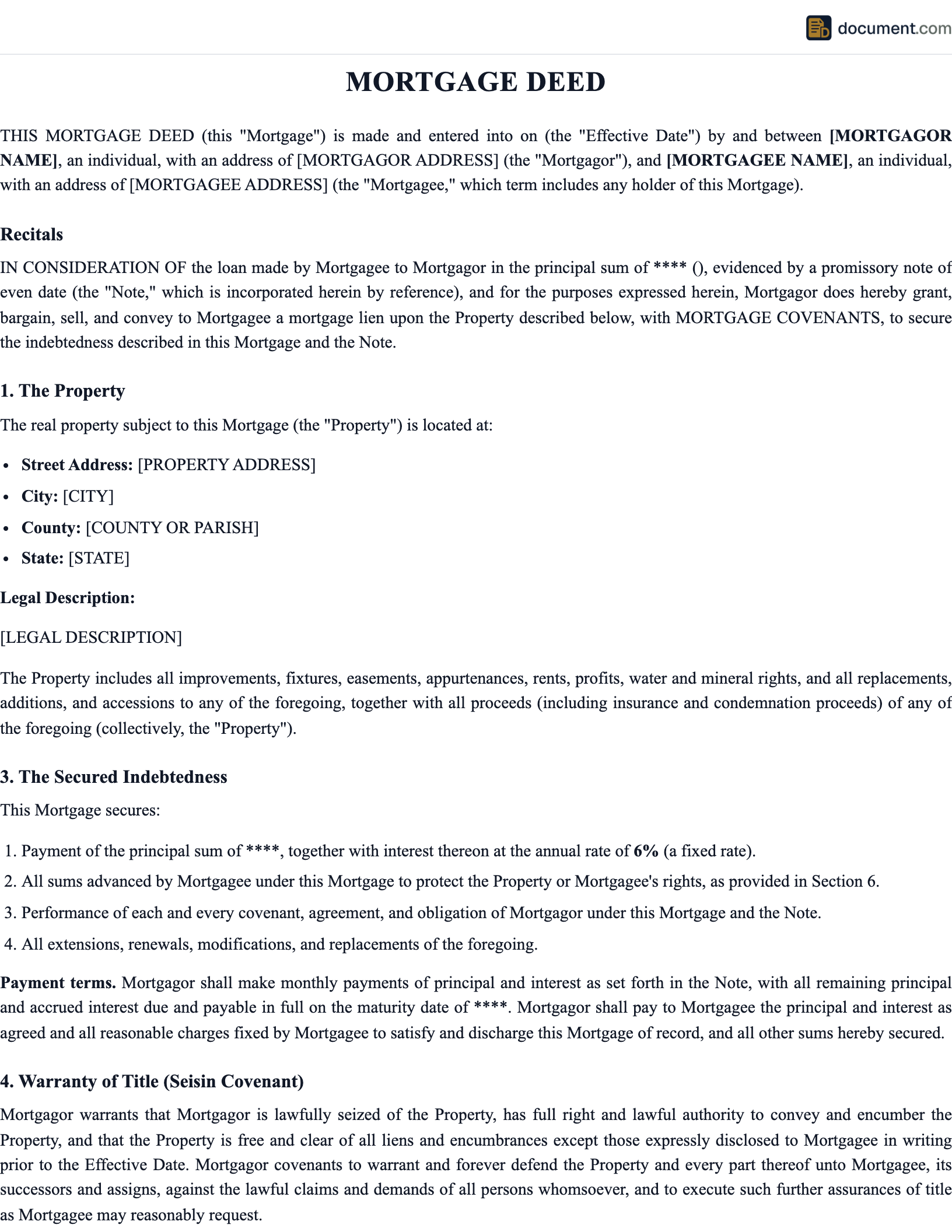
Sample South Dakota Mortgage Deed
Preview of our South Dakota-specific template. Your document will include all fields required for recording in any South Dakota county.
MORTGAGE DEED
STATE OF SOUTH DAKOTA
Legal Document
PARTY INFORMATION
Name: [Full Legal Name]
Address: [South Dakota Address]
County: [County]
PROPERTY DESCRIPTION
County: [County] State: South Dakota
Legal Description: [Per Recorded Plat]
Parcel No.: [APN]
South Dakota Mortgage Deed FAQ
Common questions about filing in South Dakota, including requirements, fees, and tax implications.
Official South Dakota Resources
Official state resources for verifying requirements and finding your local recording office.
Important Considerations
South Dakota's judicial foreclosure requirement means lenders have less leverage for a quick recovery than in deed-of-trust states. This cuts both ways: borrowers have more time and procedural protections, but lenders price that risk into loan terms. If you are a borrower, understand that the 180-day redemption period after a sheriff's sale is a right you can waive in some circumstances, and lenders sometimes negotiate that waiver at closing.
South Dakota's favorable LLC and trust laws attract out-of-state investors who hold property through South Dakota entities. If your mortgaged property is owned by or will be transferred to an LLC or trust, confirm with your lender whether the security instrument needs to be executed by the entity rather than the individual, and whether the lender requires a personal guarantee alongside the mortgage deed.
For agricultural land, which makes up a significant portion of South Dakota real estate, additional federal and state regulations may apply. Foreign ownership restrictions on agricultural land, USDA Farm Service Agency liens, and conservation easements recorded against the property can all affect the priority and enforceability of a new mortgage. A title search that goes back at least 40 years is advisable for rural parcels.
Attorney Recommendation
For straightforward residential purchase loans, a South Dakota title company can often handle the closing without a separate attorney review. For commercial mortgages, multi-party transactions, property held in trust, or any loan secured by agricultural land, having a South Dakota real estate attorney review the mortgage deed before recording is worth the cost. Many South Dakota attorneys offer flat-rate review for standard residential instruments.
Related Documents
Depending on your situation, you may need additional documents alongside this one. Below are commonly related documents that are frequently used together in real estate transactions.
Related Documents
Depending on your situation, you may need additional documents alongside this one. Below are commonly related documents that are frequently used together in real estate transactions.
Create your South Dakota Mortgage Deed in under 5 minutes.
Answer a few questions and download a South Dakota-compliant document, ready for the state agency.