



Oregon Mortgage Deed Overview
Oregon is predominantly a deed of trust state. Rather than granting a traditional mortgage, most Oregon real property lenders take a deed of trust, which places a trustee in the chain of title as the security interest holder. This structure exists specifically to allow nonjudicial foreclosure under Oregon's Trust Deed Act (ORS Chapter 86) if the borrower defaults. Some lenders still use mortgage instruments in Oregon, but they are far less common because mortgages require a full judicial foreclosure process.
Oregon has no state real estate transfer tax under ORS 306.815, and there is no separate mortgage recording tax. Recording fees are charged per page. The nonjudicial foreclosure process under the Trust Deed Act requires a minimum of 120 days from the notice of default before a trustee's sale, and Oregon law prohibits deficiency judgments after a completed nonjudicial sale, which represents a meaningful borrower protection.
$56
Recording fee
Varies by county
Transfer tax
Required
Notarization
0
Witnesses required
Oregon Requirements
Security instruments in Oregon must be notarized and meet the formatting standards set by the county clerk for recording. The document must contain a complete legal description, the names and addresses of all parties, and a clear statement of the obligations secured. Oregon does not require witnesses beyond the notary. Recording is done at the county clerk's office in the county where the property sits.
Oregon Specific Note
Oregon has no state real estate transfer tax, and no mortgage recording tax applies to trust deeds or mortgages. The recording fee starts at $56 for the first page under current Oregon statute, with additional per-page charges. Some local governments impose their own real estate taxes, so confirm with the county recorder whether any local taxes apply before closing. Lenders using a nonjudicial trust deed structure should ensure the document includes the trustee's information and the power-of-sale clause required under the Trust Deed Act.
Document Requirements
- Notarization: Must be notarized by an Oregon notary public or authorized notary
- Witnesses: Oregon requires 0 additional witness(es)
- Legal Description: Complete legal description as it appears on the current deed of record
- Parcel Number: Assessor's parcel number or tax ID
- Return Address: Mailing address for returning the recorded document
- Formatting: Standard formatting with adequate margins, black ink, minimum 10-point font
How to File in Oregon
Recording an Oregon mortgage or deed of trust follows the standard county-level recording process. Most closings in Oregon are handled through title and escrow companies, which typically manage the recording as part of their closing services.
Prepare the Document
Identify whether you are using a deed of trust or a mortgage instrument. Deeds of trust require a named trustee in addition to the trustor (borrower) and beneficiary (lender). Include the complete legal description, the loan amount, and any required Oregon-specific covenants. The power-of-sale clause is essential for nonjudicial foreclosure eligibility under the Trust Deed Act.
Notarize the Document
The trustor or mortgagor must sign before an Oregon notary public or a notary authorized under Oregon law. Bring government-issued photo ID. Oregon permits remote online notarization under ORS Chapter 194, which is useful for parties who cannot appear in person at closing.
Submit to the County Clerk
Record the notarized document with the county clerk in the county where the property is located. Major Oregon counties including Multnomah, Washington, Lane, and Clackamas accept e-recording, which is faster than walk-in or mail submission and is the norm for institutional lenders.
Pay the Recording Fee
Oregon recording fees start at $56 for the first page, with additional per-page fees set by statute. Oregon does not impose a transfer tax or mortgage tax on the recording, so fees are limited to the per-page recording charge. Confirm the current fee schedule with the specific county before submitting.
Retain the Recorded Document
Once recorded, the county clerk assigns an instrument number and returns the document to the address listed in the filing. Keep the recorded original with the loan documents. For deeds of trust, when the loan is paid off, the beneficiary must record a reconveyance through the trustee to release the lien from the title.
Oregon Fees & Costs
Typical costs for filing in Oregon. Actual fees may vary by county.
| Fee / Tax | Amount |
|---|---|
| Recording Fee | $56 |
| Transfer Tax | Varies by county |
| Notarization | $5 - $25 per signature |
| Certified Copy | $1 - $10 per page |
| Attorney Review (optional) | $150 - $500 |
Oregon Tax Implications
Oregon does not impose a state-level real estate transfer tax, and there is no mortgage recording tax under ORS 306.815. This makes Oregon straightforward on the documentary tax side. Recording fees under state statute are the primary government charge associated with recording a deed of trust or mortgage. Some local jurisdictions have enacted real estate excise taxes separate from the state, so confirm with your county whether any local surcharges apply.
Mortgage interest on a principal or second residence may be deductible on federal income taxes for borrowers who itemize. Oregon also allows a deduction for mortgage interest on Oregon state income taxes, conforming generally to federal treatment. The state deduction is subject to Oregon's own income tax structure and phaseout rules, so borrowers with high incomes should consult a tax professional about the actual benefit.
After a nonjudicial trustee's sale in Oregon, the lender is barred from pursuing a deficiency judgment against the borrower for the remaining loan balance. This anti-deficiency protection applies specifically to the nonjudicial process under the Trust Deed Act. Lenders who choose judicial foreclosure retain deficiency rights, which is one reason borrowers in default on a deed of trust have somewhat stronger protections than borrowers under a judicial mortgage foreclosure.
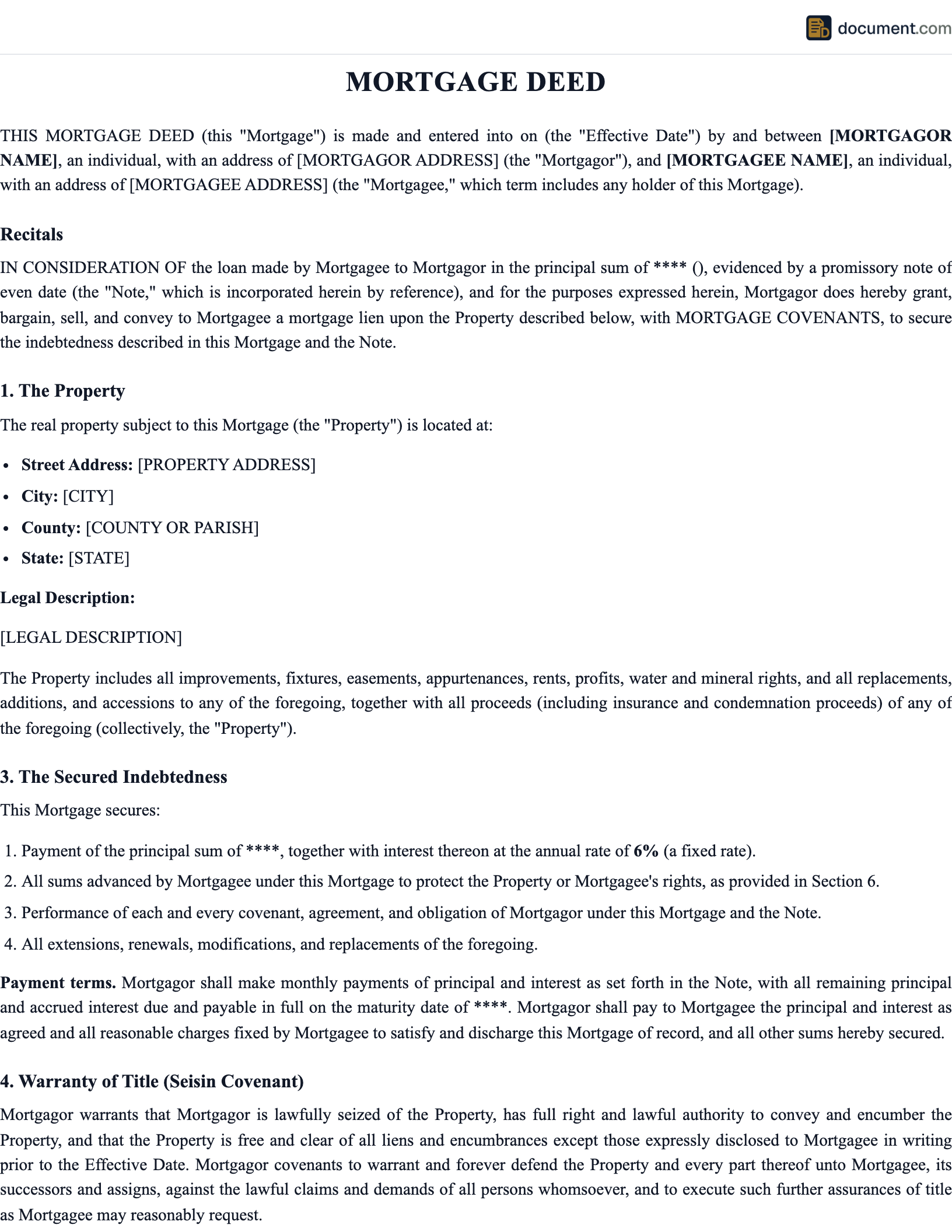
Sample Oregon Mortgage Deed
Preview of our Oregon-specific template. Your document will include all fields required for recording in any Oregon county.
MORTGAGE DEED
STATE OF OREGON
Legal Document
PARTY INFORMATION
Name: [Full Legal Name]
Address: [Oregon Address]
County: [County]
PROPERTY DESCRIPTION
County: [County] State: Oregon
Legal Description: [Per Recorded Plat]
Parcel No.: [APN]
Oregon Mortgage Deed FAQ
Common questions about filing in Oregon, including requirements, fees, and tax implications.
Official Oregon Resources
Official state resources for verifying requirements and finding your local recording office.
Important Considerations
The most important structural decision in an Oregon real property loan is whether to use a deed of trust or a mortgage. Virtually all institutional lenders use deeds of trust specifically because Oregon's Trust Deed Act enables a nonjudicial trustee's sale that is faster and cheaper than judicial foreclosure. If you are using a mortgage instrument instead, understand that foreclosure will require a court action.
Oregon's anti-deficiency rule after nonjudicial foreclosure is a significant consumer protection worth understanding before entering a transaction. If a lender forecloses nonjudicially and the sale price does not cover the full loan balance, the lender cannot pursue the borrower for the difference. This makes the nonjudicial process borrower-friendly in one respect, even though it moves quickly once initiated.
Oregon's 120-day minimum notice period before a trustee's sale gives borrowers meaningful time to explore alternatives such as loan modifications, short sales, or deeds in lieu. Borrowers who receive a Notice of Default should contact a HUD-approved housing counselor or an Oregon legal aid organization promptly, as options narrow significantly once the notice period runs.
Oregon Practice Note
Most Oregon real property closings are handled through title and escrow companies rather than attorneys, which is the norm in the Pacific Northwest. Title companies review title, prepare closing documents, handle disbursements, and submit documents for recording. For complex transactions or if you receive any document from a lender that seems unusual, having an Oregon real estate attorney review the security instrument before signing is a reasonable precaution.
Related Documents
Depending on your situation, you may need additional documents alongside this one. Below are commonly related documents that are frequently used together in real estate transactions.
Important Considerations
The most important structural decision in an Oregon real property loan is whether to use a deed of trust or a mortgage. Virtually all institutional lenders use deeds of trust specifically because Oregon's Trust Deed Act enables a nonjudicial trustee's sale that is faster and cheaper than judicial foreclosure. If you are using a mortgage instrument instead, understand that foreclosure will require a court action.
Oregon's anti-deficiency rule after nonjudicial foreclosure is a significant consumer protection worth understanding before entering a transaction. If a lender forecloses nonjudicially and the sale price does not cover the full loan balance, the lender cannot pursue the borrower for the difference. This makes the nonjudicial process borrower-friendly in one respect, even though it moves quickly once initiated.
Oregon's 120-day minimum notice period before a trustee's sale gives borrowers meaningful time to explore alternatives such as loan modifications, short sales, or deeds in lieu. Borrowers who receive a Notice of Default should contact a HUD-approved housing counselor or an Oregon legal aid organization promptly, as options narrow significantly once the notice period runs.
Oregon Practice Note
Most Oregon real property closings are handled through title and escrow companies rather than attorneys, which is the norm in the Pacific Northwest. Title companies review title, prepare closing documents, handle disbursements, and submit documents for recording. For complex transactions or if you receive any document from a lender that seems unusual, having an Oregon real estate attorney review the security instrument before signing is a reasonable precaution.
Related Documents
Depending on your situation, you may need additional documents alongside this one. Below are commonly related documents that are frequently used together in real estate transactions.
Create your Oregon Mortgage Deed in under 5 minutes.
Answer a few questions and download a Oregon-compliant document, ready for the state agency.