



Oklahoma Mortgage Deed Overview
Oklahoma is a mortgage state, which means lenders secure real property loans through a mortgage instrument rather than a deed of trust. When a borrower defaults, the lender must pursue judicial foreclosure through the Oklahoma district courts rather than using a nonjudicial trustee's sale. Mortgage deeds are recorded with the county clerk in the county where the property is located, and they become part of the county's official real property records from the moment of recording.
One factor that sets Oklahoma apart from many states is its oil and gas heritage. In areas with active or historical mineral production, it is common for mineral interests to be severed from the surface estate. Lenders and borrowers should confirm whether the mortgage is intended to encumber mineral interests alongside the surface, and the legal description should reflect that intent precisely. Oklahoma also has a well-established homestead protection law that requires spousal joinder on any mortgage encumbering property claimed as a homestead.
$18
Recording fee
$0.75 per $500
Transfer tax
Required
Notarization
0
Witnesses required
Oklahoma Requirements
Oklahoma recording requirements are administered at the county level. All mortgage deeds must be acknowledged before a notary public, and the document must contain a complete legal description of the property. Oklahoma does not require additional witnesses beyond the notary. Documents should meet standard formatting requirements, including legible font, sufficient margins for the clerk's stamp, and a return address for the recorded instrument.
Oklahoma Specific Note
If the mortgaged property is a homestead, Oklahoma law requires both spouses to sign the mortgage document, even when title is held in one spouse's name alone. Failing to include both spouses on a homestead mortgage is a common and consequential error. Oklahoma does not impose a separate mortgage tax on the loan amount, but recording fees apply per page. Verify current per-page fees with the county clerk before filing.
Document Requirements
- Notarization: Must be notarized by an Oklahoma notary public or authorized notary
- Witnesses: Oklahoma requires 0 additional witness(es)
- Legal Description: Complete legal description as it appears on the current deed of record
- Parcel Number: Assessor's parcel number or tax ID
- Return Address: Mailing address for returning the recorded document
- Formatting: Standard formatting with adequate margins, black ink, minimum 10-point font
How to File in Oklahoma
Recording a mortgage deed in Oklahoma is a county-level process. You file with the county clerk in the county where the property is physically located, regardless of where the parties reside or where the loan was originated.
Prepare the Document
Fill in all required fields: full legal names of mortgagor and mortgagee, the complete legal description of the property as it appears in the county records, the parcel identification number, and the loan amount secured by the mortgage. If the property is a homestead, ensure both spouses are listed as mortgagors.
Get the Document Notarized
All signing parties must appear before an Oklahoma notary public or a notary authorized in Oklahoma. Bring valid government-issued photo identification. Remote online notarization is an option under Oklahoma law if in-person signing is not practical.
Submit to the County Clerk
Take the fully executed and notarized document to the county clerk's office in the county where the property is located. Many Oklahoma county clerks also accept e-recording through approved vendors, which can speed up the process significantly.
Pay Recording Fees
Recording fees in Oklahoma are charged per page. Oklahoma does not levy a separate mortgage tax on the loan amount, keeping overall recording costs reasonable compared to some neighboring states. Confirm exact per-page fees with the specific county clerk before submitting.
Receive the Recorded Document
Once recorded, the county clerk stamps the document with the book and page number or instrument number and returns it to the address listed on the document. Store the recorded original in a secure location along with other loan documents.
Oklahoma Fees & Costs
Typical costs for filing in Oklahoma. Actual fees may vary by county.
| Fee / Tax | Amount |
|---|---|
| Recording Fee | $18 |
| Transfer Tax | $0.75 per $500 |
| Notarization | $5 - $25 per signature |
| Certified Copy | $1 - $10 per page |
| Attorney Review (optional) | $150 - $500 |
Oklahoma Tax Implications
Oklahoma does not impose a dedicated mortgage tax or transfer tax on mortgage instruments. This is a practical benefit for borrowers and lenders compared to states like Florida or New York, where mortgage recording taxes can add thousands of dollars to closing costs. Recording fees are charged per page by the county clerk and are modest relative to the loan amounts involved.
From a federal income tax perspective, mortgage interest paid on a qualifying Oklahoma residence may be deductible for taxpayers who itemize. The deduction is subject to federal limits on acquisition debt and is not specific to Oklahoma, but it remains a meaningful benefit for homeowners with substantial mortgage balances. Consult a tax advisor for your specific situation.
Property taxes in Oklahoma are assessed at the county level. Transferring ownership through foreclosure or a deed in lieu of foreclosure can trigger a reassessment of the property's taxable value. Borrowers who claim a homestead exemption should be aware that losing title through foreclosure terminates the exemption. Contact the county assessor to understand how a foreclosure sale might affect property tax obligations going forward.
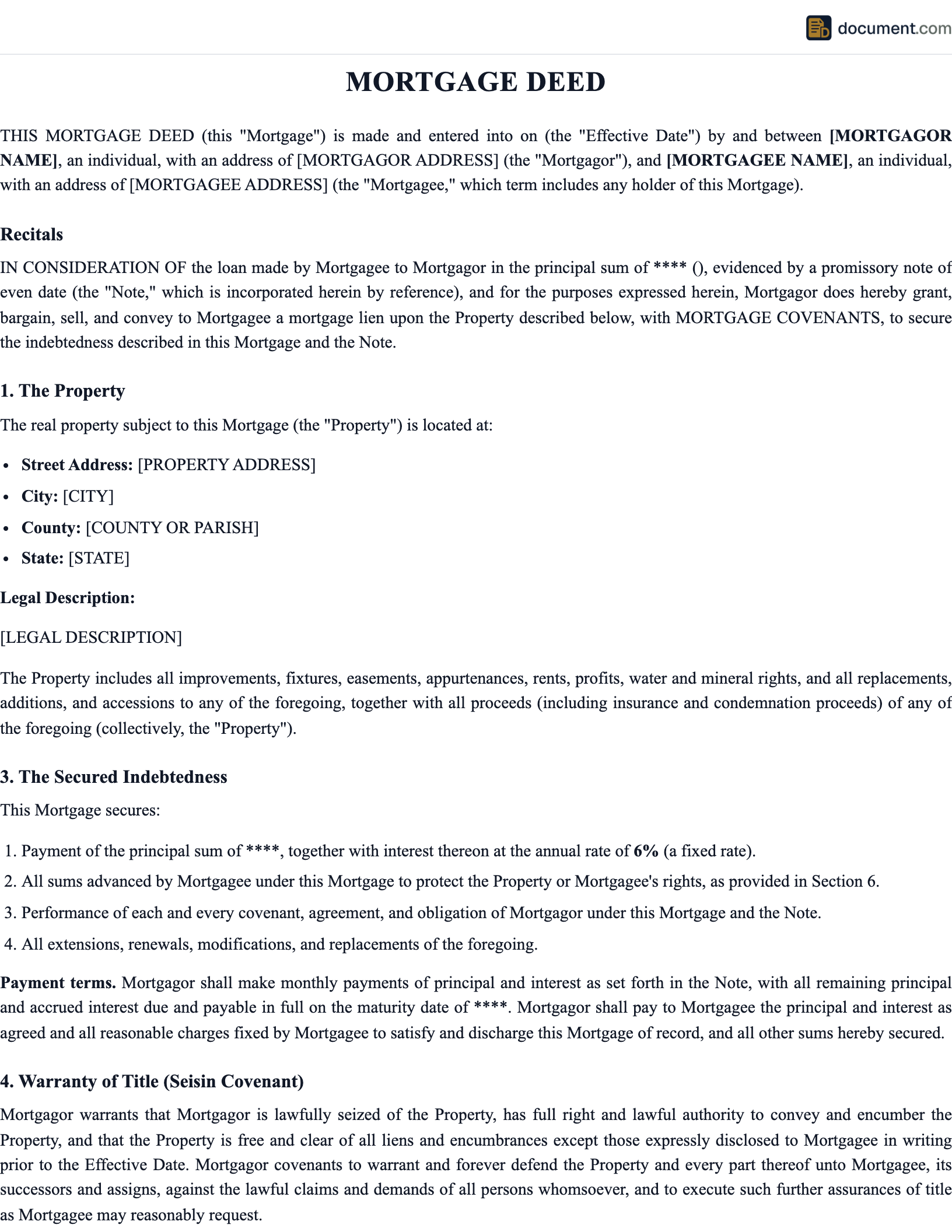
Sample Oklahoma Mortgage Deed
Preview of our Oklahoma-specific template. Your document will include all fields required for recording in any Oklahoma county.
MORTGAGE DEED
STATE OF OKLAHOMA
Legal Document
PARTY INFORMATION
Name: [Full Legal Name]
Address: [Oklahoma Address]
County: [County]
PROPERTY DESCRIPTION
County: [County] State: Oklahoma
Legal Description: [Per Recorded Plat]
Parcel No.: [APN]
Oklahoma Mortgage Deed FAQ
Common questions about filing in Oklahoma, including requirements, fees, and tax implications.
Official Oklahoma Resources
Official state resources for verifying requirements and finding your local recording office.
Important Considerations
Oklahoma's homestead joinder requirement catches borrowers and lenders off guard more often than any other state-specific rule. If the property qualifies as a homestead under Oklahoma law, a mortgage signed by only the title-holding spouse is not enforceable against the homestead interest of the non-titled spouse. This applies even for properties where one spouse never signed the original deed.
Mineral rights are another Oklahoma-specific issue that deserves attention before recording. Oklahoma has a long history of severing mineral estates from surface estates, and many properties have oil, gas, or other mineral interests that belong to someone other than the surface owner. Lenders should obtain a title search that specifically reports on mineral severances and confirm whether the mortgage is intended to include or exclude any mineral interests that remain with the borrower.
For borrowers in default, Oklahoma's judicial foreclosure process provides meaningful procedural protections. The lender must file suit, serve process, and obtain a judgment before any sheriff's sale can occur. This process typically takes several months even without active defense. Borrowers facing difficulty should contact the lender early and explore workout options, since the foreclosure timeline is long enough to allow for meaningful negotiation.
Oklahoma Attorney Note
Oklahoma real estate attorneys generally charge reasonable flat fees for mortgage deed preparation and review. Given the homestead joinder rules and the potential for mineral interest complications, particularly in central and western Oklahoma, having a local attorney confirm your document is properly drafted before recording is money well spent.
Related Documents
Depending on your situation, you may need additional documents alongside this one. Below are commonly related documents that are frequently used together in real estate transactions.
Important Considerations
Oklahoma's homestead joinder requirement catches borrowers and lenders off guard more often than any other state-specific rule. If the property qualifies as a homestead under Oklahoma law, a mortgage signed by only the title-holding spouse is not enforceable against the homestead interest of the non-titled spouse. This applies even for properties where one spouse never signed the original deed.
Mineral rights are another Oklahoma-specific issue that deserves attention before recording. Oklahoma has a long history of severing mineral estates from surface estates, and many properties have oil, gas, or other mineral interests that belong to someone other than the surface owner. Lenders should obtain a title search that specifically reports on mineral severances and confirm whether the mortgage is intended to include or exclude any mineral interests that remain with the borrower.
For borrowers in default, Oklahoma's judicial foreclosure process provides meaningful procedural protections. The lender must file suit, serve process, and obtain a judgment before any sheriff's sale can occur. This process typically takes several months even without active defense. Borrowers facing difficulty should contact the lender early and explore workout options, since the foreclosure timeline is long enough to allow for meaningful negotiation.
Oklahoma Attorney Note
Oklahoma real estate attorneys generally charge reasonable flat fees for mortgage deed preparation and review. Given the homestead joinder rules and the potential for mineral interest complications, particularly in central and western Oklahoma, having a local attorney confirm your document is properly drafted before recording is money well spent.
Related Documents
Depending on your situation, you may need additional documents alongside this one. Below are commonly related documents that are frequently used together in real estate transactions.
Create your Oklahoma Mortgage Deed in under 5 minutes.
Answer a few questions and download a Oklahoma-compliant document, ready for the state agency.