



Ohio Mortgage Deed Overview
Ohio is a judicial foreclosure state where mortgage deeds are recorded with the County Recorder in each of the state's 88 counties. Ohio's foreclosure law has evolved considerably over the past decade and a half. The 2009 reforms responded to the foreclosure crisis, and House Bill 463 enacted in 2017 further streamlined procedures and expanded courts' ability to expedite uncontested foreclosure cases. The state also requires that a certificate of mailing be sent to borrowers before foreclosure filings can proceed, and many Ohio counties have developed active foreclosure mediation programs through their courts.
Ohio's two-thirds appraisal rule is one of the state's most distinctive mortgage enforcement features. At a sheriff's sale following a foreclosure judgment, the property must be appraised by three court-appointed appraisers, and the minimum bid must be at least two-thirds of that appraised value. This floor protects borrowers from deep-discount sales but adds time to the foreclosure process. Ohio imposes no separate mortgage recording tax, but the conveyance fee of $1 per $1,000 applies to property sales. Recording fees start around $28, and the notarization requirements under ORC 5301.01 include a specific requirement that the notary's commission expiration date appear on the acknowledgment certificate.
$28
Recording fee
$1 per $1,000
Transfer tax
Required
Notarization
0
Witnesses required
Ohio Requirements
Ohio's recording requirements are set out in ORC Chapter 5301. The most important Ohio-specific requirement that catches out-of-state preparers is the notary commission expiration date requirement under ORC 5301.01: the acknowledgment certificate must show not just the notary's signature and seal but also the date the notary's commission expires. If that date is missing, the County Recorder will reject the document. Ohio also requires the permanent parcel number (PPN) from the county auditor to be listed on recorded instruments, which helps the recorder index documents correctly for property tax purposes.
Ohio-Specific Notary and Appraisal Requirements
Ohio's ORC 5301.01 requires that the notary's commission expiration date appear on the acknowledgment certificate in addition to the standard notary seal and signature. Missing this date is a common rejection reason at Ohio County Recorder offices. Separately, Ohio's two-thirds appraisal rule at foreclosure sales means the property must be appraised before the sheriff's sale and the minimum bid must equal at least two-thirds of that appraisal. Lenders should budget for appraisal costs and time in their enforcement projections. Also confirm whether your county requires a conveyance fee statement even for non-transfer mortgage recordings.
Document Requirements
- Notarization: Must be notarized by an Ohio notary public or authorized notary
- Witnesses: Ohio requires 0 additional witness(es)
- Legal Description: Complete legal description as it appears on the current deed of record
- Parcel Number: Assessor's parcel number or tax ID
- Return Address: Mailing address for returning the recorded document
- Formatting: Standard formatting with adequate margins, black ink, minimum 10-point font
How to File in Ohio
Recording a mortgage deed in Ohio is handled by the County Recorder in each of the state's 88 counties. Ohio-specific requirements, particularly around the notary acknowledgment, make careful document preparation important before you show up at the recorder's window.
Prepare the Mortgage Deed with Ohio-Specific Requirements
Draft the mortgage deed including the full legal names and addresses of all parties, the complete legal description, the permanent parcel number (PPN) from the county auditor, the loan amount, and the return address. The acknowledgment block must be prepared to include space for the notary's commission expiration date, which is a mandatory Ohio requirement under ORC 5301.01 that differs from most other states.
Execute Before a Notary with Commission Expiration Date
The mortgagor signs before an Ohio notary public who completes the acknowledgment certificate. The certificate must include the notary's signature, seal, and commission expiration date. An Ohio notary who omits the expiration date from the certificate will cause the document to be rejected by the County Recorder. No additional witnesses are required. Out-of-state signatories may use notaries from their state if the acknowledgment form otherwise satisfies Ohio requirements.
Check County-Specific Cover Sheet Requirements
Some Ohio counties require a conveyance fee statement, an auditor's transfer form, or a specific cover sheet to accompany any recorded instrument, even when no conveyance fee is owed. Check with the County Auditor and County Recorder in the specific county before submitting. Franklin County and Cuyahoga County, for instance, have their own standardized submission procedures that differ from smaller rural counties.
Submit to the County Recorder and Pay Fees
File the original notarized mortgage deed with the County Recorder. Recording fees start around $28 for the first page plus per-page charges. Ohio does not impose a mortgage recording tax. Many Ohio counties accept e-recording, which reduces processing time. Walk-in same-day recording is typically available in most counties during business hours.
Confirm Recording and Maintain the Stamped Original
The County Recorder stamps the document with a volume and page number or instrument number that becomes the public record reference for the lien. Retain the recorded copy. When the mortgage is satisfied, the lender must file a release or satisfaction of mortgage with the County Recorder. In Ohio, a lender who fails to release a satisfied mortgage within a reasonable time can face liability to the borrower under ORC 5301.36.
Ohio Fees & Costs
Typical costs for filing in Ohio. Actual fees may vary by county.
| Fee / Tax | Amount |
|---|---|
| Recording Fee | $28 |
| Transfer Tax | $1 per $1,000 |
| Notarization | $5 - $25 per signature |
| Certified Copy | $1 - $10 per page |
| Attorney Review (optional) | $150 - $500 |
Ohio Tax Implications
Ohio's conveyance fee is $1 per $1,000 of the consideration on property transfers, and it is collected by the County Auditor before a deed can be recorded with the County Recorder. This fee applies to sales, not to the recording of a mortgage deed itself. There is no separate mortgage recording tax in Ohio. For a property selling at $400,000, the conveyance fee is $400. Some Ohio counties add a local conveyance fee on top of the state rate, so check with the county auditor to confirm the total amount owed before closing.
Ohio has a state income tax, and mortgage-related events can carry state income tax consequences. If a lender forgives debt through a loan modification, short sale, or foreclosure, the borrower may need to report cancellation of debt income on their Ohio state return in addition to their federal return. Ohio generally conforms to federal rules on the mortgage interest deduction for itemizers, though taxpayers should verify current Ohio tax treatment with a CPA, as Ohio's tax code has been modified multiple times in recent legislative sessions.
Property taxes in Ohio are administered by the county auditor and are notoriously complex in some urban counties. Ohio reappraises property on a six-year cycle with an update in the third year. Recording a mortgage deed does not trigger reassessment, but a sale can cause the County Auditor to review the transfer price for tax purposes. Ohio's Current Agricultural Use Value (CAUV) program provides reduced assessed values for agricultural land, which is relevant to lenders taking farm property as mortgage collateral, since the tax valuation may differ substantially from the market value.
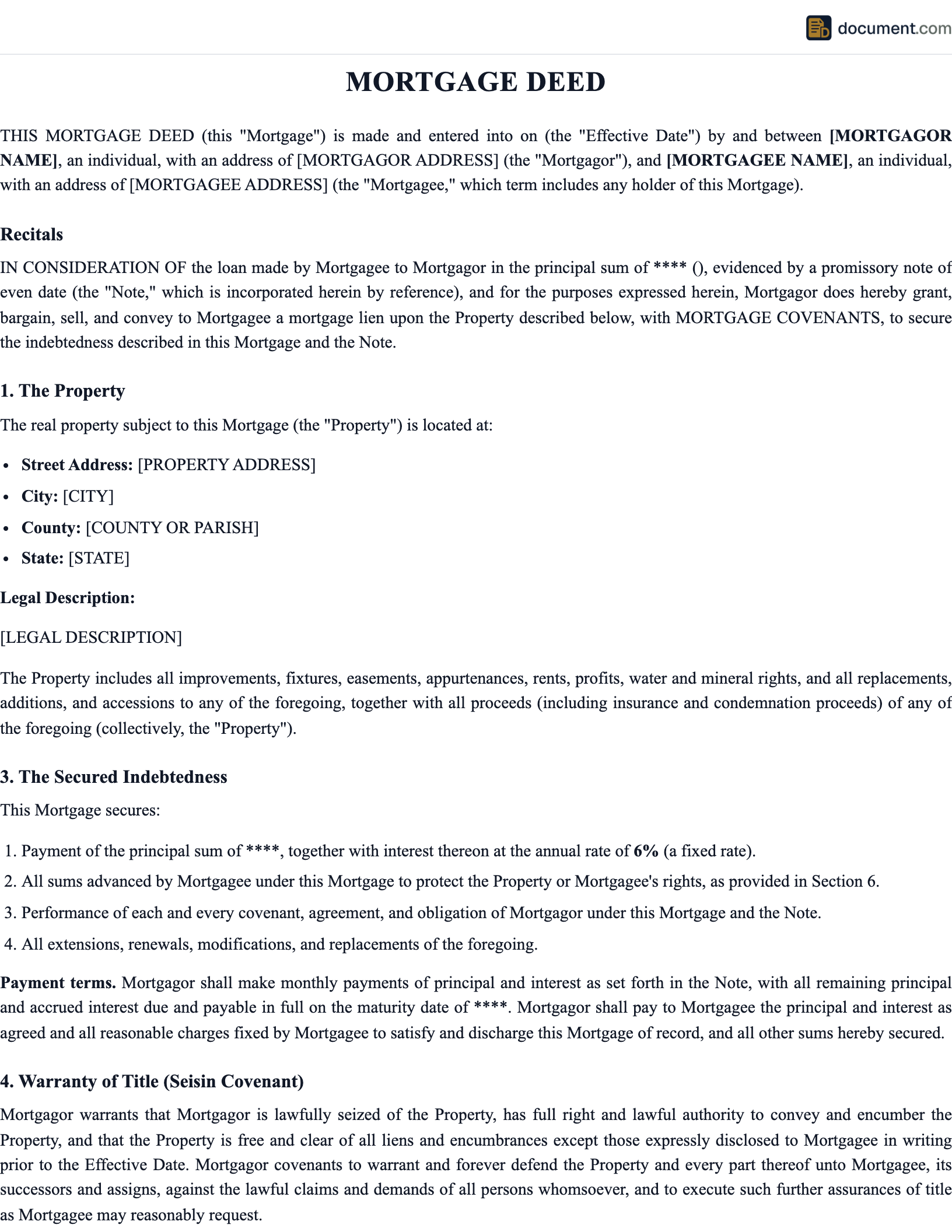
Sample Ohio Mortgage Deed
Preview of our Ohio-specific template. Your document will include all fields required for recording in any Ohio county.
MORTGAGE DEED
STATE OF OHIO
Legal Document
PARTY INFORMATION
Name: [Full Legal Name]
Address: [Ohio Address]
County: [County]
PROPERTY DESCRIPTION
County: [County] State: Ohio
Legal Description: [Per Recorded Plat]
Parcel No.: [APN]
Ohio Mortgage Deed FAQ
Common questions about filing in Ohio, including requirements, fees, and tax implications.
Official Ohio Resources
Official state resources for verifying requirements and finding your local recording office.
Important Considerations
The notary commission expiration date requirement in Ohio is worth flagging prominently because it is a genuine trap for practitioners who are used to other states. Ohio Revised Code 5301.01 specifically requires that the acknowledgment certificate show the date on which the notary's commission expires. County Recorders across Ohio strictly enforce this requirement. Documents prepared on a generic out-of-state template often lack this field, and discovering the problem after the notary has already signed requires re-execution by all parties.
Ohio's foreclosure mediation programs are a meaningful practical resource for borrowers in default. Counties like Cuyahoga, Franklin, Hamilton, and Summit have established programs that require lenders and borrowers to participate in mediation conferences before the foreclosure case proceeds to judgment. These programs have produced a significant number of loan modifications and alternative resolutions. Borrowers who receive a foreclosure complaint in Ohio should immediately check whether the county where the property is located has an active mediation program and request participation if available.
Ohio's two-thirds appraisal rule provides important collateral protection at foreclosure sales but also adds time and procedural steps that lenders must plan for. The court must appoint appraisers, the appraisal must be completed, and the sale must be publicly noticed before the sheriff's auction can proceed. If the property receives no qualifying bid at two-thirds of appraisal, the court may order a second sale. This entire process extends the enforcement timeline beyond what lenders in non-judicial states might expect.
Ohio County-Level Variation
Ohio's 88 counties have meaningful variation in how they handle mortgage deed recordings. Urban counties like Cuyahoga and Franklin have streamlined digital systems with e-recording options. Smaller rural counties may have limited hours, manual processes, and specific local forms. Before submitting a mortgage deed for recording in any Ohio county, call the County Recorder's office to confirm current fees, required forms, and whether the county requires the County Auditor's stamp before the recorder will accept the document. Getting this wrong means a trip back to fix it.
Related Documents
Depending on your situation, you may need additional documents alongside this one. Below are commonly related documents that are frequently used together in real estate transactions.
Important Considerations
The notary commission expiration date requirement in Ohio is worth flagging prominently because it is a genuine trap for practitioners who are used to other states. Ohio Revised Code 5301.01 specifically requires that the acknowledgment certificate show the date on which the notary's commission expires. County Recorders across Ohio strictly enforce this requirement. Documents prepared on a generic out-of-state template often lack this field, and discovering the problem after the notary has already signed requires re-execution by all parties.
Ohio's foreclosure mediation programs are a meaningful practical resource for borrowers in default. Counties like Cuyahoga, Franklin, Hamilton, and Summit have established programs that require lenders and borrowers to participate in mediation conferences before the foreclosure case proceeds to judgment. These programs have produced a significant number of loan modifications and alternative resolutions. Borrowers who receive a foreclosure complaint in Ohio should immediately check whether the county where the property is located has an active mediation program and request participation if available.
Ohio's two-thirds appraisal rule provides important collateral protection at foreclosure sales but also adds time and procedural steps that lenders must plan for. The court must appoint appraisers, the appraisal must be completed, and the sale must be publicly noticed before the sheriff's auction can proceed. If the property receives no qualifying bid at two-thirds of appraisal, the court may order a second sale. This entire process extends the enforcement timeline beyond what lenders in non-judicial states might expect.
Ohio County-Level Variation
Ohio's 88 counties have meaningful variation in how they handle mortgage deed recordings. Urban counties like Cuyahoga and Franklin have streamlined digital systems with e-recording options. Smaller rural counties may have limited hours, manual processes, and specific local forms. Before submitting a mortgage deed for recording in any Ohio county, call the County Recorder's office to confirm current fees, required forms, and whether the county requires the County Auditor's stamp before the recorder will accept the document. Getting this wrong means a trip back to fix it.
Related Documents
Depending on your situation, you may need additional documents alongside this one. Below are commonly related documents that are frequently used together in real estate transactions.
Create your Ohio Mortgage Deed in under 5 minutes.
Answer a few questions and download a Ohio-compliant document, ready for the state agency.