



North Carolina Mortgage Deed Overview
North Carolina is predominantly a deed of trust state, and that is important context for anyone working with a mortgage deed here. Most NC residential and commercial lending uses deeds of trust because they allow foreclosure through the Clerk of Superior Court's power-of-sale procedure, which is faster and less expensive than a full court lawsuit. A mortgage deed is still valid and used in certain transactions, but it means judicial foreclosure if things go wrong, which is a meaningful difference from a lender's perspective. Documents are recorded with the Register of Deeds in the county where the property sits.
North Carolina imposes no separate mortgage recording tax, which keeps closing costs lower than in New York or Tennessee. The real estate excise tax of $1 per $500 of consideration applies to property sales, not directly to mortgage recordings. Recording fees start around $26. North Carolina is one of the few states where attorney involvement at closing is legally required for residential transactions, and that attorney must be licensed in North Carolina, which shapes how closings are staffed and priced throughout the state.
$26
Recording fee
$1 per $500
Transfer tax
Required
Notarization
0
Witnesses required
North Carolina Requirements
North Carolina's recording framework is governed by Chapter 47 of the General Statutes. Instruments affecting real property must be acknowledged before a notary public using the certificate forms prescribed by the NC Notary Public Act (G.S. Chapter 10B). The Register of Deeds maintains a grantor-grantee index, so full legal names of all parties must be spelled correctly and completely. Many North Carolina counties have moved to digital indexing and accept e-recording, which can speed up turnaround significantly in larger counties.
North Carolina: Deed of Trust vs. Mortgage Deed
North Carolina is a deed of trust state for most lending purposes. If you use a mortgage deed instead of a deed of trust, foreclosure requires a judicial proceeding in Superior Court rather than the faster non-judicial power-of-sale process available under a deed of trust. Make sure the instrument type matches your intended enforcement mechanism. Additionally, North Carolina requires a licensed NC attorney to supervise real property closings by law, so budget for attorney fees regardless of which instrument you use.
Document Requirements
- Notarization: Must be notarized by a North Carolina notary public or authorized notary
- Witnesses: North Carolina requires 0 additional witness(es)
- Legal Description: Complete legal description as it appears on the current deed of record
- Parcel Number: Assessor's parcel number or tax ID
- Return Address: Mailing address for returning the recorded document
- Formatting: Standard formatting with adequate margins, black ink, minimum 10-point font
How to File in North Carolina
North Carolina closings are supervised by a licensed NC attorney, which means the attorney typically coordinates document preparation, notarization, and submission to the Register of Deeds. The steps below reflect the process from the borrower's perspective.
Engage a North Carolina Closing Attorney
NC law requires a licensed North Carolina attorney to supervise real property closings. If you are working with an institutional lender, they will appoint a closing attorney. For seller-financed or private transactions, retain your own NC real estate attorney to prepare and review the mortgage deed before execution.
Prepare the Mortgage Deed with Correct NC Acknowledgment
The mortgage deed must include the full legal names of all parties, the complete legal description matching the chain of title, the parcel identification number, and the acknowledgment block required under G.S. Chapter 10B. North Carolina's notarial certificate language is form-specific, and using a generic acknowledgment block can result in rejection by the Register of Deeds.
Execute Before a Notary
All parties who must sign the mortgage deed should do so in the presence of a commissioned North Carolina notary public. Bring government-issued photo identification. The notary completes the acknowledgment certificate and affixes their notarial seal. No additional witnesses are required beyond the notary in North Carolina.
Submit to the Register of Deeds
File the original notarized mortgage deed with the Register of Deeds in the county where the property is located. Recording fees start at approximately $26 for the first page. There is no mortgage recording tax in North Carolina. Many counties accept same-day walk-in recording, and e-recording is available through approved vendors in a growing number of counties.
Confirm Recording and Retain the Stamped Copy
The Register of Deeds stamps the document with a book-and-page reference or instrument number and returns it. This recorded copy is the authoritative evidence that the lien has been properly perfected. The lender holds the recorded original during the loan term. When the debt is satisfied, the lender must file a satisfaction of mortgage with the Register of Deeds to release the lien.
North Carolina Fees & Costs
Typical costs for filing in North Carolina. Actual fees may vary by county.
| Fee / Tax | Amount |
|---|---|
| Recording Fee | $26 |
| Transfer Tax | $1 per $500 |
| Notarization | $5 - $25 per signature |
| Certified Copy | $1 - $10 per page |
| Attorney Review (optional) | $150 - $500 |
North Carolina Tax Implications
North Carolina's real estate excise tax is imposed on the grantor (seller) in a property sale at the rate of $1 per $500 of the consideration amount, calculated and paid at closing. For a mortgage deed in a purchase transaction, this tax is computed on the sale price, not the loan amount. There is no separate mortgage recording tax in North Carolina, which keeps the recording-related closing costs modest compared to states like New York.
North Carolina has a flat state income tax rate, and mortgage interest is deductible for state income tax purposes for taxpayers who itemize deductions. Borrowers who receive loan forgiveness through a short sale or deed in lieu of foreclosure may need to report cancellation of debt income at both the state and federal level, though exclusions may apply depending on the borrower's circumstances and the type of debt forgiven.
Property taxes in North Carolina are administered at the county level and are due annually. Counties conduct reappraisals on cycles set by the state, typically every four to eight years. Recording a mortgage deed does not trigger a reappraisal, and North Carolina does not reassess property on transfer the way some other states do. Owners may be eligible for homestead exemptions that reduce assessed values for qualifying primary residences, elderly owners, or disabled veterans.
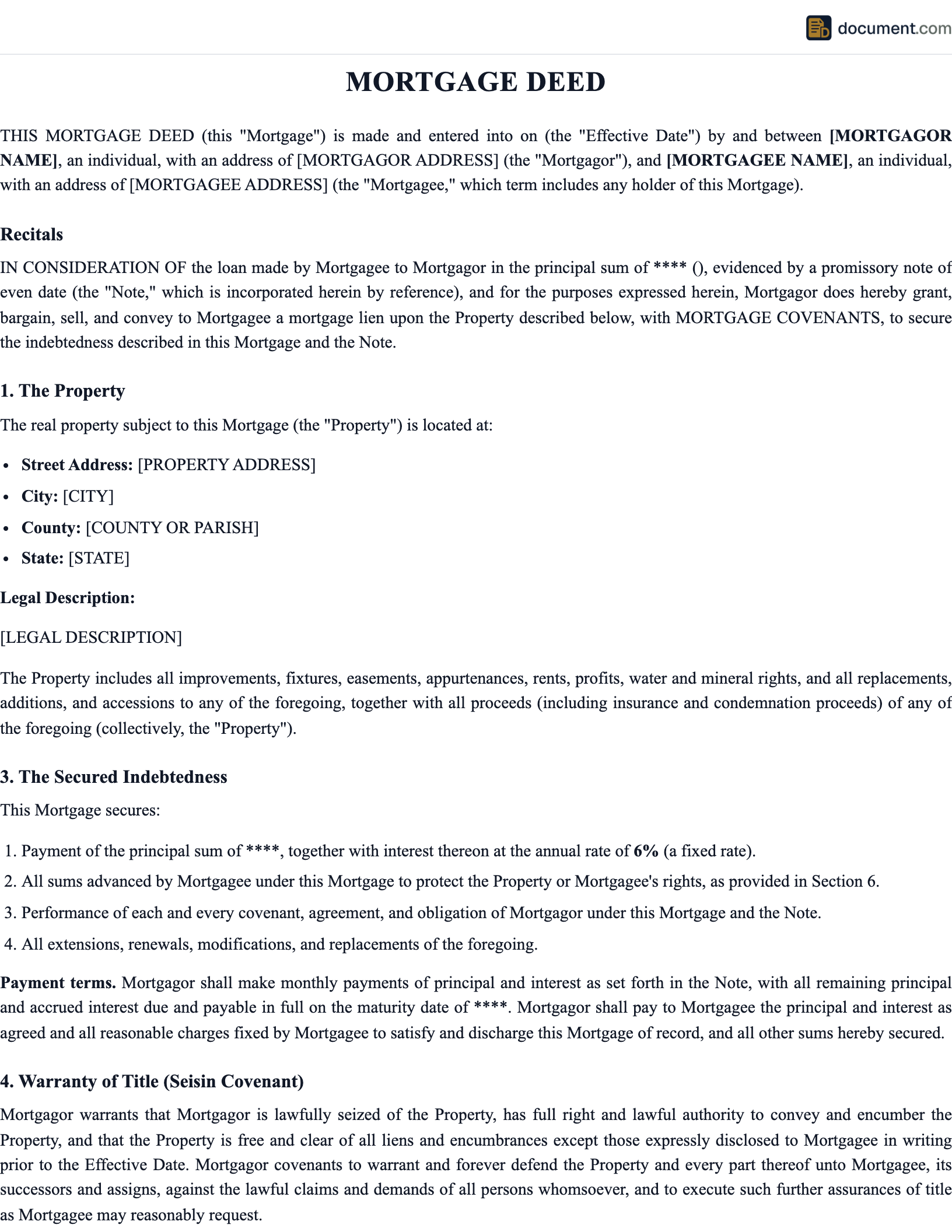
Sample North Carolina Mortgage Deed
Preview of our North Carolina-specific template. Your document will include all fields required for recording in any North Carolina county.
MORTGAGE DEED
STATE OF NORTH CAROLINA
Legal Document
PARTY INFORMATION
Name: [Full Legal Name]
Address: [North Carolina Address]
County: [County]
PROPERTY DESCRIPTION
County: [County] State: North Carolina
Legal Description: [Per Recorded Plat]
Parcel No.: [APN]
North Carolina Mortgage Deed FAQ
Common questions about filing in North Carolina, including requirements, fees, and tax implications.
Official North Carolina Resources
Official state resources for verifying requirements and finding your local recording office.
Important Considerations
The most consequential choice in North Carolina secured lending is whether to use a mortgage deed or a deed of trust. If you use a mortgage deed and the borrower defaults, you will need to file a lawsuit in Superior Court to foreclose. If you use a deed of trust, you have access to a faster power-of-sale process through the Clerk of Superior Court that can typically be completed in 60 to 90 days. For most institutional lenders and sophisticated private lenders, the deed of trust is the preferred instrument precisely because of this enforcement advantage.
North Carolina's attorney closing requirement is not negotiable. Any party who shows up to a North Carolina residential real estate closing expecting to handle it themselves, or through a title company without attorney involvement, will run into problems. The attorney must be licensed in North Carolina, must review and certify title, and must supervise execution of the closing documents. Out-of-state lenders and buyers routinely hire local NC closing attorneys for this purpose.
Deficiency judgments are available in North Carolina after foreclosure, but the procedure and timing differ depending on whether the foreclosure was judicial (for mortgage deeds) or power-of-sale (for deeds of trust). For a mortgage deed foreclosure, the lender may pursue a deficiency as part of the Superior Court action. Borrowers facing default on a North Carolina mortgage deed should get legal advice quickly, as the foreclosure timeline and deficiency rules can significantly affect their options and exposure.
Use a Licensed North Carolina Attorney
North Carolina's mandatory attorney closing requirement means that attorney involvement is built into the closing cost structure for every real property transaction in the state. This is not just a recommendation; it is a legal obligation for residential closings. Your closing attorney will handle document preparation, title certification, recording submission, and disbursement of funds. For private or seller-financed mortgage transactions that fall outside the standard institutional process, retain a NC real estate attorney separately to prepare and review the mortgage deed.
Related Documents
Depending on your situation, you may need additional documents alongside this one. Below are commonly related documents that are frequently used together in real estate transactions.
Important Considerations
The most consequential choice in North Carolina secured lending is whether to use a mortgage deed or a deed of trust. If you use a mortgage deed and the borrower defaults, you will need to file a lawsuit in Superior Court to foreclose. If you use a deed of trust, you have access to a faster power-of-sale process through the Clerk of Superior Court that can typically be completed in 60 to 90 days. For most institutional lenders and sophisticated private lenders, the deed of trust is the preferred instrument precisely because of this enforcement advantage.
North Carolina's attorney closing requirement is not negotiable. Any party who shows up to a North Carolina residential real estate closing expecting to handle it themselves, or through a title company without attorney involvement, will run into problems. The attorney must be licensed in North Carolina, must review and certify title, and must supervise execution of the closing documents. Out-of-state lenders and buyers routinely hire local NC closing attorneys for this purpose.
Deficiency judgments are available in North Carolina after foreclosure, but the procedure and timing differ depending on whether the foreclosure was judicial (for mortgage deeds) or power-of-sale (for deeds of trust). For a mortgage deed foreclosure, the lender may pursue a deficiency as part of the Superior Court action. Borrowers facing default on a North Carolina mortgage deed should get legal advice quickly, as the foreclosure timeline and deficiency rules can significantly affect their options and exposure.
Use a Licensed North Carolina Attorney
North Carolina's mandatory attorney closing requirement means that attorney involvement is built into the closing cost structure for every real property transaction in the state. This is not just a recommendation; it is a legal obligation for residential closings. Your closing attorney will handle document preparation, title certification, recording submission, and disbursement of funds. For private or seller-financed mortgage transactions that fall outside the standard institutional process, retain a NC real estate attorney separately to prepare and review the mortgage deed.
Related Documents
Depending on your situation, you may need additional documents alongside this one. Below are commonly related documents that are frequently used together in real estate transactions.
Create your North Carolina Mortgage Deed in under 5 minutes.
Answer a few questions and download a North Carolina-compliant document, ready for the state agency.