
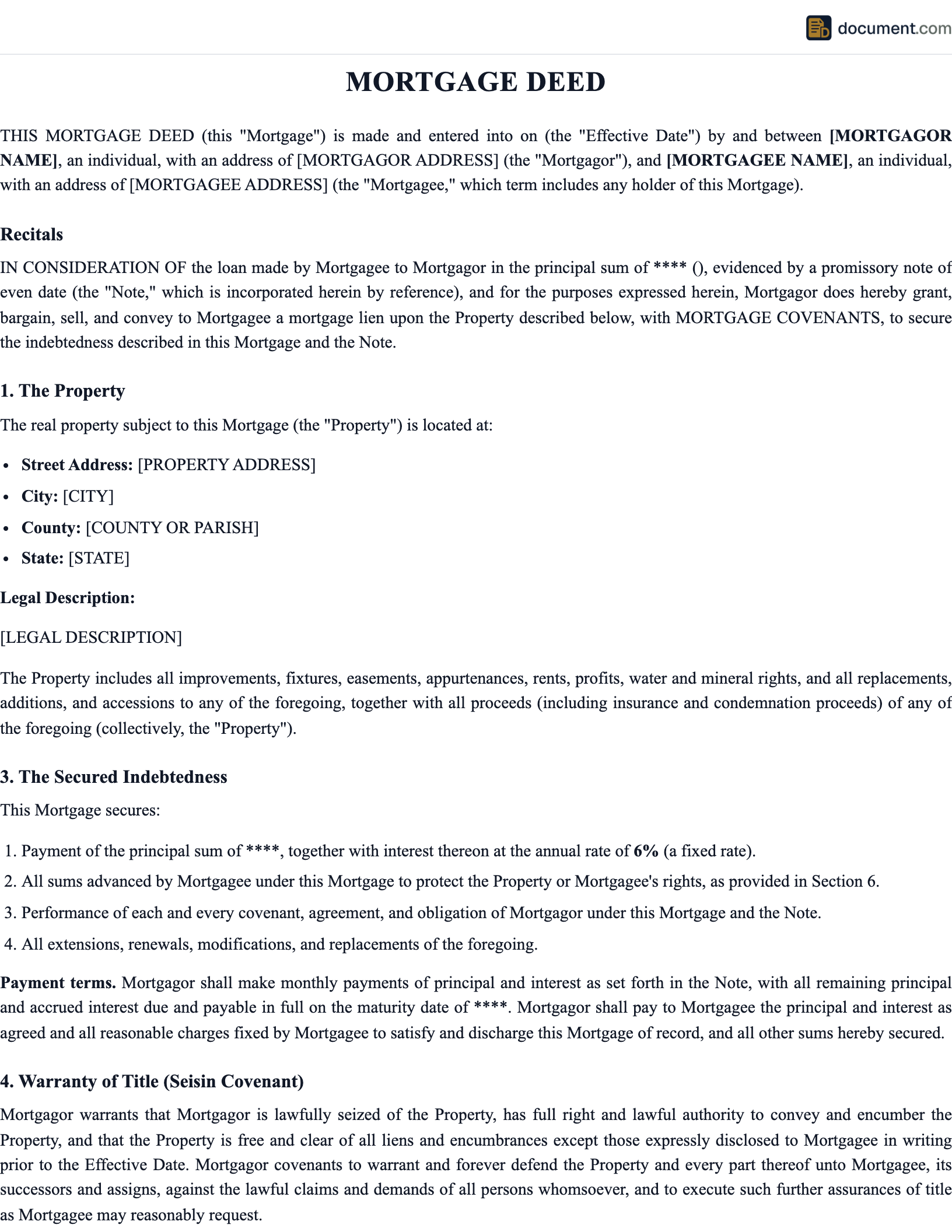



New York Mortgage Deed Overview
New York is a mortgage state operating under a judicial foreclosure system governed by CPLR Article 13. When a borrower signs a mortgage deed, the lender receives a lien on the real property, but the borrower retains title. If the borrower defaults, the lender must sue in Supreme Court and obtain a judgment of foreclosure and sale before the property can be auctioned. The process is notoriously lengthy, often running 18 months or more in downstate courts. Lenders are also required to send a 90-day pre-foreclosure notice under RPAPL 1304 before any legal action can commence.
What truly distinguishes New York from most other states is the mortgage recording tax. On top of standard recording fees, New York imposes a state MRT of 0.50% of the loan amount, with counties adding their own surcharges. In New York City, the combined rate reaches 1.925% on loans of $500,000 or more, making the recording tax a substantial closing cost line item. Attorney representation at closings is universal practice in New York, and the state's acknowledgment requirements under Real Property Law must be followed precisely or the county clerk will reject the filing.
$40
Recording fee
$2 per $500
Transfer tax
Required
Notarization
0
Witnesses required
New York Requirements
New York's recording requirements are governed by the Real Property Law and vary meaningfully between New York City and the rest of the state. NYC counties require the Tax Map Designation (the tax lot's section-block-lot number) on all recorded instruments. Upstate counties use different indexing systems. Acknowledgments must comply strictly with RPL Sections 309-a and 309-b, and any defect in the acknowledgment block is grounds for rejection. Most professional closings in New York involve a title company that handles submission and interacts directly with the recording office.
New York Mortgage Recording Tax Alert
New York imposes a mortgage recording tax on top of standard recording fees. The state base rate is 0.50% of the mortgage amount, with county surcharges layered on. In New York City, the combined rate reaches 1.80% for mortgages under $500,000 and 1.925% for $500,000 or more on residential properties. This tax is split between lender and borrower, but the borrower's share is typically the larger portion. Budget for this cost well before closing or it will catch you off guard.
Document Requirements
- Notarization: Must be notarized by a New York notary public or authorized notary
- Witnesses: New York requires 0 additional witness(es)
- Legal Description: Complete legal description as it appears on the current deed of record
- Parcel Number: Assessor's parcel number or tax ID
- Return Address: Mailing address for returning the recorded document
- Formatting: Standard formatting with adequate margins, black ink, minimum 10-point font
How to File in New York
New York mortgage closings are almost always handled by attorneys, with a title company coordinating the recording. The steps below describe the process in practical terms, though the actual mechanics vary between NYC and upstate counties.
Prepare the Mortgage Deed
Draft the mortgage deed with the full legal names of the mortgagor and mortgagee, the complete legal property description, the tax map designation (section-block-lot in NYC, or the applicable county format upstate), and the principal loan amount. The loan amount must be stated accurately because it is used to calculate the mortgage recording tax.
Execute the Acknowledgment Correctly
New York requires a formal acknowledgment under RPL 309-a (for individuals) or 309-b (for entities), not just a standard notarization. The notary must use the correct certificate language for New York. An error in the acknowledgment block is one of the most common reasons the county clerk returns documents unrecorded.
Calculate and Prepare the Mortgage Recording Tax Payment
Determine the total mortgage recording tax owed based on the loan amount and the county where the property is located. NYC closings require submission through the NYC Register's ACRIS system. Upstate counties have their own submission processes. Your title company or attorney will typically prepare the required tax forms and payment.
Submit to the County Clerk
In New York City, the NYC Register's office processes real property recordings through ACRIS. In the other 57 counties, documents go to the county clerk. Submit the original executed mortgage deed along with the mortgage recording tax payment and any required cover sheets or transmittal forms specific to that county.
Receive the Recorded Document
The recording office will stamp the document with a liber and page number or instrument number and return it, typically within several days to weeks depending on the county's volume. Retain the stamped original. The lender holds it through the loan term and must file a satisfaction of mortgage when the debt is discharged.
New York Fees & Costs
Typical costs for filing in New York. Actual fees may vary by county.
| Fee / Tax | Amount |
|---|---|
| Recording Fee | $40 |
| Transfer Tax | $2 per $500 |
| Notarization | $5 - $25 per signature |
| Certified Copy | $1 - $10 per page |
| Attorney Review (optional) | $150 - $500 |
New York Tax Implications
The mortgage recording tax is the most immediate and significant tax associated with recording a mortgage deed in New York. The state imposes a basic MRT of 0.50% of the loan amount, and New York City piles on additional county and special taxes that bring the combined rate to 1.80% or 1.925% depending on the loan size and property type. Upstate counties typically impose an additional 0.25% to 0.50%. The borrower pays the majority of this tax at closing, and it is calculated on the original loan principal, not the purchase price. Refinances are also subject to the MRT, though a credit may be available if the original mortgage is being replaced.
New York also imposes a real estate transfer tax of $2 per $500 of consideration on the transfer of real property. This is the seller's tax on the sale transaction itself, not on the mortgage, but it comes into play at the same closing. High-value residential transfers in NYC (above $1 million for one- to three-family homes) trigger an additional "mansion tax" paid by the buyer, ranging from 1% to 3.9% depending on the purchase price. Commercial transactions follow a different rate schedule.
Mortgage interest deductibility for New York residents follows federal conformity rules in broad strokes, but New York state income tax has its own adjustments. New York does not conform to the federal $750,000 mortgage interest deduction cap in the same way as all states, and high-income borrowers should verify their state deduction with a CPA familiar with New York tax law. Property taxes in New York are notoriously high in many suburban counties, and STAR exemptions are available for owner-occupied primary residences that can reduce the assessed value for school tax purposes.
Sample New York Mortgage Deed
Preview of our New York-specific template. Your document will include all fields required for recording in any New York county.
MORTGAGE DEED
STATE OF NEW YORK
Legal Document
PARTY INFORMATION
Name: [Full Legal Name]
Address: [New York Address]
County: [County]
PROPERTY DESCRIPTION
County: [County] State: New York
Legal Description: [Per Recorded Plat]
Parcel No.: [APN]
New York Mortgage Deed FAQ
Common questions about filing in New York, including requirements, fees, and tax implications.
Official New York Resources
Official state resources for verifying requirements and finding your local recording office.
Important Considerations
The single most important thing to understand about New York mortgage practice is that co-op financing is fundamentally different from real property mortgage financing. If the property you are financing is a co-operative apartment, you are not getting a mortgage deed on real estate. You are getting a UCC-1 security interest in the shares of the cooperative corporation and the appurtenant proprietary lease. That document is filed with the New York Department of State, not the county clerk, and the rules governing that lien are entirely different.
The mortgage recording tax in New York is non-trivial and cannot be negotiated around. On a $800,000 mortgage in Manhattan, the combined MRT approaches $15,000 to $16,000. Buyers who are surprised by this at the closing table often find themselves scrambling. The tax applies to refinances as well as purchase mortgages, though a refinancing credit may be available if the existing mortgage is being replaced with the same lender.
New York's judicial foreclosure timeline is a reality that both lenders and borrowers need to plan around. For lenders, pricing in the cost of a potentially multi-year foreclosure process affects how they underwrite New York loans. For borrowers in distress, the lengthy process provides meaningful time to explore loss mitigation options. Many New York Supreme Court counties have mortgage foreclosure settlement conference programs that require lenders to engage in good-faith settlement discussions before proceeding to judgment.
Attorney Involvement is Standard Practice in New York
Unlike many states where title companies handle closings without attorneys, New York has a deeply established attorney closing culture. Both buyer and seller typically retain separate counsel, and lenders' counsel prepares the loan documents. For any New York mortgage transaction involving meaningful amounts, working without an attorney creates real risk, particularly around acknowledgment compliance, MRT calculation, and the specific requirements of the recording office where the property is located.
Related Documents
Depending on your situation, you may need additional documents alongside this one. Below are commonly related documents that are frequently used together in real estate transactions.
Important Considerations
The single most important thing to understand about New York mortgage practice is that co-op financing is fundamentally different from real property mortgage financing. If the property you are financing is a co-operative apartment, you are not getting a mortgage deed on real estate. You are getting a UCC-1 security interest in the shares of the cooperative corporation and the appurtenant proprietary lease. That document is filed with the New York Department of State, not the county clerk, and the rules governing that lien are entirely different.
The mortgage recording tax in New York is non-trivial and cannot be negotiated around. On a $800,000 mortgage in Manhattan, the combined MRT approaches $15,000 to $16,000. Buyers who are surprised by this at the closing table often find themselves scrambling. The tax applies to refinances as well as purchase mortgages, though a refinancing credit may be available if the existing mortgage is being replaced with the same lender.
New York's judicial foreclosure timeline is a reality that both lenders and borrowers need to plan around. For lenders, pricing in the cost of a potentially multi-year foreclosure process affects how they underwrite New York loans. For borrowers in distress, the lengthy process provides meaningful time to explore loss mitigation options. Many New York Supreme Court counties have mortgage foreclosure settlement conference programs that require lenders to engage in good-faith settlement discussions before proceeding to judgment.
Attorney Involvement is Standard Practice in New York
Unlike many states where title companies handle closings without attorneys, New York has a deeply established attorney closing culture. Both buyer and seller typically retain separate counsel, and lenders' counsel prepares the loan documents. For any New York mortgage transaction involving meaningful amounts, working without an attorney creates real risk, particularly around acknowledgment compliance, MRT calculation, and the specific requirements of the recording office where the property is located.
Related Documents
Depending on your situation, you may need additional documents alongside this one. Below are commonly related documents that are frequently used together in real estate transactions.
Create your New York Mortgage Deed in under 5 minutes.
Answer a few questions and download a New York-compliant document, ready for the state agency.