
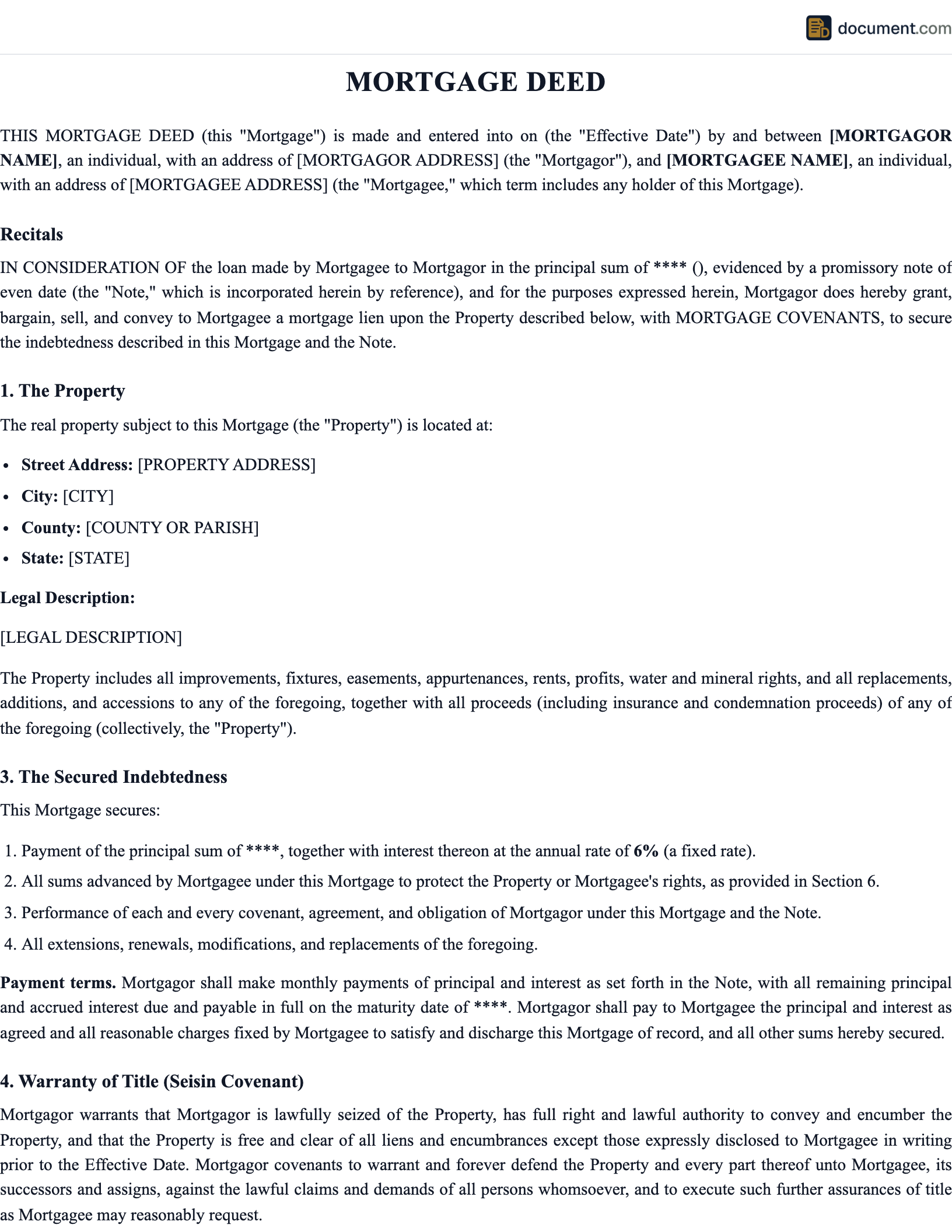



New Mexico Mortgage Deed Overview
New Mexico is a mortgage state, meaning lenders here use a mortgage deed rather than a deed of trust to secure real property loans. When you sign a mortgage deed, you remain the legal owner of the property but grant the lender a lien against it. If you default, the lender must go through the district court system to foreclose, a process that typically takes four to nine months in New Mexico. Documents are recorded with the county clerk in the county where the property is located, not with a statewide office.
New Mexico imposes no mortgage recording tax and no state real property transfer tax, which is a meaningful cost advantage compared to states like New York. Recording fees are modest, generally starting around $25. Because New Mexico is a community property state, both spouses must typically sign when mortgaging community real property. Buyers and lenders dealing with Permian Basin or San Juan Basin properties should also pay close attention to how mineral interests are treated in the mortgage documents, since severed mineral estates are common throughout the state.
$25
Recording fee
None
Transfer tax
Required
Notarization
0
Witnesses required
New Mexico Requirements
New Mexico recording requirements are governed by NMSA 1978, Chapter 14, Article 8. All instruments affecting title must be notarized and submitted to the county clerk in the county where the land is situated. Because New Mexico operates a grantor-grantee index system, the full legal names of all parties must appear exactly as they will be indexed, and the legal description must match the description in the vesting deed precisely. Recording gives constructive notice to all subsequent purchasers and encumbrancers.
New Mexico Specific Note
New Mexico has no mortgage recording tax and no real property transfer tax, but recording fees vary by page count. Because New Mexico is a community property state, both spouses must typically sign a mortgage encumbering community real property. Properties in southeastern or northwestern New Mexico may have severed mineral estates that require separate treatment in the mortgage document. Confirm fee amounts with your county clerk before filing.
Document Requirements
- Notarization: Must be notarized by a New Mexico notary public or authorized notary
- Witnesses: New Mexico requires 0 additional witness(es)
- Legal Description: Complete legal description as it appears on the current deed of record
- Parcel Number: Assessor's parcel number or tax ID
- Return Address: Mailing address for returning the recorded document
- Formatting: Standard formatting with adequate margins, black ink, minimum 10-point font
How to File in New Mexico
Recording a mortgage deed in New Mexico is handled county by county. The steps below reflect standard practice across the state, but call your specific county clerk in advance since a few rural counties have limited hours or specific submission requirements.
Prepare the Mortgage Deed
Complete all fields using the borrower and lender's full legal names, the property's complete legal description as shown on the existing deed of record, and the assessor's parcel number. If married and the property is community property, both spouses must be identified as mortgagors.
Have All Parties Sign Before a Notary
The mortgagor must sign in the presence of a commissioned New Mexico notary public. Bring valid government-issued photo ID. No additional witnesses are required. If signing out of state, ensure the notary's authority will be recognized in New Mexico.
Submit to the County Clerk
Take the original notarized mortgage deed to the county clerk's office in the county where the property is located. Some New Mexico counties accept e-recording submissions through Simplifile or similar platforms. Check with your county before driving in.
Pay the Recording Fee
New Mexico charges a base recording fee around $25 for the first page plus a per-page charge for additional pages. There is no mortgage recording tax or real property transfer tax in New Mexico. Pay by check, cash, or credit card depending on the county.
Retrieve the Recorded Document
The county clerk will stamp the document with the recording information and return it by mail or in person, depending on the office. Retain the recorded copy with the instrument number. The lender typically holds the original during the loan term and must release the lien once the debt is paid.
New Mexico Fees & Costs
Typical costs for filing in New Mexico. Actual fees may vary by county.
| Fee / Tax | Amount |
|---|---|
| Recording Fee | $25 |
| Transfer Tax | None |
| Notarization | $5 - $25 per signature |
| Certified Copy | $1 - $10 per page |
| Attorney Review (optional) | $150 - $500 |
New Mexico Tax Implications
New Mexico does not impose a mortgage recording tax or a state-level real estate transfer tax, which makes it one of the less expensive states from a recording cost perspective. The only fees involved are the county clerk's modest per-page recording charges. This is a genuine advantage for borrowers and private lenders who might otherwise face substantial recording taxes in states like New York or Tennessee.
New Mexico does have a state income tax, and certain mortgage-related transactions can trigger income tax consequences. If a lender forgives part of a loan balance through a short sale or modification, the borrower may need to report that cancellation of debt income to the New Mexico Taxation and Revenue Department, in addition to any federal reporting obligations. The federal mortgage interest deduction is only available to those who itemize, and New Mexico's conformity with federal tax treatment should be confirmed with a CPA for the current tax year.
Property taxes in New Mexico are administered at the county level through the county assessor. Recording a mortgage deed does not itself trigger reassessment, since New Mexico does not use a transfer-based reassessment system like California. However, if a foreclosure results in a change of ownership, the new owner's property will be valued at current market rates during the next valuation cycle. New Mexico offers a veterans property tax exemption and a head-of-household exemption that can reduce the property tax burden for qualifying owners.
Sample New Mexico Mortgage Deed
Preview of our New Mexico-specific template. Your document will include all fields required for recording in any New Mexico county.
MORTGAGE DEED
STATE OF NEW MEXICO
Legal Document
PARTY INFORMATION
Name: [Full Legal Name]
Address: [New Mexico Address]
County: [County]
PROPERTY DESCRIPTION
County: [County] State: New Mexico
Legal Description: [Per Recorded Plat]
Parcel No.: [APN]
New Mexico Mortgage Deed FAQ
Common questions about filing in New Mexico, including requirements, fees, and tax implications.
Official New Mexico Resources
Official state resources for verifying requirements and finding your local recording office.
Important Considerations
New Mexico's community property rules are one of the most important practical considerations for anyone mortgaging real estate in the state. If a property is community property, a mortgage signed by only one spouse may not be fully enforceable. Both spouses should appear on the mortgage deed, even when the purchase or loan is in only one name, unless the property is clearly separate property with documentation to support that classification.
Mineral rights deserve careful attention in New Mexico, particularly in counties with active oil and gas production. A surface owner may not control the subsurface mineral estate if those rights were severed in a prior transaction. When a lender takes a mortgage on New Mexico property, they should determine whether they are getting a lien on both surface and mineral rights or only the surface. This matters because mineral royalty income and leasing rights can affect the collateral's value substantially.
Foreclosure in New Mexico moves through the judicial system, and the process typically takes four to nine months depending on court dockets and whether the borrower contests the action. Deficiency judgments are available to lenders in New Mexico after a foreclosure sale, subject to court approval. Borrowers in financial distress should get legal advice early, as New Mexico courts do offer some protections and lenders are sometimes open to loan modifications before initiating foreclosure proceedings.
Attorney Review Recommended
New Mexico real estate transactions involving community property, severed mineral interests, trust ownership, or seller financing benefit significantly from attorney involvement. A New Mexico real estate attorney can review the mortgage deed for enforceability issues, confirm community property treatment, and ensure the lien properly attaches to all intended collateral. Many New Mexico attorneys offer flat-fee document review for straightforward residential mortgages.
Related Documents
Depending on your situation, you may need additional documents alongside this one. Below are commonly related documents that are frequently used together in real estate transactions.
Important Considerations
New Mexico's community property rules are one of the most important practical considerations for anyone mortgaging real estate in the state. If a property is community property, a mortgage signed by only one spouse may not be fully enforceable. Both spouses should appear on the mortgage deed, even when the purchase or loan is in only one name, unless the property is clearly separate property with documentation to support that classification.
Mineral rights deserve careful attention in New Mexico, particularly in counties with active oil and gas production. A surface owner may not control the subsurface mineral estate if those rights were severed in a prior transaction. When a lender takes a mortgage on New Mexico property, they should determine whether they are getting a lien on both surface and mineral rights or only the surface. This matters because mineral royalty income and leasing rights can affect the collateral's value substantially.
Foreclosure in New Mexico moves through the judicial system, and the process typically takes four to nine months depending on court dockets and whether the borrower contests the action. Deficiency judgments are available to lenders in New Mexico after a foreclosure sale, subject to court approval. Borrowers in financial distress should get legal advice early, as New Mexico courts do offer some protections and lenders are sometimes open to loan modifications before initiating foreclosure proceedings.
Attorney Review Recommended
New Mexico real estate transactions involving community property, severed mineral interests, trust ownership, or seller financing benefit significantly from attorney involvement. A New Mexico real estate attorney can review the mortgage deed for enforceability issues, confirm community property treatment, and ensure the lien properly attaches to all intended collateral. Many New Mexico attorneys offer flat-fee document review for straightforward residential mortgages.
Related Documents
Depending on your situation, you may need additional documents alongside this one. Below are commonly related documents that are frequently used together in real estate transactions.
Create your New Mexico Mortgage Deed in under 5 minutes.
Answer a few questions and download a New Mexico-compliant document, ready for the state agency.