



New Jersey Mortgage Deed Overview
New Jersey is one of a small number of states that requires all mortgage foreclosures to go through the Superior Court. There is no power of sale or non-judicial alternative available to lenders in New Jersey. This mandatory judicial process, combined with the requirements of the Fair Foreclosure Act and the state's foreclosure mediation program, means that New Jersey foreclosures take an average of two to three years to complete from the first missed payment. That timeline is not an anomaly; it reflects a state policy that prioritizes borrower notice and court oversight at every stage of the process.
New Jersey mortgage deeds are recorded at the county clerk's office in the county where the property is located. New Jersey imposes a Realty Transfer Fee on deed transfers, but this applies to the transfer of ownership by deed rather than the recording of a mortgage instrument. Recording fees at the county clerk vary and are charged per page. All mortgage deeds must be acknowledged before a notary prior to recording, and the notarial acknowledgment must be properly completed for the document to be accepted.
$35
Recording fee
Varies by value
Transfer tax
Required
Notarization
0
Witnesses required
New Jersey Requirements
New Jersey's recording requirements for mortgage deeds are set by statute and administered at the county level. The county clerk's office in each of New Jersey's 21 counties is responsible for recording real property documents. Document rejection at the counter is common when acknowledgments are missing, legal descriptions do not match the title chain, or margin requirements are not met. E-recording is available in many New Jersey counties and is the preferred submission method for most institutional lenders and title companies in the state.
New Jersey Specific Note
New Jersey requires judicial foreclosure for all mortgages, and the average process takes two to three years. The Fair Foreclosure Act mandates a 30-day Notice of Intention to Foreclose before a complaint can be filed, and borrowers who receive the notice have meaningful cure and mediation rights. There is no non-judicial option. The Realty Transfer Fee applies to deed transfers, not mortgage recording, but confirm with the county clerk how RTF obligations interact with your specific closing structure. Recording fees are paid per page and vary by county; call ahead or check the county clerk's website before submitting.
Document Requirements
- Notarization: Must be notarized by a New Jersey notary public or authorized notary
- Witnesses: New Jersey requires 0 additional witness(es)
- Legal Description: Complete legal description as it appears on the current deed of record
- Parcel Number: Assessor's parcel number or tax ID
- Return Address: Mailing address for returning the recorded document
- Formatting: Standard formatting with adequate margins, black ink, minimum 10-point font
How to File in New Jersey
New Jersey mortgage deeds are recorded with the county clerk in the county where the real property is located. Most institutional transactions in New Jersey go through title companies that handle e-recording as part of the closing process. For private transactions, here is how to get your mortgage deed properly recorded.
Draft the Mortgage Deed Carefully
Include the full legal names and addresses of the mortgagor and mortgagee, the complete legal description matching what appears in the county's current title index, the loan amount and maturity date, all required covenants and conditions, and the mortgagee's mailing address for return of the stamped original. New Jersey's court system relies on the recorded mortgage to establish lien priority in any subsequent foreclosure action, so accuracy in the legal description is essential.
Execute Before a New Jersey Notary
The mortgagor must sign the document in the presence of a New Jersey notary public, presenting valid government-issued photo identification. The notary completes the statutory acknowledgment block and affixes the official stamp. New Jersey does not require witnesses beyond the notary. For instruments executed on behalf of a corporation, LLC, partnership, or trust, the acknowledgment must reflect the signatory's representative capacity and authority.
Submit to the County Clerk
Bring the original executed and notarized mortgage deed to the county clerk's recording office in the county where the property is located. E-recording through approved vendors is available in many New Jersey counties and is standard practice for institutional closings. If filing in person, check the clerk's office hours and payment methods, as not all locations accept credit cards or exact change requirements vary.
Pay the Recording Fee
New Jersey county clerks charge a per-page recording fee for mortgage deeds, with minimum charges that vary by county. There is no separate mortgage recording tax in New Jersey. The Realty Transfer Fee applies to deed transfers of ownership, not to the recording of a mortgage lien. Confirm the current fee schedule with the specific county clerk before submitting.
Keep the Stamped Original and Plan for Discharge
After recording, the county clerk returns the mortgage deed stamped with a book and page or instrument number establishing lien priority from the date of recording. Store the original securely. When the loan is paid off, the lender is required by New Jersey law to record a discharge of mortgage within a specified period; failure to do so can give rise to a statutory claim by the borrower. Track the payoff and confirm that a discharge is timely recorded.
New Jersey Fees & Costs
Typical costs for filing in New Jersey. Actual fees may vary by county.
| Fee / Tax | Amount |
|---|---|
| Recording Fee | $35 |
| Transfer Tax | Varies by value |
| Notarization | $5 - $25 per signature |
| Certified Copy | $1 - $10 per page |
| Attorney Review (optional) | $150 - $500 |
New Jersey Tax Implications
New Jersey's Realty Transfer Fee is one of the more complex transfer tax structures in the Northeast. It is a graduated tax paid by the seller on the transfer of real property by deed, with rates ranging from roughly $2 to over $6 per $500 of consideration depending on the purchase price tier. Non-resident sellers pay a surcharge, and there are additional fees for certain property types. The RTF is a deed transfer tax; recording a mortgage deed does not trigger it. However, it is a significant closing cost on the deed side of a purchase transaction and should be accounted for in any acquisition involving financing.
New Jersey property taxes are notoriously high relative to most other states. The state has one of the highest average property tax burdens in the country, and for a lender holding a mortgage on New Jersey real estate, property tax delinquency is a real risk that is typically addressed through escrow requirements in the loan documents. Most New Jersey residential mortgage covenants require the borrower to maintain a tax escrow with the lender, and lenders are entitled to pay overdue taxes directly to protect the priority of their lien.
New Jersey does have a state income tax, and gains on the sale of mortgaged property are subject to New Jersey income tax for residents. Non-resident sellers of New Jersey real estate are required to withhold New Jersey income tax at closing on the gain, regardless of where they live. This withholding obligation is administered through the NJ Division of Taxation and applies even when the closing is handled by a title company. Borrowers refinancing rather than selling do not trigger a taxable event, but any forgiveness of mortgage debt in a short sale or workout may result in cancellation of debt income reportable on both the federal and New Jersey return.
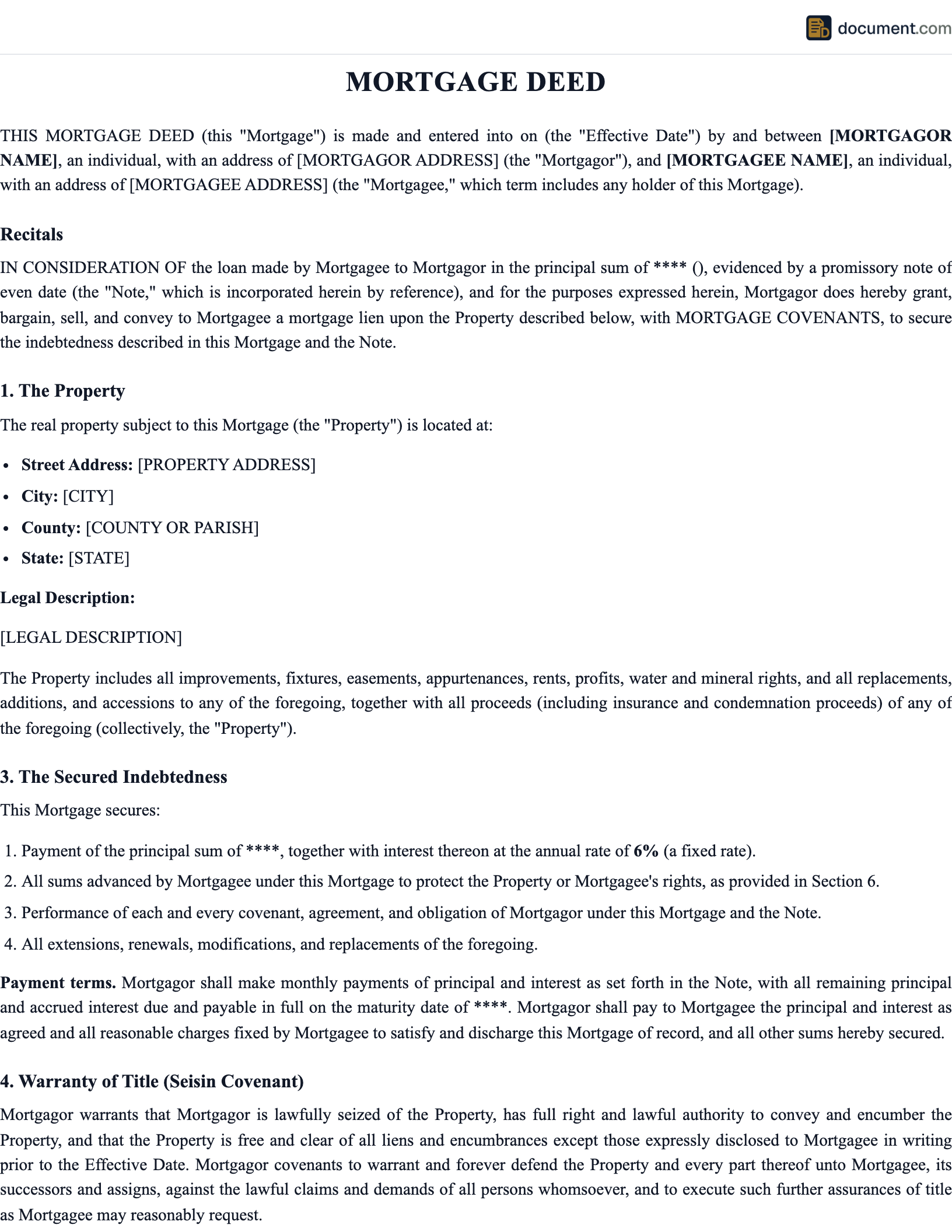
Sample New Jersey Mortgage Deed
Preview of our New Jersey-specific template. Your document will include all fields required for recording in any New Jersey county.
MORTGAGE DEED
STATE OF NEW JERSEY
Legal Document
PARTY INFORMATION
Name: [Full Legal Name]
Address: [New Jersey Address]
County: [County]
PROPERTY DESCRIPTION
County: [County] State: New Jersey
Legal Description: [Per Recorded Plat]
Parcel No.: [APN]
New Jersey Mortgage Deed FAQ
Common questions about filing in New Jersey, including requirements, fees, and tax implications.
Official New Jersey Resources
Official state resources for verifying requirements and finding your local recording office.
Important Considerations
New Jersey's judicial foreclosure requirement is not merely a procedural formality; it is a fundamental feature of how mortgage lending works in this state. Lenders must build the cost and time of potential court proceedings into their underwriting, and borrowers benefit from the oversight that comes with a mandatory court process. Understanding this before entering into a New Jersey mortgage transaction helps both parties set realistic expectations about what happens if the loan goes into default.
The Fair Foreclosure Act's 30-day Notice of Intention requirement is an enforceable prerequisite. Lenders who file a foreclosure complaint without first sending a compliant NFA notice risk having the complaint dismissed and having to restart the process. For institutional lenders with New Jersey mortgage portfolios, FFA compliance procedures should be built into the default servicing workflow from the outset. For private lenders, this is one of the most important reasons to consult a New Jersey real estate attorney before acting on a default.
New Jersey's foreclosure mediation program provides a genuine opportunity for workout in many cases. Borrowers who participate in mediation and come prepared with financial documentation have secured loan modifications, forbearance agreements, and short sale approvals through the program. Lenders who participate in good faith also benefit from a structured process that can resolve defaults more efficiently than contested litigation. Take the mediation program seriously if you are on either side of a distressed New Jersey mortgage.
New Jersey Attorney Note
New Jersey has a deep bench of real estate attorneys in Newark, Jersey City, Trenton, Cherry Hill, and throughout the suburban counties. Given the complexity of the state's foreclosure process, Fair Foreclosure Act requirements, Realty Transfer Fee structure, and high-value real estate transactions common in the Hudson County corridor and Shore communities, professional legal review of any New Jersey mortgage deed before recording is strongly advisable for both lenders and borrowers.
Related Documents
Depending on your situation, you may need additional documents alongside this one. Below are commonly related documents that are frequently used together in real estate transactions.
Important Considerations
New Jersey's judicial foreclosure requirement is not merely a procedural formality; it is a fundamental feature of how mortgage lending works in this state. Lenders must build the cost and time of potential court proceedings into their underwriting, and borrowers benefit from the oversight that comes with a mandatory court process. Understanding this before entering into a New Jersey mortgage transaction helps both parties set realistic expectations about what happens if the loan goes into default.
The Fair Foreclosure Act's 30-day Notice of Intention requirement is an enforceable prerequisite. Lenders who file a foreclosure complaint without first sending a compliant NFA notice risk having the complaint dismissed and having to restart the process. For institutional lenders with New Jersey mortgage portfolios, FFA compliance procedures should be built into the default servicing workflow from the outset. For private lenders, this is one of the most important reasons to consult a New Jersey real estate attorney before acting on a default.
New Jersey's foreclosure mediation program provides a genuine opportunity for workout in many cases. Borrowers who participate and come prepared with financial documentation have secured loan modifications, forbearance agreements, and short sale approvals through the program. Keep the stamped recorded original mortgage deed in a secure location; when the loan is eventually paid off, ensure the lender promptly records a discharge of mortgage at the county clerk's office to clear the lien from the public record.
New Jersey Attorney Note
New Jersey has a deep bench of real estate attorneys in Newark, Jersey City, Trenton, Cherry Hill, and throughout the suburban counties. Given the complexity of the state's foreclosure process, Fair Foreclosure Act requirements, Realty Transfer Fee structure, and high-value real estate transactions common in the Hudson County corridor and Shore communities, professional legal review of any New Jersey mortgage deed before recording is strongly advisable for both lenders and borrowers.
Related Documents
Depending on your situation, you may need additional documents alongside this one. Below are commonly related documents that are frequently used together in real estate transactions.
Create your New Jersey Mortgage Deed in under 5 minutes.
Answer a few questions and download a New Jersey-compliant document, ready for the state agency.