



New Hampshire Mortgage Deed Overview
New Hampshire stands out among New England states for its relatively efficient foreclosure process. Unlike Massachusetts or Connecticut, New Hampshire gives lenders the option to foreclose through a statutory power of sale that does not require going to court. The tradeoff for lenders is that New Hampshire prohibits deficiency judgments following a power of sale foreclosure, which means the property itself is the lender's only recourse. For borrowers, this provides meaningful protection from personal liability after losing a home.
New Hampshire imposes a Real Estate Transfer Tax on the conveyance of property interests. Mortgage deeds are recorded at the county Registry of Deeds, and New Hampshire does not levy a separate mortgage recording tax. The state also has no income tax on wages, though investment income is taxed at a flat rate, which affects how borrowers and investors think about holding and financing property in New Hampshire. Recording fees are paid per page at the Registry of Deeds and vary slightly by county.
$26
Recording fee
$7.50 per $1,000
Transfer tax
Required
Notarization
0
Witnesses required
New Hampshire Requirements
New Hampshire's Registry of Deeds offices operate county by county, and while the statutory requirements for recording are consistent statewide, each registry has its own counter procedures, accepted payment methods, and e-recording vendor relationships. Rockingham, Hillsborough, and Merrimack counties are the busiest, and their registries generally have the most up-to-date self-service options. For smaller counties like Coos or Sullivan, calling ahead before submitting is worthwhile.
New Hampshire Specific Note
New Hampshire's statutory power of sale foreclosure bars any deficiency judgment against the borrower after the sale, which is a critical distinction for lenders underwriting high loan-to-value transactions. The notice requirements for a valid power of sale foreclosure in New Hampshire are strict and courts have voided sales that failed to comply. At origination, ensure all parties are properly identified, all required notarization steps are completed, and the legal description matches the current Registry index. Recording fees are charged per page; the Real Estate Transfer Tax may apply depending on the nature of the transaction and should be confirmed with the registry or a New Hampshire attorney before closing.
Document Requirements
- Notarization: Must be notarized by a New Hampshire notary public or authorized notary
- Witnesses: New Hampshire requires 0 additional witness(es)
- Legal Description: Complete legal description as it appears on the current deed of record
- Parcel Number: Assessor's parcel number or tax ID
- Return Address: Mailing address for returning the recorded document
- Formatting: Standard formatting with adequate margins, black ink, minimum 10-point font
How to File in New Hampshire
New Hampshire mortgage deeds go to the county Registry of Deeds in the county where the property is located. New Hampshire has 10 counties, and each operates its own recording office. Here is what the process looks like from document preparation to recorded lien.
Prepare the Mortgage Deed
Include the full legal names and addresses of all parties, the complete legal description from the current Registry index, the loan amount and maturity date, applicable covenants, and the grantee's mailing address for return of the stamped document. New Hampshire uses its own recording number system, so the legal description must match what is on file at the Registry precisely.
Get the Document Acknowledged
All grantors must sign before a New Hampshire notary public or justice of the peace with valid government-issued photo identification. The notary completes the statutory acknowledgment and affixes their official stamp. New Hampshire does not require witnesses beyond the notary. If the instrument is being signed by a corporate officer or trustee, the notary acknowledgment block must reflect that representative capacity.
Submit to the County Registry of Deeds
Take the original executed document to the Registry of Deeds in the correct county. Several New Hampshire registries accept e-recording through approved vendors. If submitting by mail, include a check for the recording fee and a self-addressed envelope for the return of the recorded original. Confirm the specific registry's requirements before mailing.
Pay the Recording Fee
New Hampshire registries charge a per-page recording fee, typically around $10 per page with a minimum for most instruments. There is no separate mortgage recording tax. The Real Estate Transfer Tax applies to property transfers by deed; its applicability to a mortgage transaction should be confirmed with the registry or a New Hampshire attorney for your specific circumstances.
Retain the Stamped Recorded Original
After recording, the Registry stamps the document with a book and page reference establishing lien priority. The recorded original is returned to the address provided in the document. Store this in a secure location. If the mortgage is eventually paid off, you will need to record a discharge at the same Registry of Deeds to clear the lien from the public record.
New Hampshire Fees & Costs
Typical costs for filing in New Hampshire. Actual fees may vary by county.
| Fee / Tax | Amount |
|---|---|
| Recording Fee | $26 |
| Transfer Tax | $7.50 per $1,000 |
| Notarization | $5 - $25 per signature |
| Certified Copy | $1 - $10 per page |
| Attorney Review (optional) | $150 - $500 |
New Hampshire Tax Implications
New Hampshire has an unusual tax profile among northeastern states. There is no state income tax on wages or salaries, though the state does tax interest and dividend income under its Investment Income Tax. There is no broad sales tax. These features make New Hampshire relatively attractive for individual borrowers and real estate investors compared to neighboring Massachusetts or Maine, but property taxes in New Hampshire are among the highest in the country on a per-capita basis, which affects carrying costs for mortgaged properties.
The Real Estate Transfer Tax (RETT) applies to transfers of real property in New Hampshire at a rate of $0.75 per $100 of the sale price, paid separately by both buyer and seller (effectively $1.50 per $100 of total consideration). The RETT is a deed transfer tax and applies when property changes ownership, not when a mortgage lien is created. In a straightforward purchase-money mortgage, the RETT is calculated on the purchase price and paid at the time the deed is recorded. A refinance does not trigger RETT because no transfer of ownership occurs.
New Hampshire does not have a separate mortgage recording tax, so the cost of recording the mortgage itself is limited to the per-page Registry fee. Property taxes in New Hampshire are assessed by individual municipalities, not the state, and rates vary significantly from town to town. For mortgaged investment properties, some of the highest property tax rates in New England appear in New Hampshire municipalities near the Massachusetts border and in resort communities in the Lakes Region and White Mountains.
Sample New Hampshire Mortgage Deed
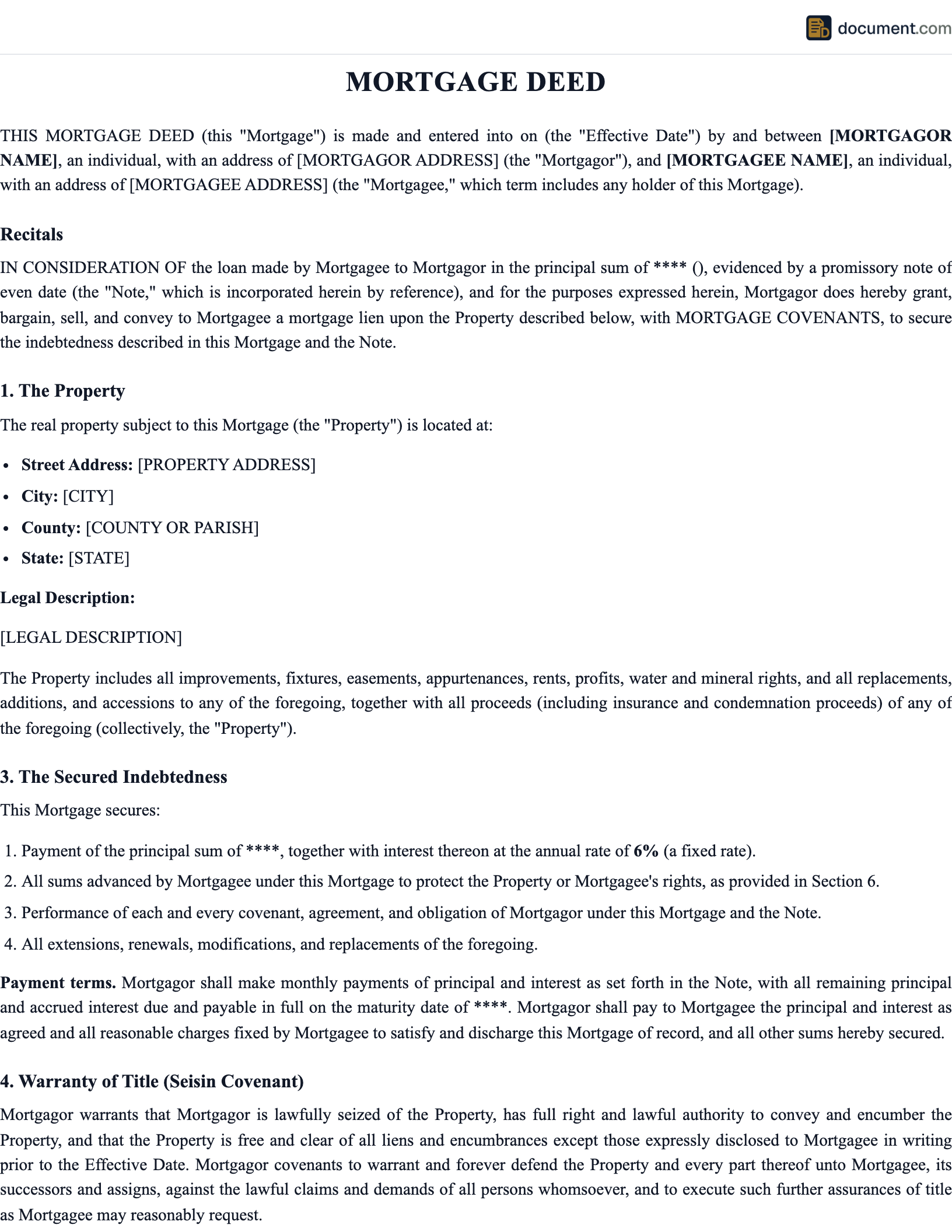
Preview of our New Hampshire-specific template. Your document will include all fields required for recording in any New Hampshire county.
MORTGAGE DEED
STATE OF NEW HAMPSHIRE
Legal Document
PARTY INFORMATION
Name: [Full Legal Name]
Address: [New Hampshire Address]
County: [County]
PROPERTY DESCRIPTION
County: [County] State: New Hampshire
Legal Description: [Per Recorded Plat]
Parcel No.: [APN]
New Hampshire Mortgage Deed FAQ
Common questions about filing in New Hampshire, including requirements, fees, and tax implications.
Official New Hampshire Resources
Official state resources for verifying requirements and finding your local recording office.
Important Considerations
The no-deficiency-judgment rule after a power of sale foreclosure in New Hampshire is worth understanding at the time you execute a mortgage deed, not just if a default later occurs. Because lenders know they cannot pursue a deficiency if they use the faster non-judicial route, they may price higher loan-to-value transactions differently or include additional covenants in the mortgage to protect their position. Borrowers should recognize this protection exists and understand what triggers it and what does not.
New Hampshire's notice requirements for a power of sale foreclosure are strictly construed. If the lender fails to provide the 25-day written notice to the borrower or does not publish notice in a newspaper of general circulation for three consecutive weeks before the sale, the sale can be voided. This creates real risk for lenders who cut procedural corners, but it also means that borrowers who receive a notice of default have meaningful time and legal standing to respond.
Property taxes in New Hampshire are collected at the municipal level, and rates differ substantially across towns. For mortgaged properties, particularly second homes and investment properties near resort areas, high property tax bills can strain the debt service coverage. Lenders financing resort-area properties in New Hampshire often require tax escrow as a loan condition. Once the mortgage is paid off, make sure a discharge or release of mortgage is promptly recorded at the Registry of Deeds to remove the lien from the title chain.
New Hampshire Attorney Note
New Hampshire real estate attorneys are concentrated in Manchester, Concord, Portsmouth, and Nashua, with active practices in resort communities like Conway, Wolfeboro, and Laconia. The state's power of sale foreclosure statute, RETT rules, and strict notice requirements all have nuances that benefit from local counsel review, particularly for commercial mortgage transactions and any loan where the borrower's financial profile suggests a higher risk of default.
Related Documents
Depending on your situation, you may need additional documents alongside this one. Below are commonly related documents that are frequently used together in real estate transactions.
Important Considerations
The no-deficiency-judgment rule after a power of sale foreclosure in New Hampshire is worth understanding at the time you execute a mortgage deed, not just if a default later occurs. Because lenders know they cannot pursue a deficiency if they use the faster non-judicial route, they may price higher loan-to-value transactions differently or include additional covenants in the mortgage to protect their position. Borrowers should recognize this protection exists and understand what triggers it and what does not.
New Hampshire's notice requirements for a power of sale foreclosure are strictly construed by the courts. If the lender fails to provide the 25-day written notice to the borrower or does not publish in a newspaper of general circulation for three consecutive weeks before the sale, the sale can be voided. This creates real risk for lenders who cut procedural corners, but it also means that borrowers who receive a notice of default have meaningful time and legal standing to respond.
Property taxes in New Hampshire are collected at the municipal level, and rates differ substantially across towns. For mortgaged properties near resort areas, high property tax bills can strain debt service coverage. Lenders financing resort-area properties in New Hampshire often require tax escrow as a loan condition. Once the mortgage is paid off, make sure a discharge or release of mortgage is promptly recorded at the correct Registry of Deeds to remove the lien from the title chain.
New Hampshire Attorney Note
New Hampshire real estate attorneys are concentrated in Manchester, Concord, Portsmouth, and Nashua, with active practices in resort communities like Conway, Wolfeboro, and Laconia. The state's power of sale foreclosure statute, RETT rules, and strict notice requirements all have nuances that benefit from local counsel review, particularly for commercial mortgage transactions and any loan where the borrower's financial profile suggests a higher risk of default.
Related Documents
Depending on your situation, you may need additional documents alongside this one. Below are commonly related documents that are frequently used together in real estate transactions.
Create your New Hampshire Mortgage Deed in under 5 minutes.
Answer a few questions and download a New Hampshire-compliant document, ready for the state agency.