
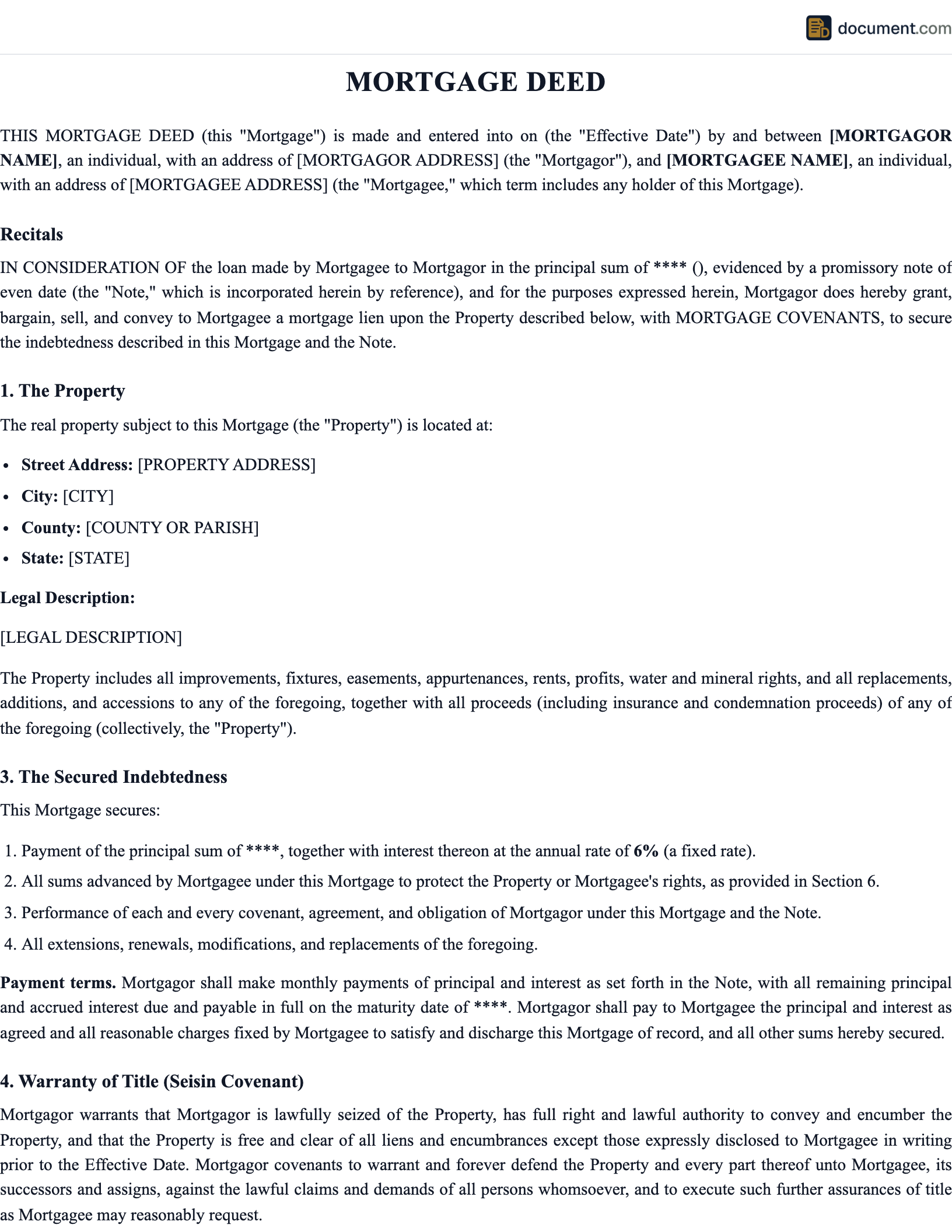



Nebraska Mortgage Deed Overview
Nebraska is one of the states that requires judicial foreclosure, meaning lenders cannot foreclose on a mortgage without taking the matter through district court. This procedural requirement gives borrowers meaningful notice and the ability to contest a foreclosure action, and it comes with a statutory three-month redemption period after any court-confirmed sale. For borrowers, the judicial process provides real protections. For lenders, it means higher transaction costs and longer timelines when defaults occur.
Nebraska eliminated its documentary stamp tax in 1967 and has never replaced it with a general real estate transfer tax. Recording a mortgage deed with the county Register of Deeds costs only the per-page filing fee. Agricultural lending is a major component of the Nebraska real estate market, and mortgage documents for farm and ranch property frequently include specialized covenants covering conservation compliance, crop insurance requirements, and restrictions on how the land may be used during the loan term.
$10
Recording fee
$2.25 per $1,000
Transfer tax
Required
Notarization
0
Witnesses required
Nebraska Requirements
Nebraska's Register of Deeds offices are the recording authority for all real property security instruments in the state. Requirements for document acceptance are set by statute and implemented locally, so it pays to confirm county-specific expectations before submission. Most Nebraska counties accept e-recording through approved platforms, which eliminates the need for in-person delivery in most transactions.
Nebraska Specific Note
Nebraska has no real estate transfer tax and no mortgage recording tax. The only filing cost is the per-page recording fee at the Register of Deeds, starting around $10 for the first page. Nebraska's judicial foreclosure requirement and three-month redemption period are not negotiable in the mortgage instrument. If your lender tries to include a waiver of the redemption right, that provision is not enforceable under Nebraska law. For agricultural mortgages, confirm whether FSA or farm credit covenants need to be incorporated into the document.
Document Requirements
- Notarization: Must be notarized by a Nebraska notary public or authorized notary
- Witnesses: Nebraska requires 0 additional witness(es)
- Legal Description: Complete legal description as it appears on the current deed of record
- Parcel Number: Assessor's parcel number or tax ID
- Return Address: Mailing address for returning the recorded document
- Formatting: Standard formatting with adequate margins, black ink, minimum 10-point font
How to File in Nebraska
Nebraska mortgage deeds are recorded at the county Register of Deeds office. Because Nebraska has no transfer tax or mortgage tax, the process is purely administrative once the document is properly executed. Here is how it works.
Prepare the Mortgage Deed
Fill in the borrower and lender names, the complete legal description as it appears in the county's records, the loan amount and maturity date, and all required covenants. For agricultural property, include any farm-specific provisions your lender requires, such as conservation compliance representations or crop insurance covenants.
Execute Before a Nebraska Notary
All parties who are granting the mortgage must sign in the presence of a Nebraska notary public. Bring valid government-issued photo identification. The notary completes the acknowledgment and affixes their official seal. Nebraska does not require witnesses beyond the notary, but all grantor signatures must be individually acknowledged.
Submit to the Register of Deeds
Present the original executed and notarized document to the Register of Deeds in the county where the property is located. Many Nebraska counties accept e-recording. If mailing, include a check for the recording fee and a self-addressed return envelope for the stamped original.
Pay the Per-Page Recording Fee
Nebraska charges a per-page fee at the Register of Deeds, starting around $10 for the first page. There is no transfer tax and no mortgage recording tax. The fee is due at the time of filing. Confirm the exact amount with the specific county office before submitting.
Secure the Recorded Original
After recording, the Register of Deeds stamps the document with the reception number, book, and page. The original is typically returned to the borrower or the lender depending on the escrow arrangement. The recorded document establishes lien priority as of the date and time of presentation to the office.
Nebraska Fees & Costs
Typical costs for filing in Nebraska. Actual fees may vary by county.
| Fee / Tax | Amount |
|---|---|
| Recording Fee | $10 |
| Transfer Tax | $2.25 per $1,000 |
| Notarization | $5 - $25 per signature |
| Certified Copy | $1 - $10 per page |
| Attorney Review (optional) | $150 - $500 |
Nebraska Tax Implications
Nebraska is one of the few states with no real estate transfer tax at all. When Nebraska repealed its documentary stamp tax in 1967, it did not replace it with any comparable levy, so there is no tax owed to the state simply because property is being mortgaged or conveyed. The cost of recording a mortgage deed is limited to the Register of Deeds' per-page fee.
Property taxes in Nebraska are administered at the county level and represent one of the higher property tax burdens in the Great Plains region. Lenders on Nebraska real estate typically require property tax escrow as a condition of the loan. Failing to pay property taxes can result in a tax sale proceeding that could cloud or extinguish the mortgage lender's interest, so this is taken seriously in the lending community. Agricultural land benefits from a special valuation methodology in Nebraska that caps increases in taxable value in certain years, which can be advantageous for farm borrowers managing their carrying costs.
Nebraska does have a state income tax, and any gain realized when mortgaged property is eventually sold may be subject to Nebraska income tax for residents, or to Nebraska withholding for non-resident sellers. The mortgage transaction itself does not create an income tax event, but it is worth discussing with a Nebraska CPA when structuring longer-term financing arrangements, particularly for agricultural land with significant appreciated value.
Sample Nebraska Mortgage Deed
Preview of our Nebraska-specific template. Your document will include all fields required for recording in any Nebraska county.
MORTGAGE DEED
STATE OF NEBRASKA
Legal Document
PARTY INFORMATION
Name: [Full Legal Name]
Address: [Nebraska Address]
County: [County]
PROPERTY DESCRIPTION
County: [County] State: Nebraska
Legal Description: [Per Recorded Plat]
Parcel No.: [APN]
Nebraska Mortgage Deed FAQ
Common questions about filing in Nebraska, including requirements, fees, and tax implications.
Official Nebraska Resources
Official state resources for verifying requirements and finding your local recording office.
Important Considerations
Nebraska's judicial foreclosure requirement is a meaningful borrower protection, but it also creates real costs for lenders when loans go bad. Borrowers in Nebraska should understand that the three-month statutory redemption period is a legal right that cannot be waived in a mortgage contract. If you are facing foreclosure on a Nebraska mortgage, you have time after the sale to redeem the property by paying the purchase price plus applicable interest, and this window should not be ignored.
For agricultural mortgage transactions, the complexity increases substantially. Nebraska farm mortgage documents often run significantly longer than residential mortgages because they need to address crop insurance covenants, FSA and USDA program compliance representations, restrictions on subdivision, and provisions governing what happens if the land is taken out of agricultural production. Farm Credit Services of America and similar agricultural lenders have standard mortgage forms that address these issues, but private lenders and seller-financed transactions may need custom drafting.
Deficiency judgment rules in Nebraska carry real weight. If you grant a lender the right to take the property in full satisfaction of the debt as part of the loan workout, that agreement forecloses any subsequent deficiency claim. Understanding how Nebraska treats deficiency judgments matters both at origination and during any default resolution process.
Nebraska Attorney Note
Nebraska real estate attorneys are concentrated in Omaha, Lincoln, and Grand Island, but practitioners in the Platte Valley, Panhandle, and southeastern counties routinely handle agricultural mortgage work. For farm and ranch loans, lenders operating in Nebraska should engage local counsel familiar with FSA-compatible mortgage covenants and the specific District Court foreclosure procedures in the relevant county.
Related Documents
Depending on your situation, you may need additional documents alongside this one. Below are commonly related documents that are frequently used together in real estate transactions.
Important Considerations
Nebraska's judicial foreclosure requirement is a meaningful borrower protection, but it also creates real costs for lenders when loans go bad. Borrowers in Nebraska should understand that the three-month statutory redemption period is a legal right that cannot be waived in a mortgage contract. If you are facing foreclosure on a Nebraska mortgage, you have time after the sale to redeem the property by paying the purchase price plus applicable interest, and this window should not be ignored.
For agricultural mortgage transactions, the complexity increases substantially. Nebraska farm mortgage documents often run significantly longer than residential mortgages because they need to address crop insurance covenants, FSA and USDA program compliance representations, restrictions on subdivision, and provisions governing what happens if the land is taken out of agricultural production. Farm Credit Services of America and similar agricultural lenders have standard mortgage forms that address these issues, but private lenders and seller-financed transactions may need custom drafting.
Deficiency judgment rules in Nebraska carry real weight. If you grant a lender the right to take the property in full satisfaction of the debt as part of the loan workout, that agreement forecloses any subsequent deficiency claim. Understanding how Nebraska treats deficiency judgments matters both at origination and during any default resolution process. Keep the stamped recorded original in a secure location once it is returned from the Register of Deeds.
Nebraska Attorney Note
Nebraska real estate attorneys are concentrated in Omaha, Lincoln, and Grand Island, but practitioners in the Platte Valley, Panhandle, and southeastern counties routinely handle agricultural mortgage work. For farm and ranch loans, lenders operating in Nebraska should engage local counsel familiar with FSA-compatible mortgage covenants and the specific District Court foreclosure procedures in the relevant county.
Related Documents
Depending on your situation, you may need additional documents alongside this one. Below are commonly related documents that are frequently used together in real estate transactions.
Create your Nebraska Mortgage Deed in under 5 minutes.
Answer a few questions and download a Nebraska-compliant document, ready for the state agency.