



Missouri Mortgage Deed Overview
Missouri is a deed of trust state where non-judicial foreclosure by trustee's sale is the standard remedy when a borrower defaults. Unlike a sheriff's sale in judicial foreclosure states, the Missouri foreclosure sale is conducted by the trustee named in the deed of trust. The process can be completed in approximately 60 days from the point that proper notice is given, and Missouri does not provide a post-sale redemption period for residential properties. Once the sale occurs, the borrower's interest ends.
Deeds of trust and any mortgage instruments used in Missouri are recorded with the Recorder of Deeds in the county where the property is situated. Recording fees start around $24. Missouri imposes no state transfer tax and no mortgage recording tax, which keeps closing costs straightforward. The state also has no state income tax on wages, which factors into the economic appeal of Missouri real estate from an ownership perspective. All instruments must be notarized, with no additional witnesses required beyond the notary.
$24
Recording fee
None
Transfer tax
Required
Notarization
0
Witnesses required
Missouri Requirements
Missouri deeds of trust must be recorded with the Recorder of Deeds in the county where the property is located. If the property is in St. Louis City, note that the city is independent of St. Louis County and has its own Recorder of Deeds office. All instruments must be notarized, and the acknowledgment should conform to Missouri statutory form requirements. Missouri does not require witnesses in addition to the notary.
Missouri Specific Note
Missouri uses a deed of trust as the standard security instrument, not a traditional two-party mortgage deed. The trustee conducts the foreclosure sale without court involvement, and there is no post-sale redemption period for most residential properties. Missouri has no state transfer tax or mortgage recording tax. St. Louis City and St. Louis County are separate jurisdictions with separate Recorder offices. Confirm the correct office before filing.
Document Requirements
- Notarization: Must be notarized by a Missouri notary public or authorized notary
- Witnesses: Missouri requires 0 additional witness(es)
- Legal Description: Complete legal description as it appears on the current deed of record
- Parcel Number: Assessor's parcel number or tax ID
- Return Address: Mailing address for returning the recorded document
- Formatting: Standard formatting with adequate margins, black ink, minimum 10-point font
How to File in Missouri
Missouri recording is straightforward with no transfer tax or mortgage tax to calculate. The main preparation task is confirming the correct Recorder of Deeds office, since St. Louis City is a separate jurisdiction from St. Louis County and other larger metro areas straddle county lines.
Identify the Correct Recording Office
Confirm the county where the property is physically located. In the St. Louis area, verify whether the property is in St. Louis City (independent jurisdiction) or St. Louis County. These are separate offices with separate records. For Kansas City properties, confirm the correct county among Jackson, Clay, Platte, or Cass.
Draft the Deed of Trust
Prepare the deed of trust naming the borrower, the lender as beneficiary, and the trustee. Include the complete legal description from the current deed of record, the loan amount, and the power-of-sale clause authorizing the trustee to foreclose by advertisement without court action.
Execute Before a Missouri Notary
The borrower signs the deed of trust before a Missouri notary public with valid government-issued ID. Missouri does not require additional witnesses. The acknowledgment must conform to Missouri statutory requirements to be accepted for recording.
Record with the Recorder of Deeds
File the executed deed of trust with the correct Recorder of Deeds office. Pay the recording fee, approximately $24 for the first page. No state transfer tax or mortgage recording tax applies. Many Missouri counties accept e-recording through approved vendors.
Receive the Recorded Copy
The Recorder stamps the instrument with an entry number and returns a copy. This recorded copy is your confirmation of the lien. Keep it with your closing documents. The lien is effective as constructive notice from the time of recording.
Missouri Fees & Costs
Typical costs for filing in Missouri. Actual fees may vary by county.
| Fee / Tax | Amount |
|---|---|
| Recording Fee | $24 |
| Transfer Tax | None |
| Notarization | $5 - $25 per signature |
| Certified Copy | $1 - $10 per page |
| Attorney Review (optional) | $150 - $500 |
Missouri Tax Implications
Missouri has no state income tax on wages and no state real estate transfer tax, which simplifies the tax picture for real estate transactions compared to many neighboring states. There is also no mortgage recording tax, so the cost to record a deed of trust is limited to the Recorder's flat filing fee. These factors make Missouri an attractive state for real estate investors and for borrowers managing overall cost of ownership.
Missouri property taxes are reassessed periodically and can change after a sale. County assessors across the state set assessed values based on fair market value, and the effective tax rate varies significantly between counties and municipalities. St. Louis City and Jackson County (Kansas City) typically carry higher effective rates than rural counties. Borrowers whose loans include tax escrow should confirm the expected post-closing property tax amount rather than relying on the seller's prior year bill.
When a Missouri property sells at a foreclosure trustee's sale for less than the loan balance, the lender may be able to obtain a deficiency judgment in court. Unlike some states that cap or prohibit deficiency actions, Missouri generally allows them. The lender must file a separate lawsuit within a prescribed period after the sale to obtain the deficiency judgment. Borrowers facing this scenario should consult a Missouri attorney about any available defenses or the possibility of negotiating a release of the deficiency claim.
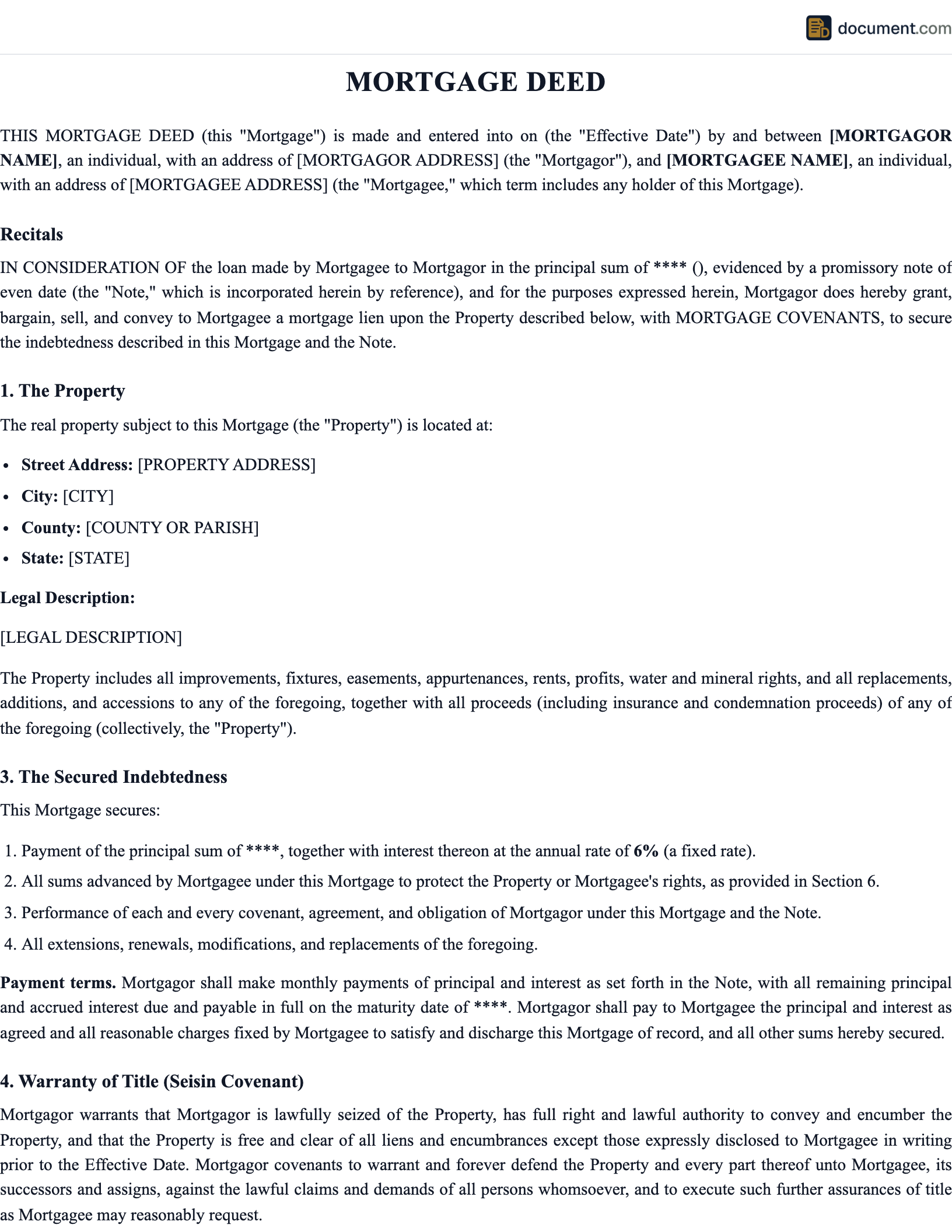
Sample Missouri Mortgage Deed
Preview of our Missouri-specific template. Your document will include all fields required for recording in any Missouri county.
MORTGAGE DEED
STATE OF MISSOURI
Legal Document
PARTY INFORMATION
Name: [Full Legal Name]
Address: [Missouri Address]
County: [County]
PROPERTY DESCRIPTION
County: [County] State: Missouri
Legal Description: [Per Recorded Plat]
Parcel No.: [APN]
Missouri Mortgage Deed FAQ
Common questions about filing in Missouri, including requirements, fees, and tax implications.
Official Missouri Resources
Official state resources for verifying requirements and finding your local recording office.
Important Considerations
The St. Louis City vs. St. Louis County distinction is one of the most common filing errors in Missouri real estate. St. Louis City separated from the county in 1876 and operates as an independent jurisdiction with its own Recorder of Deeds. Filing a deed of trust with the county recorder when the property is in the city, or vice versa, creates a gap in the public record that can cloud title for years.
Missouri's non-judicial foreclosure process has no post-sale redemption period for residential borrowers. When the trustee's sale is complete, it is done. Borrowers who are considering letting a property go to foreclosure should understand that they lose all rights at the sale date and should maximize any remaining time to negotiate with the lender before the sale occurs.
The trustee named in the deed of trust plays a critical role in Missouri. If the lender assigns the loan to another entity, a substitute trustee may be appointed. Borrowers should track any notices of substitute trustee appointment to ensure the foreclosure process is being conducted by a party with proper authority.
Missouri does not require attorneys at closing, and title companies handle most residential transactions. For transactions involving commercial property, LLC-held real estate, or properties with complex title histories, retaining a Missouri real estate attorney adds meaningful protection.
No Redemption Period After Sale
Missouri does not give residential borrowers a statutory right to redeem property after a trustee's foreclosure sale. The sale extinguishes the borrower's interest. If you are facing foreclosure in Missouri, act before the sale date. Options available before the sale, such as reinstatement, loan modification, or short sale, are not available after.
Related Documents
Depending on your situation, you may need additional documents alongside this one. Below are commonly related documents that are frequently used together in real estate transactions.
Important Considerations
The St. Louis City vs. St. Louis County distinction is one of the most common filing errors in Missouri real estate. St. Louis City is an independent jurisdiction with its own Recorder of Deeds. Filing with the wrong office creates a title gap that can take significant effort to correct.
Missouri's non-judicial foreclosure has no post-sale redemption period for residential borrowers. When the trustee's sale is complete, the borrower's interest is extinguished. All meaningful borrower options, including reinstatement, loan modification, and short sale, must be exercised before the sale date.
The trustee in a Missouri deed of trust is a key party. Lenders sometimes appoint substitute trustees when loans are transferred. Borrowers should track notices of substitute trustee appointments to confirm the foreclosure is being conducted by a party with proper authority.
Missouri does not require attorneys at closing. Title companies handle most residential transactions. For commercial deals or properties with complex title histories, a Missouri real estate attorney provides meaningful additional protection.
No Redemption Period After Sale
Missouri does not give residential borrowers a statutory right to redeem property after a trustee's foreclosure sale. If you are facing foreclosure in Missouri, act before the sale date. Options available before the sale are not available after.
Related Documents
Depending on your situation, you may need additional documents alongside this one. Below are commonly related documents that are frequently used together in real estate transactions.
Create your Missouri Mortgage Deed in under 5 minutes.
Answer a few questions and download a Missouri-compliant document, ready for the state agency.