



Mississippi Mortgage Deed Overview
Mississippi is a deed of trust state in practice. While mortgage deeds are legally valid, lenders throughout the state almost universally use the deed of trust structure, which names a trustee who holds legal title for the lender's benefit. The key advantage for lenders is non-judicial foreclosure by power of sale. When a borrower defaults, the trustee can proceed with a foreclosure sale after proper notice without filing a lawsuit, a process that can be completed in roughly 60 days from start to sale.
Deeds of trust and mortgage deeds in Mississippi are recorded with the Chancery Clerk of the county where the property is located. Mississippi imposes no state mortgage tax or transfer tax, keeping recording costs low. The recording fee is approximately $25 for a standard document. All instruments must be notarized before recording. After a foreclosure sale, Mississippi lenders may pursue a deficiency judgment for any shortfall, which is an important distinction from states that limit this remedy.
$25
Recording fee
None
Transfer tax
Required
Notarization
0
Witnesses required
Mississippi Requirements
Mississippi requires notarization for all instruments affecting real property before they can be recorded. The acknowledgment form must comply with state statutory requirements. Deficiency judgments after foreclosure are allowed in Mississippi, which means borrowers need to understand their exposure even after the property is sold. Chain of title research in Mississippi can be complex, particularly in rural counties where heirs' property situations are more common.
Mississippi Specific Note
Mississippi's non-judicial foreclosure process can proceed in approximately 60 days, which is faster than most states. Borrowers who anticipate default should contact their lender immediately. Mississippi does not have an anti-deficiency statute covering most residential loans, so lenders can pursue the remaining balance after a foreclosure sale falls short. There is no state transfer tax or mortgage tax, keeping recording costs lower than many surrounding states.
Document Requirements
- Notarization: Must be notarized by a Mississippi notary public or authorized notary
- Witnesses: Mississippi requires 0 additional witness(es)
- Legal Description: Complete legal description as it appears on the current deed of record
- Parcel Number: Assessor's parcel number or tax ID
- Return Address: Mailing address for returning the recorded document
- Formatting: Standard formatting with adequate margins, black ink, minimum 10-point font
How to File in Mississippi
Mississippi's recording process is handled by the Chancery Clerk in each of the state's 82 counties. The process is relatively simple and low-cost compared to many states. There is no transfer tax or mortgage tax to calculate, so the main costs are the flat recording fee and the title insurance premium.
Draft the Deed of Trust or Mortgage Deed
Prepare the instrument with the full legal names of the borrower, lender, and trustee (for a deed of trust), the complete legal description from the current chain of title, the loan amount, and the power-of-sale clause if using a deed of trust structure.
Execute Before a Mississippi Notary
All borrowers must sign the instrument before a Mississippi notary public with valid government-issued identification. Mississippi does not require additional witnesses beyond the notary. The acknowledgment must conform to the statutory form to be acceptable at recording.
File with the Chancery Clerk
Take the executed instrument to the Chancery Clerk's office in the county where the property is located. There is no state transfer tax or mortgage tax due at recording, just the recording fee.
Pay the Recording Fee
Pay the Chancery Clerk's recording fee, which is approximately $25 for a standard document. Fees vary by page count, so longer instruments may cost more. No state mortgage tax or transfer tax applies.
Obtain the Filed Copy
The Chancery Clerk stamps the instrument with recording information and returns a copy. Keep the confirmed copy with your transaction records. The recording creates constructive notice of the lien to all future parties claiming an interest in the property.
Mississippi Fees & Costs
Typical costs for filing in Mississippi. Actual fees may vary by county.
| Fee / Tax | Amount |
|---|---|
| Recording Fee | $25 |
| Transfer Tax | None |
| Notarization | $5 - $25 per signature |
| Certified Copy | $1 - $10 per page |
| Attorney Review (optional) | $150 - $500 |
Mississippi Tax Implications
Mississippi imposes neither a state real estate transfer tax nor a mortgage recording tax. This makes Mississippi one of the more borrower-friendly states in terms of recording costs. The primary tax consideration at closing is the property tax proration between buyer and seller, which is handled as an escrow adjustment rather than a government fee. Mississippi property taxes are among the lowest in the nation on average, though rates vary by county and municipality.
One significant tax exposure that Mississippi borrowers need to understand is the deficiency judgment risk after foreclosure. If a lender forecloses and the property sells for less than the outstanding balance, the lender can sue the borrower for the difference. If the lender later forgives that deficiency, the forgiven amount may constitute cancellation-of-debt income taxable at both the federal and Mississippi state level. Borrowers considering short sales or deeds in lieu should consult a tax professional about the potential income tax consequences.
Mississippi does have a state income tax, and the treatment of mortgage interest deductions generally follows federal rules. Property used as a primary residence and meeting the federal requirements for mortgage interest deductibility will generally receive the same deduction at the Mississippi level. Investment property mortgage interest follows the federal passive activity rules.
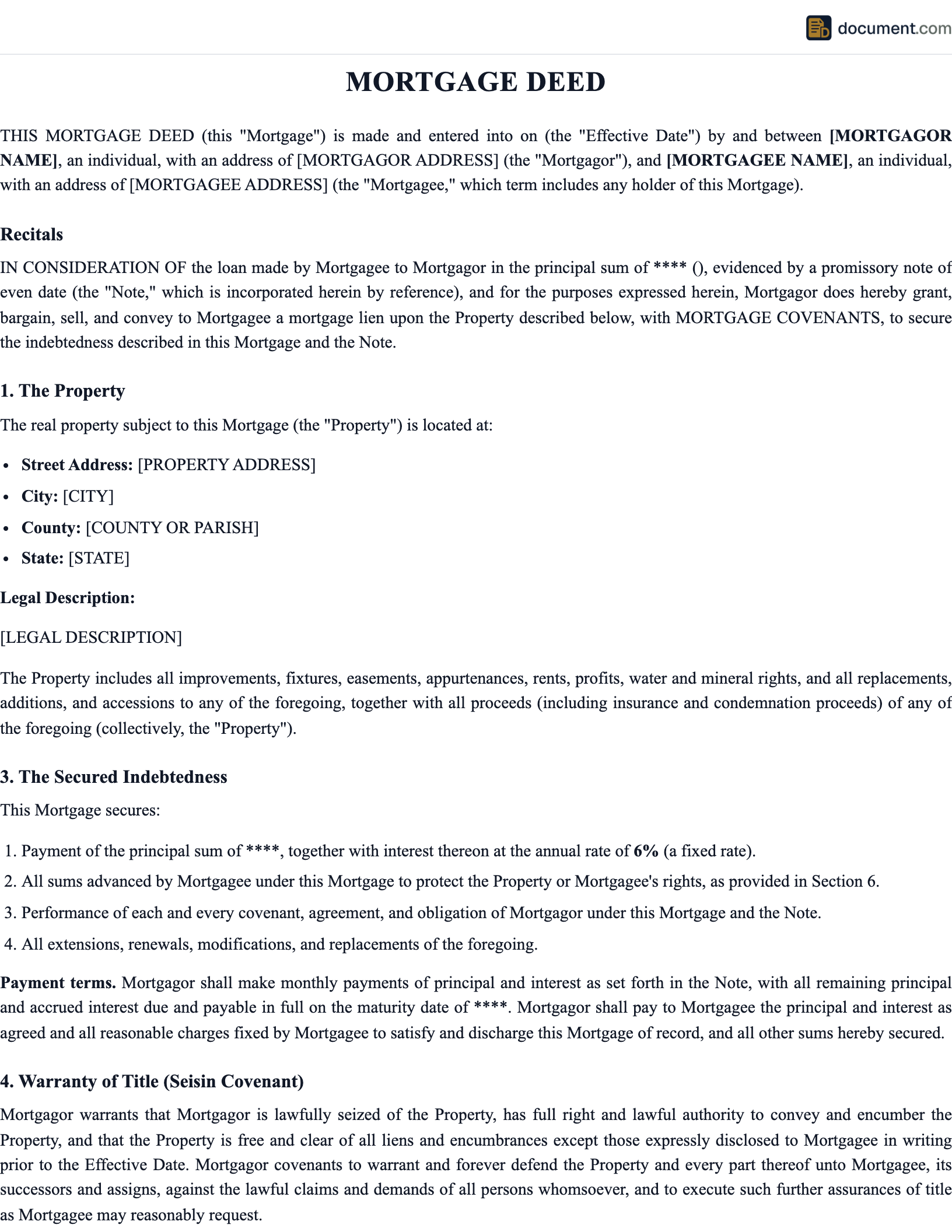
Sample Mississippi Mortgage Deed
Preview of our Mississippi-specific template. Your document will include all fields required for recording in any Mississippi county.
MORTGAGE DEED
STATE OF MISSISSIPPI
Legal Document
PARTY INFORMATION
Name: [Full Legal Name]
Address: [Mississippi Address]
County: [County]
PROPERTY DESCRIPTION
County: [County] State: Mississippi
Legal Description: [Per Recorded Plat]
Parcel No.: [APN]
Mississippi Mortgage Deed FAQ
Common questions about filing in Mississippi, including requirements, fees, and tax implications.
Official Mississippi Resources
Official state resources for verifying requirements and finding your local recording office.
Important Considerations
Mississippi's non-judicial foreclosure process is fast. Borrowers who fall behind on payments have very little time to respond before a foreclosure sale can occur, often less than 60 days from the formal notice. If you receive a default notice on a Mississippi property, do not wait. Contact the lender or a HUD-approved housing counselor immediately to understand your options.
The deficiency judgment risk in Mississippi is real and should be part of any borrower's risk assessment. If the property sells at foreclosure for less than the loan balance, the lender can pursue the difference through a separate lawsuit. Borrowers who are already struggling financially may face a judgment that affects wages, bank accounts, or future credit for years after the property is lost.
Title research in Mississippi can be more involved than in other states, particularly in rural counties with older records and properties that have passed through multiple generations of an extended family without formal probate. Heirs' property situations are common in Mississippi, and a lender taking a mortgage on property with uncertain title is taking a significant risk. A thorough title examination and owner's title insurance are worth the investment.
Mississippi does not require attorneys to conduct real estate closings. Title companies and settlement agents handle most residential transactions. For commercial property, estate-related transactions, or any deal involving complicated title questions, engaging a Mississippi real estate attorney separately is advisable.
Fast Foreclosure Timeline
Mississippi's power-of-sale foreclosure can be completed in approximately 60 days. This is significantly faster than judicial foreclosure states, leaving borrowers limited time to respond. If you are financing Mississippi property as a lender, this timeline is an asset. If you are a borrower, understand the urgency of responding to any default notice.
Related Documents
Depending on your situation, you may need additional documents alongside this one. Below are commonly related documents that are frequently used together in real estate transactions.
Important Considerations
Mississippi's non-judicial foreclosure process is fast. Borrowers who fall behind have very little time before a foreclosure sale can occur. If you receive a default notice on a Mississippi property, contact the lender or a HUD-approved housing counselor immediately.
The deficiency judgment risk in Mississippi should be part of any borrower's risk assessment. If the property sells at foreclosure for less than the loan balance, the lender can pursue the difference through a separate lawsuit. Borrowers facing financial difficulty should understand this exposure when evaluating options such as short sale, deed in lieu, or loan modification.
Title research in Mississippi can be complex, particularly in rural counties with older records and properties that have passed through multiple generations without formal probate. Heirs' property situations are common. A thorough title examination and owner's title insurance are worth the investment.
Mississippi does not require attorneys to conduct real estate closings. Title companies and settlement agents handle most residential transactions. For commercial property, estate-related transactions, or deals involving complicated title questions, engaging a Mississippi real estate attorney is advisable.
Fast Foreclosure Timeline
Mississippi's power-of-sale foreclosure can be completed in approximately 60 days. If you are a lender, this is an asset. If you are a borrower, understand the urgency of responding to any default notice.
Related Documents
Depending on your situation, you may need additional documents alongside this one. Below are commonly related documents that are frequently used together in real estate transactions.
Create your Mississippi Mortgage Deed in under 5 minutes.
Answer a few questions and download a Mississippi-compliant document, ready for the state agency.