



Minnesota Mortgage Deed Overview
Minnesota operates a dual land title system, and where you file your mortgage depends entirely on how the land is held. Abstract (recorded) land goes to the County Recorder, while Torrens (registered) land requires filing with the Registrar of Titles so the mortgage can be noted on the Certificate of Title. Filing in the wrong office is not a technicality that gets fixed easily, so verifying the land title type before closing is a non-negotiable first step.
Minnesota is also one of the few states that imposes a Mortgage Registry Tax at recording. The MRT is 0.23% of the secured debt, meaning a $400,000 loan generates $920 in MRT at closing. Recording fees themselves start around $46. Minnesota allows both traditional mortgage deeds and deeds of trust, but mortgage deeds remain the standard instrument. Borrowers using certain state housing programs may be required to complete HUD-approved counseling before their mortgage closes.
$46
Recording fee
$1.65 per $500
Transfer tax
Required
Notarization
0
Witnesses required
Minnesota Requirements
Before preparing the mortgage document, confirm whether the property is abstract or Torrens land. This determines whether you file with the County Recorder or the Registrar of Titles. Both offices have formatting requirements, and mortgage documents must include the correct county, legal description, and borrower information. The well disclosure requirement must also be addressed as part of the transaction if any wells exist on the property.
Minnesota Specific Note
Minnesota imposes a Mortgage Registry Tax of 0.23% of the principal loan amount at recording. This is a significant closing cost that applies to both purchases and refinances. Budget for this tax separately from the recording fee. Additionally, if the property is Torrens (registered) land, the mortgage must be filed with the Registrar of Titles, not the County Recorder, or the lien will not be properly perfected.
Document Requirements
- Notarization: Must be notarized by a Minnesota notary public or authorized notary
- Witnesses: Minnesota requires 0 additional witness(es)
- Legal Description: Complete legal description as it appears on the current deed of record
- Parcel Number: Assessor's parcel number or tax ID
- Return Address: Mailing address for returning the recorded document
- Formatting: Standard formatting with adequate margins, black ink, minimum 10-point font
How to File in Minnesota
Minnesota mortgage recording involves a few more steps than most states because of the dual title system and the Mortgage Registry Tax. Confirm the land type first, then budget accordingly for the MRT before the closing date.
Confirm Abstract or Torrens Land
Pull the current title commitment or contact the county to confirm whether the property is abstract (County Recorder) or registered Torrens land (Registrar of Titles). This determines the entire filing path. The well disclosure status also needs to be confirmed at this stage.
Prepare the Mortgage Document
Draft the mortgage with the full legal description, borrower and lender information, loan amount, interest rate, and maturity date. Minnesota-specific provisions including the power of sale and redemption right should be included if the lender intends to use statutory foreclosure by advertisement.
Execute Before a Minnesota Notary
All borrowers sign the mortgage before a Minnesota notary public with valid government-issued ID. Minnesota does not require additional witnesses. Remote online notarization is available in Minnesota if all parties and the lender agree to use it.
File with the Correct Office and Pay MRT
Present the mortgage at the County Recorder (abstract land) or Registrar of Titles (Torrens land). Pay the recording fee (approximately $46 for the first page) and the Mortgage Registry Tax of 0.23% of the principal debt amount secured. Have the correct funds available at filing.
Receive Recorded Copy or Updated Certificate
For abstract land, the recorded mortgage is returned with a document number and recording information. For Torrens land, the Registrar notes the mortgage on the Certificate of Title. Keep all confirmation documentation in a secure location with your other closing records.
Minnesota Fees & Costs
Typical costs for filing in Minnesota. Actual fees may vary by county.
| Fee / Tax | Amount |
|---|---|
| Recording Fee | $46 |
| Transfer Tax | $1.65 per $500 |
| Notarization | $5 - $25 per signature |
| Certified Copy | $1 - $10 per page |
| Attorney Review (optional) | $150 - $500 |
Minnesota Tax Implications
The Mortgage Registry Tax is Minnesota's most distinctive mortgage-related tax and catches many out-of-state borrowers and lenders off guard. At 0.23% of the mortgage principal, a $500,000 loan generates $1,150 in MRT at closing. This applies to both purchase mortgages and refinance transactions. When refinancing, if the new mortgage replaces an existing one and the principal does not increase, a partial MRT credit may be available. Consult a Minnesota title company or attorney to confirm eligibility.
Minnesota's deed tax (real property transfer tax) applies to conveyances of ownership at a rate of $1.65 per $500 of net consideration. This is separate from and in addition to the MRT. For a standard purchase transaction, the buyer pays the MRT on the mortgage and the deed tax applies to the transfer deed.
Minnesota has its own individual income tax and does not conform to all federal provisions. Borrowers who receive loan forgiveness or who have a deficiency waived after foreclosure should be aware that Minnesota may treat that amount as taxable income even in circumstances where federal law provides an exclusion. Consult a Minnesota CPA or tax attorney if loan modification or post-foreclosure tax treatment is a concern.
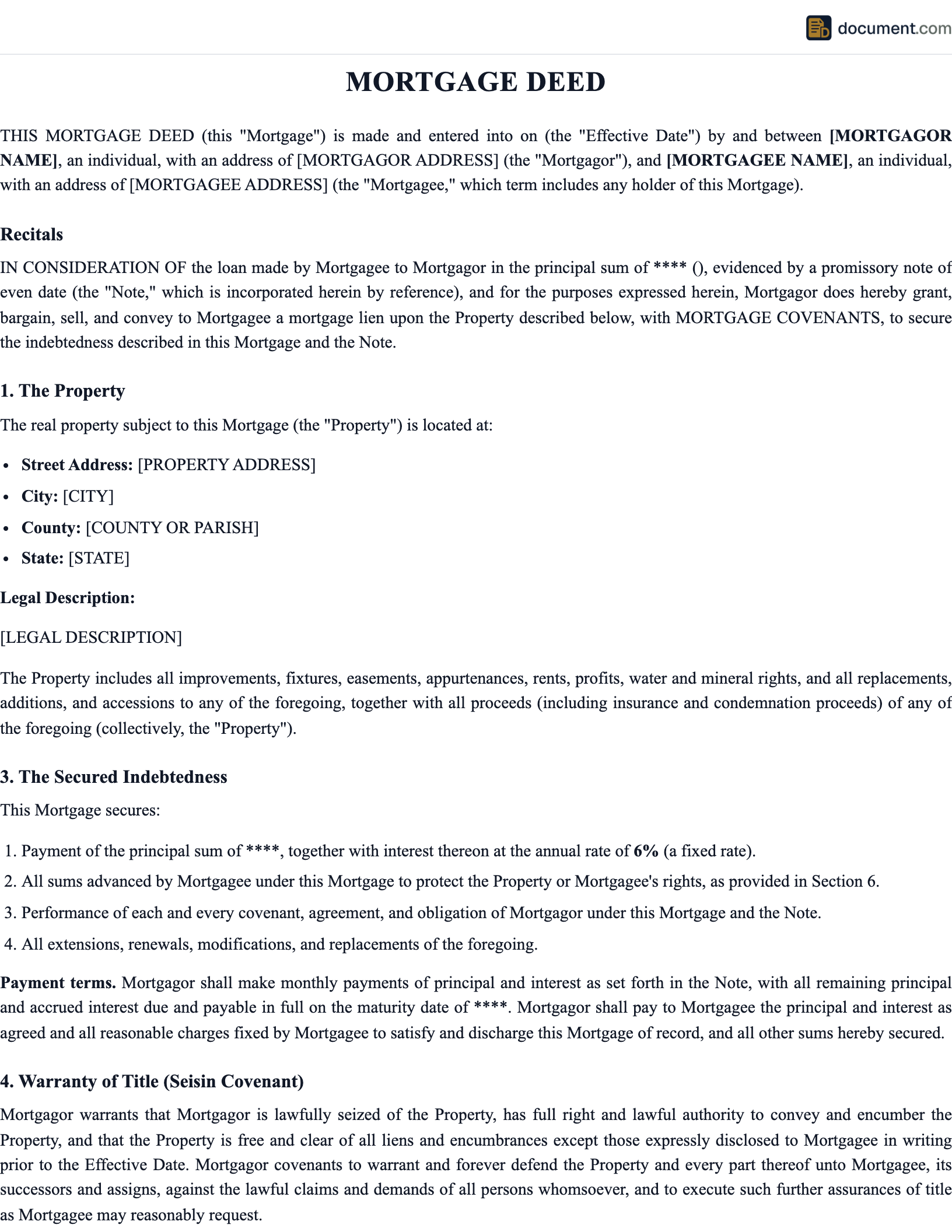
Sample Minnesota Mortgage Deed
Preview of our Minnesota-specific template. Your document will include all fields required for recording in any Minnesota county.
MORTGAGE DEED
STATE OF MINNESOTA
Legal Document
PARTY INFORMATION
Name: [Full Legal Name]
Address: [Minnesota Address]
County: [County]
PROPERTY DESCRIPTION
County: [County] State: Minnesota
Legal Description: [Per Recorded Plat]
Parcel No.: [APN]
Minnesota Mortgage Deed FAQ
Common questions about filing in Minnesota, including requirements, fees, and tax implications.
Official Minnesota Resources
Official state resources for verifying requirements and finding your local recording office.
Important Considerations
The Torrens vs. abstract land distinction is the most consequential threshold question in any Minnesota mortgage transaction. Filing a mortgage with the County Recorder when the property is Torrens-registered will not properly perfect the lien. Before any closing documents are prepared, confirm the land type through the county or your title company.
The Mortgage Registry Tax is a closing cost specific to Minnesota that must be budgeted before closing day. Unlike recording fees that are relatively fixed, the MRT scales with the loan amount. On a larger purchase, the MRT alone can represent several thousand dollars. Make sure this is reflected in the Loan Estimate and Closing Disclosure.
Minnesota's six-month redemption period after foreclosure sale means that borrowers who face default have more time and options than in many states. Lenders operating in Minnesota should build this timeline into their loss mitigation planning. Borrowers facing difficulty should contact their lender early, as Minnesota also has HUD-approved housing counseling resources available to help navigate loan modifications before foreclosure proceedings begin.
Well disclosure is a legal requirement in Minnesota and must be satisfied as part of the transaction. If the seller fails to make required disclosures and a well issue surfaces later, it can create liability and title complications.
Plan for the Mortgage Registry Tax
Minnesota's Mortgage Registry Tax of 0.23% of the loan principal is a real closing cost that does not appear in transactions in most other states. Lenders and borrowers new to Minnesota often underestimate total closing costs as a result. Confirm the MRT amount with your title company when ordering the title commitment.
Related Documents
Depending on your situation, you may need additional documents alongside this one. Below are commonly related documents that are frequently used together in real estate transactions.
Important Considerations
The Torrens vs. abstract land distinction is the most consequential threshold question in any Minnesota mortgage transaction. Filing a mortgage with the County Recorder when the property is Torrens-registered will not properly perfect the lien. Confirm the land type through the county or your title company before preparing closing documents.
The Mortgage Registry Tax is a closing cost specific to Minnesota and scales with the loan amount. On larger purchases, the MRT alone can reach several thousand dollars. Make sure it is correctly reflected in the Loan Estimate and Closing Disclosure so there are no surprises at closing.
Minnesota's six-month redemption period after foreclosure gives distressed borrowers more runway than most states. Lenders operating here should build this into their servicing and loss mitigation timelines. Borrowers in financial difficulty should reach out to their lender early and look into HUD-approved housing counseling, which is available throughout the state.
Well disclosure is a statutory requirement in Minnesota and must be completed before closing. Failure to disclose can create liability and potential title issues that affect the value of the security.
Plan for the Mortgage Registry Tax
Minnesota's Mortgage Registry Tax of 0.23% of the loan principal is a real closing cost that does not exist in most other states. Lenders and borrowers new to Minnesota consistently underestimate total closing costs as a result. Confirm the MRT amount with your title company when ordering the title commitment.
Related Documents
Depending on your situation, you may need additional documents alongside this one. Below are commonly related documents that are frequently used together in real estate transactions.
Create your Minnesota Mortgage Deed in under 5 minutes.
Answer a few questions and download a Minnesota-compliant document, ready for the state agency.