



Michigan Mortgage Deed Overview
Michigan uses the traditional two-party mortgage as its standard real property security instrument. Lenders hold the mortgage as security for the loan, with the borrower retaining title. When a borrower defaults, Michigan law gives the lender two paths: judicial foreclosure through circuit court, or the more commonly used statutory foreclosure by advertisement. The advertisement process does not require a lawsuit, but it does result in a redemption period of up to six months during which the borrower can reclaim the property by paying off the debt.
All Michigan mortgage deeds must be recorded with the county Register of Deeds. Recording fees start at $15 for the first page. Michigan imposes a real estate transfer tax on property sales at a combined rate of about $4.30 per $500, but that tax applies to the deed of conveyance, not to the mortgage instrument. One point unique to Michigan: if the property is the borrower's homestead, the non-title spouse must sign the mortgage even if they hold no ownership interest in the property.
$15
Recording fee
$3.75 per $500
Transfer tax
Required
Notarization
0
Witnesses required
Michigan Requirements
Michigan's recording statutes set out specific formatting requirements that Registers of Deeds enforce. The document must identify the drafter, include a return address for the recorded copy, and contain a complete legal description matching the current deed of record. Margin requirements apply, and the first page must have a blank area for the Register to stamp. Getting these details right up front avoids rejection and re-recording delays.
Michigan Specific Note
If the property is the borrower's homestead, the non-owning spouse must sign the mortgage deed even if they hold no title interest. Failing to get that signature can leave a gap in the lender's security. Michigan also requires the drafter's name and address on the face of the document. The transfer tax applies to purchase deeds, not to mortgage instruments recorded separately.
Document Requirements
- Notarization: Must be notarized by a Michigan notary public or authorized notary
- Witnesses: Michigan requires 0 additional witness(es)
- Legal Description: Complete legal description as it appears on the current deed of record
- Parcel Number: Assessor's parcel number or tax ID
- Return Address: Mailing address for returning the recorded document
- Formatting: Standard formatting with adequate margins, black ink, minimum 10-point font
How to File in Michigan
Michigan mortgage recording is generally straightforward if the document is correctly prepared. Pay attention to the homestead spousal signature requirement before you get to closing, because getting a non-title spouse to sign at the last minute can delay the process.
Prepare the Document with Drafter Information
Complete all fields including party names, the complete legal description from the current deed, the loan amount, and maturity date. Include the drafter's full name and address on the face of the document, as required by MCL 565.201.
Confirm Spousal Signature Requirement
If the property is the borrower's primary residence, the non-title spouse must sign the mortgage. Confirm marital status and homestead designation before the signing appointment to avoid last-minute complications.
Execute Before a Michigan Notary
All required signatories, including the non-title spouse if applicable, must sign before a Michigan notary public with valid government-issued ID. Michigan does not require additional witnesses beyond the notary.
Record at the County Register of Deeds
Take the executed mortgage to the Register of Deeds in the county where the property is located. The recording fee is $15 for the first page and $3 per additional page. E-recording is available in many Michigan counties through approved submitters.
Retain the Recorded Copy
After recording, the Register stamps the document with liber and page information and returns a copy. Keep this confirmed copy in a safe place. The lender also retains a recorded copy for their file. The mortgage is effective as constructive notice from the recording date.
Michigan Fees & Costs
Typical costs for filing in Michigan. Actual fees may vary by county.
| Fee / Tax | Amount |
|---|---|
| Recording Fee | $15 |
| Transfer Tax | $3.75 per $500 |
| Notarization | $5 - $25 per signature |
| Certified Copy | $1 - $10 per page |
| Attorney Review (optional) | $150 - $500 |
Michigan Tax Implications
Michigan does not impose a mortgage recording tax. The state and county real estate transfer taxes are triggered by the deed transferring ownership, not by the mortgage. When you purchase a home, you pay the transfer tax on the sale deed. When you record the mortgage separately, no additional tax applies to that instrument. This keeps refinancing costs relatively clean compared to states that tax the mortgage itself.
Michigan property taxes operate under the Proposal A framework adopted in 1994, which caps annual assessment increases on a property at the lower of 5% or the rate of inflation as long as the property is not transferred. When a property sells, the taxable value uncaps and resets to the state equalized value, which can substantially increase the property tax bill for the buyer. This is an important consideration when underwriting a purchase mortgage, since the buyer's post-sale property tax may be significantly higher than the seller's current bill.
Michigan borrowers who are active-duty military or veterans should also be aware that the federal Servicemembers Civil Relief Act can cap mortgage interest rates at 6% during active duty and provides protections against foreclosure. Michigan veterans may qualify for additional property tax exemptions through the state Department of Military and Veterans Affairs.
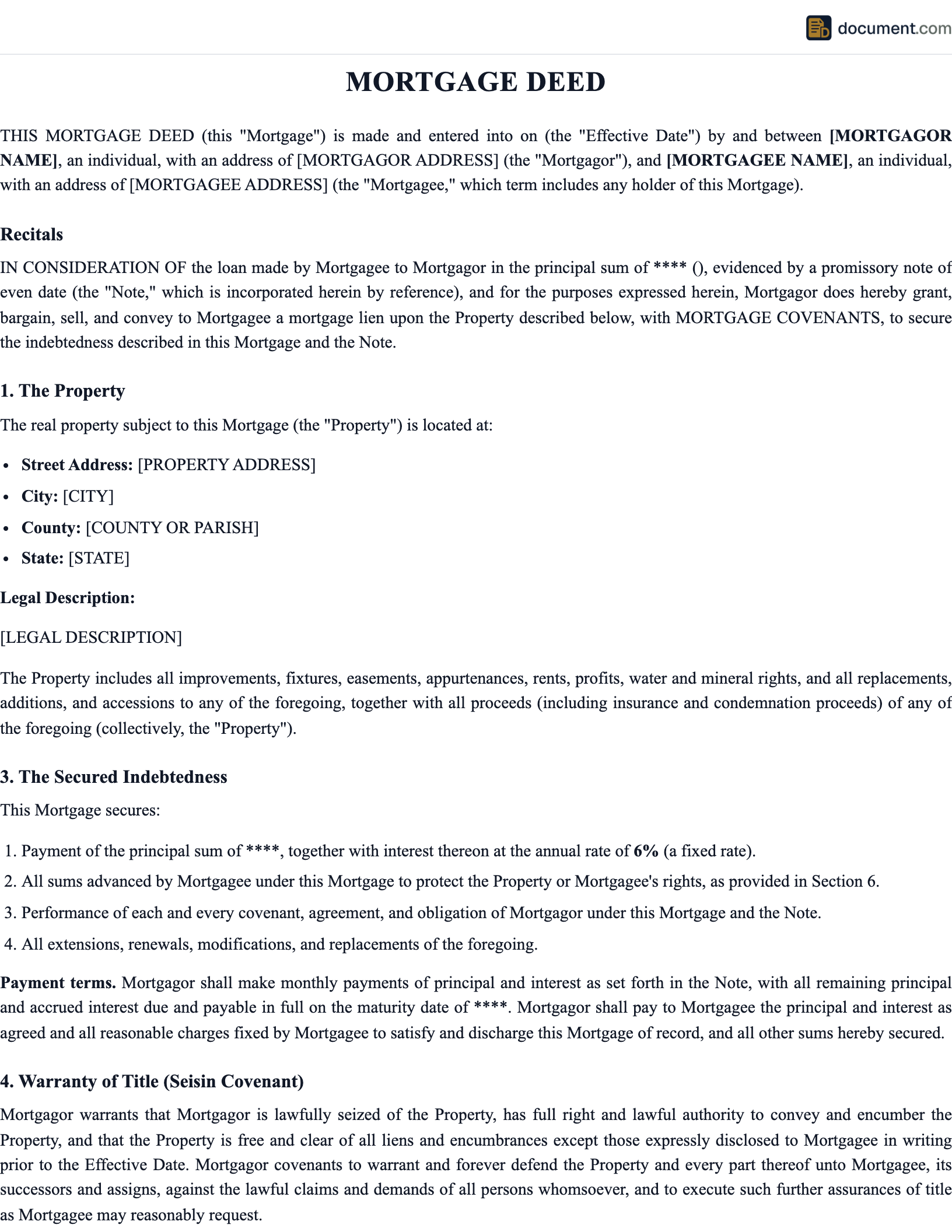
Sample Michigan Mortgage Deed
Preview of our Michigan-specific template. Your document will include all fields required for recording in any Michigan county.
MORTGAGE DEED
STATE OF MICHIGAN
Legal Document
PARTY INFORMATION
Name: [Full Legal Name]
Address: [Michigan Address]
County: [County]
PROPERTY DESCRIPTION
County: [County] State: Michigan
Legal Description: [Per Recorded Plat]
Parcel No.: [APN]
Michigan Mortgage Deed FAQ
Common questions about filing in Michigan, including requirements, fees, and tax implications.
Official Michigan Resources
Official state resources for verifying requirements and finding your local recording office.
Important Considerations
The spousal homestead signature requirement is the single most common Michigan-specific mistake in mortgage transactions. If the borrower is married and the property is their primary residence, the spouse must sign the mortgage regardless of whether the spouse is on the deed. This is not optional. A lender that fails to obtain the non-title spouse's signature may not be able to enforce its lien against the homestead interest.
Michigan's six-month statutory redemption period is one of the most generous in the country. After a foreclosure by advertisement sale, the borrower retains the right to redeem the property and generally stays in possession during that window. This can complicate lender planning and should be factored into any investment or lending analysis on Michigan property.
Michigan's Proposal A property tax cap means buyers should research the current taxable value and assessed value before closing. In markets where property values have appreciated significantly, the tax bill can increase substantially in the year after purchase. Factor this into the borrower's debt-to-income calculation if taxes are collected through escrow.
Michigan does not require attorneys to conduct closings, but title companies and attorneys both operate in this market. For complex transactions involving commercial property, LLC borrowers, or non-standard loan structures, retaining a Michigan real estate attorney is worth the investment.
Homestead Spousal Signature
Under MCL 558.1 and related statutes, a Michigan mortgage on homestead property requires the signature of both spouses, even when only one spouse holds title. Make sure to identify this situation during loan origination rather than at the closing table.
Related Documents
Depending on your situation, you may need additional documents alongside this one. Below are commonly related documents that are frequently used together in real estate transactions.
Important Considerations
The spousal homestead signature requirement is the single most common Michigan-specific mistake in mortgage transactions. If the borrower is married and the property is their primary residence, the spouse must sign the mortgage regardless of whether the spouse is on the deed. A lender that fails to obtain the non-title spouse's signature may not be able to enforce its lien against the homestead interest.
Michigan's six-month statutory redemption period is one of the most generous in the country. After a foreclosure by advertisement sale, the borrower retains the right to redeem the property and generally stays in possession during that window. This can complicate lender planning and should be factored into any investment or lending analysis on Michigan property.
Michigan's Proposal A property tax cap means buyers should research the current taxable value and assessed value before closing. In markets where property values have appreciated significantly, the tax bill can increase substantially in the year after purchase.
Michigan does not require attorneys to conduct closings, but title companies and attorneys both operate in this market. For complex transactions involving commercial property, LLC borrowers, or non-standard loan structures, retaining a Michigan real estate attorney is worth the investment.
Homestead Spousal Signature
Under MCL 558.1 and related statutes, a Michigan mortgage on homestead property requires the signature of both spouses, even when only one spouse holds title. Identify this situation during loan origination rather than at the closing table.
Related Documents
Depending on your situation, you may need additional documents alongside this one. Below are commonly related documents that are frequently used together in real estate transactions.
Create your Michigan Mortgage Deed in under 5 minutes.
Answer a few questions and download a Michigan-compliant document, ready for the state agency.