



Massachusetts Mortgage Deed Overview
Massachusetts is one of the relatively few states where mortgage deeds are the standard instrument for securing real property loans, yet non-judicial foreclosure through a statutory power of sale is fully available. That combination makes Massachusetts distinctive: borrowers get a 90-day right to cure after default notice, but lenders who follow proper procedure can foreclose without ever setting foot in a courtroom. Documents are filed with the Registry of Deeds in the county where the property is located, or with the Land Court for registered (Torrens) land.
Attorney closings are effectively standard in Massachusetts. Lenders require a licensed real estate attorney to certify title, conduct the closing, and handle registry filings. The state's deed excise tax of $2.28 per $500 applies to deeds conveying ownership, not to mortgage instruments directly. Recording fees run around $75 per document. All mortgage deeds must be notarized, and the acknowledgment form must comply with Massachusetts statutory requirements before a Registry will accept the document for recording.
$75
Recording fee
$2.28 per $500
Transfer tax
Required
Notarization
0
Witnesses required
Massachusetts Requirements
Massachusetts Registries of Deeds are strict about document formatting and acknowledgment requirements. A mortgage submitted without a proper notarial acknowledgment in the Massachusetts statutory form will be rejected. Properties registered under the Land Court system follow a separate set of requirements and are filed differently than standard recorded-land mortgages. Confirm with your attorney which system covers your property before drafting the document.
Massachusetts Specific Note
Massachusetts requires attorney involvement at closing. If the property is registered land under the Land Court system, the filing process and requirements differ significantly from standard Registry of Deeds recording. The deed excise tax ($2.28 per $500) applies to ownership transfers, not to the mortgage itself. Servicemembers Civil Relief Act compliance must be verified before any foreclosure action.
Document Requirements
- Notarization: Must be notarized by a Massachusetts notary public or authorized notary
- Witnesses: Massachusetts requires 0 additional witness(es)
- Legal Description: Complete legal description as it appears on the current deed of record
- Parcel Number: Assessor's parcel number or tax ID
- Return Address: Mailing address for returning the recorded document
- Formatting: Standard formatting with adequate margins, black ink, minimum 10-point font
How to File in Massachusetts
In Massachusetts, residential mortgage closings are handled by a licensed real estate attorney who prepares documents, handles escrow, certifies title, and files the recorded instruments. The steps below reflect that attorney-closing practice, which is the norm across the state.
Conduct a Title Examination
A Massachusetts real estate attorney examines the chain of title at the relevant Registry of Deeds (or Land Court for registered land) to confirm the property is free of undisclosed liens and encumbrances before any mortgage documents are prepared.
Prepare and Review the Mortgage Deed
The closing attorney drafts the mortgage incorporating the statutory power-of-sale clause, the correct legal description from the Registry records, and the lender's required covenants. Borrowers should review all documents before signing.
Execute with Notarial Acknowledgment
All borrowers sign the mortgage before a Massachusetts notary public at the closing. The acknowledgment must follow the statutory form prescribed by Massachusetts law or the Registry will reject it.
Record at the Correct Office
File the original mortgage with the Registry of Deeds for the county where the property is located. For Land Court registered properties, file at the Land Court instead. Many registries accept e-recording. The recording fee is approximately $75 per document.
Obtain Confirmation and Copies
The Registry stamps the document with a book and page number and returns a confirmed copy. Keep this copy with your closing documents. The recording establishes constructive notice of the mortgage lien against all subsequent parties.
Massachusetts Fees & Costs
Typical costs for filing in Massachusetts. Actual fees may vary by county.
| Fee / Tax | Amount |
|---|---|
| Recording Fee | $75 |
| Transfer Tax | $2.28 per $500 |
| Notarization | $5 - $25 per signature |
| Certified Copy | $1 - $10 per page |
| Attorney Review (optional) | $150 - $500 |
Massachusetts Tax Implications
Massachusetts does not impose a separate mortgage tax or stamp tax on mortgage instruments. The state's deed excise tax of $2.28 per $500 of consideration applies to deeds that transfer ownership, not to the mortgage itself. That said, a typical purchase transaction will trigger the excise tax on the deed while the accompanying mortgage remains tax-free at the state level.
Massachusetts has its own estate tax with a relatively low threshold, and property held as a mortgaged asset can affect estate planning. Borrowers who refinance frequently should also be mindful that mortgage interest deductibility at the federal level depends on loan amounts and use of proceeds, particularly for high-value Massachusetts properties where loan balances often exceed federal limits.
Local property taxes in Massachusetts are set by individual municipalities and can vary significantly. A sale or transfer of property can prompt the assessor to update the valuation, which may affect future tax bills. In some communities that have adopted the Community Preservation Act, there is an additional surcharge on property taxes that funds local open space and affordable housing. These costs do not directly affect the mortgage instrument, but they are part of the total carrying cost picture.
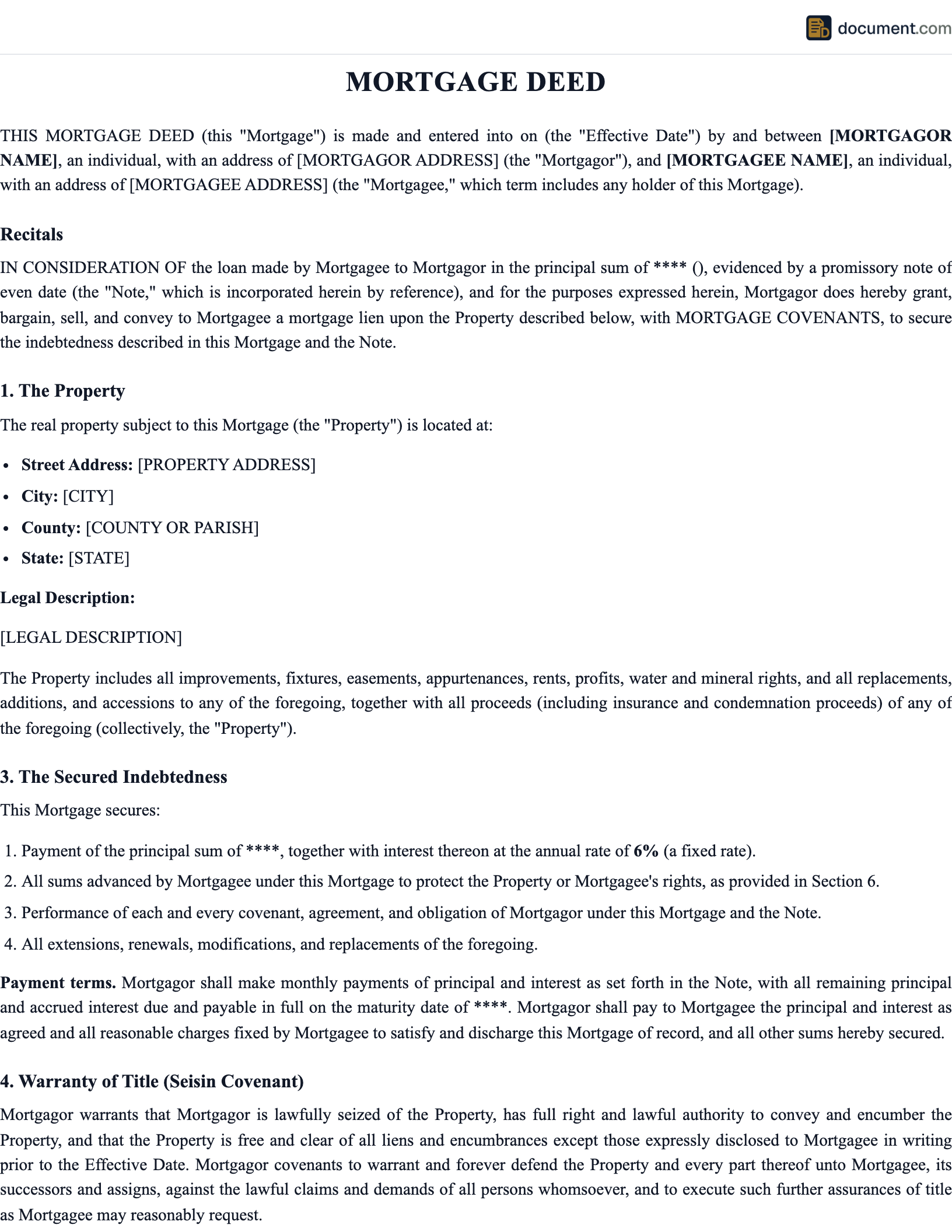
Sample Massachusetts Mortgage Deed
Preview of our Massachusetts-specific template. Your document will include all fields required for recording in any Massachusetts county.
MORTGAGE DEED
STATE OF MASSACHUSETTS
Legal Document
PARTY INFORMATION
Name: [Full Legal Name]
Address: [Massachusetts Address]
County: [County]
PROPERTY DESCRIPTION
County: [County] State: Massachusetts
Legal Description: [Per Recorded Plat]
Parcel No.: [APN]
Massachusetts Mortgage Deed FAQ
Common questions about filing in Massachusetts, including requirements, fees, and tax implications.
Official Massachusetts Resources
Official state resources for verifying requirements and finding your local recording office.
Important Considerations
Massachusetts is not a state where borrowers typically navigate a mortgage closing without an attorney. The combination of the Land Court registered-land system, strict Registry of Deeds acknowledgment requirements, and the lender-side attorney practice means that most closings have at least one, and often two, attorneys present. Borrowers should not assume the lender's attorney represents their interests.
The statutory power of sale in Massachusetts mortgages is a significant clause. It authorizes the lender to foreclose by advertisement without court involvement if the borrower defaults, subject to the 90-day cure period for owner-occupied residential properties. Borrowers should read and understand this provision before signing, as it controls the remedies available to the lender.
If the property being mortgaged is registered land, the recording process is entirely different from standard Registry of Deeds filing. The mortgage must reference the Land Court certificate number, and it must be noted on the certificate to bind subsequent parties. Mixing up the two systems can create serious title defects.
Active-duty military borrowers should inform their lender and closing attorney of their status. Federal Servicemembers Civil Relief Act protections apply in Massachusetts, and any attempt to proceed with foreclosure on a protected servicemember can be challenged and unwound.
Attorney Closing Practice in Massachusetts
Unlike many states where settlement agents or title companies conduct closings, Massachusetts requires a licensed real estate attorney to handle residential mortgage closings. If you are buying or refinancing, budget for independent legal counsel in addition to the lender's attorney. The cost is modest relative to the protection it provides.
Related Documents
Depending on your situation, you may need additional documents alongside this one. Below are commonly related documents that are frequently used together in real estate transactions.
Important Considerations
Massachusetts is not a state where borrowers typically navigate a mortgage closing without an attorney. The combination of the Land Court registered-land system, strict Registry of Deeds acknowledgment requirements, and the lender-side attorney practice means that most closings have at least one, and often two, attorneys present. Borrowers should not assume the lender's attorney represents their interests.
The statutory power of sale in Massachusetts mortgages is a significant clause. It authorizes the lender to foreclose by advertisement without court involvement if the borrower defaults, subject to the 90-day cure period for owner-occupied residential properties. Borrowers should read and understand this provision before signing.
If the property being mortgaged is registered land, the recording process is entirely different from standard Registry of Deeds filing. The mortgage must reference the Land Court certificate number, and it must be noted on the certificate to bind subsequent parties.
Active-duty military borrowers should inform their lender and closing attorney of their status. Federal Servicemembers Civil Relief Act protections apply in Massachusetts, and any attempt to proceed with foreclosure on a protected servicemember can be challenged and unwound.
Attorney Closing Practice in Massachusetts
Unlike many states where settlement agents or title companies conduct closings, Massachusetts requires a licensed real estate attorney to handle residential mortgage closings. If you are buying or refinancing, budget for independent legal counsel in addition to the lender's attorney. The cost is modest relative to the protection it provides.
Related Documents
Depending on your situation, you may need additional documents alongside this one. Below are commonly related documents that are frequently used together in real estate transactions.
Create your Massachusetts Mortgage Deed in under 5 minutes.
Answer a few questions and download a Massachusetts-compliant document, ready for the state agency.