



Maryland Mortgage Deed Overview
Maryland's real property security market features both traditional mortgage deeds and deeds of trust, with most institutional lenders strongly preferring the deed of trust because it enables non-judicial foreclosure under a power-of-sale provision. Both instruments secure a debt against real property and must be recorded with the Circuit Court Land Records in the county or independent city where the property is located, but the enforcement process differs materially depending on which instrument is used.
Maryland's recording tax structure is more complex than most states. A county-level recordation tax is applied to the mortgage amount, ranging from roughly $3.33 to $10.00 per $1,000 of debt depending on the jurisdiction. State and county transfer taxes also apply to the underlying property conveyance. Older Baltimore City properties may be subject to ground rent arrangements that affect how a mortgage is structured and what the lender's security interest actually covers. Notarization is required and no additional witnesses are needed beyond the notary.
$60
Recording fee
0.5%-1.5%
Transfer tax
Required
Notarization
0
Witnesses required
Maryland Requirements
Maryland mortgage deeds must be acknowledged before a notary public or other authorized officer. The document must include the full legal description of the property, the names and addresses of all parties, and a return address for the recorded instrument. Maryland Land Records offices typically require state intake forms alongside recording documents, and some counties have their own additional cover sheets. Because recording costs are higher in Maryland than in many states, it is worth confirming the exact fee and tax amounts with the specific county Land Records office before submitting.
Maryland Specific Note
Maryland imposes a county-level recordation tax on the mortgage amount that varies by jurisdiction and can be substantial on high-value loans. State and county transfer taxes apply separately to the underlying sale. Baltimore City properties subject to ground rents require additional due diligence at the title and mortgage stage. Confirm all applicable taxes and fees with the specific Circuit Court Land Records office before recording, as costs differ significantly across Maryland's 23 counties and Baltimore City.
Document Requirements
- Notarization: Must be notarized by a Maryland notary public or authorized notary
- Witnesses: Maryland requires 0 additional witness(es)
- Legal Description: Complete legal description as it appears on the current deed of record
- Parcel Number: Assessor's parcel number or tax ID
- Return Address: Mailing address for returning the recorded document
- Formatting: Standard formatting with adequate margins, black ink, minimum 10-point font
How to File in Maryland
Recording a mortgage deed in Maryland involves more steps and higher costs than most states, primarily because of the multi-layered tax system and the requirement to file specific state and county intake forms alongside the recorded instrument. Here is a practical overview of the process.
Determine Whether to Use a Mortgage or Deed of Trust
For institutional lenders, a deed of trust with a power-of-sale clause is almost always the preferred instrument because it allows non-judicial foreclosure. For private lenders or transactions where the parties prefer judicial oversight of any potential foreclosure, a traditional mortgage deed may be appropriate. Confirm this with legal counsel or your title company before drafting.
Prepare the Document with Required Information
Include the full legal description from the current Land Records deed, all party names and addresses, the mortgage amount, the promissory note reference, a return address, and any Maryland-specific affidavits or disclosure language required for the transaction type. If the property has a ground rent, the mortgage must address the ground rent holder's interest.
Execute Before a Notary
The mortgagor must sign before a Maryland notary public with a valid acknowledgment. No witnesses beyond the notary are required. If the property is co-owned, all owners must sign. For properties in Baltimore City or Baltimore County with ground rents, the signing should be coordinated through a title company experienced with ground rent matters.
Submit to the Circuit Court Land Records Office
File the notarized mortgage deed along with the required state and county intake forms with the Circuit Court Land Records office in the county or independent city where the property is located. Some offices accept e-recording through approved vendors. Confirm with the specific Land Records office for current submission procedures and hours.
Pay Recordation Tax, Transfer Tax, and Recording Fees
Maryland's total tax and fee burden at recording can be significant. You will pay the county recordation tax on the mortgage amount, state and county transfer taxes on the underlying sale, and the circuit court's recording fee. A Maryland title company or attorney will prepare the closing disclosure with the exact amounts before the closing date, but do not budget based on generic estimates; confirm the actual figures for your county and transaction.
Maryland Fees & Costs
Typical costs for filing in Maryland. Actual fees may vary by county.
| Fee / Tax | Amount |
|---|---|
| Recording Fee | $60 |
| Transfer Tax | 0.5%-1.5% |
| Notarization | $5 - $25 per signature |
| Certified Copy | $1 - $10 per page |
| Attorney Review (optional) | $150 - $500 |
Maryland Tax Implications
Maryland's tax structure for real estate transactions is among the most layered of any state. The recordation tax applies to the mortgage amount and varies by county, typically ranging from $3.33 to $10.00 per $1,000. Baltimore City has its own rate. On top of recordation tax, Maryland charges a state transfer tax of 0.5% of the consideration and a county transfer tax that varies by jurisdiction (ranging from 0 to 1.5% depending on the county). First-time homebuyers may qualify for a partial exemption from both transfer taxes on their primary residence purchase, but this exemption must be properly claimed at the time of recording.
Maryland has a state income tax and follows federal treatment of mortgage interest deductions for most purposes. Capital gains on the sale of real property are taxed as ordinary income at Maryland's income tax rates, subject to the federal exclusion rules for primary residences. Maryland does not offer a separate state capital gains exclusion for home sales, so sellers relying solely on the federal primary residence exclusion should confirm their Maryland tax obligations separately with a Maryland tax professional.
Property taxes in Maryland are administered by the State Department of Assessments and Taxation (SDAT), which assesses all real property statewide on a triennial cycle. Property is assessed at a percentage of market value, and the actual tax bill reflects county and municipal tax rates applied to that assessment. New mortgage transactions tied to purchases trigger an SDAT notification and may lead to a value update at the next assessment cycle. Ground rent holders in Baltimore City also have their own tax accounts for the land value separate from the improvements, which adds another layer of tax tracking for affected properties.
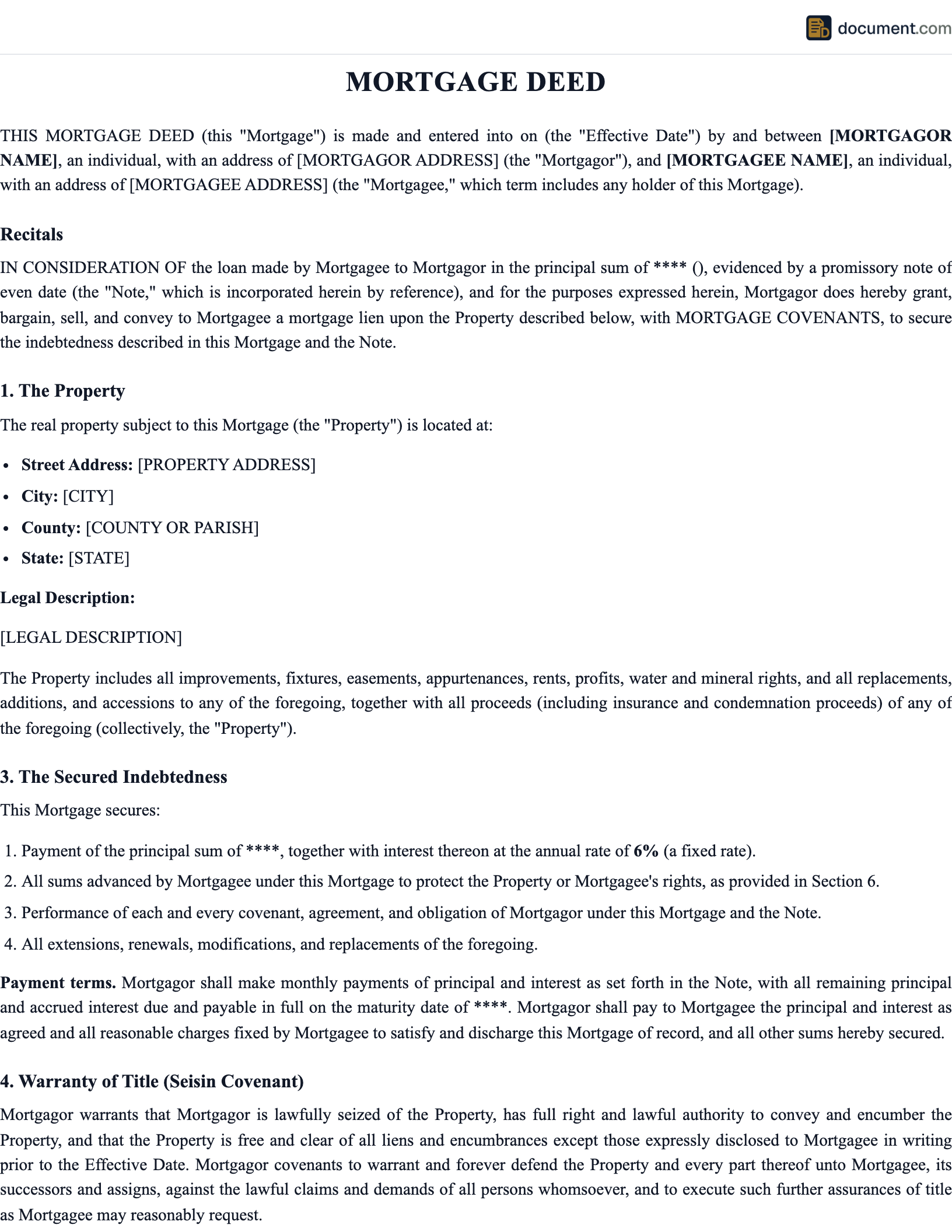
Sample Maryland Mortgage Deed
Preview of our Maryland-specific template. Your document will include all fields required for recording in any Maryland county.
MORTGAGE DEED
STATE OF MARYLAND
Legal Document
PARTY INFORMATION
Name: [Full Legal Name]
Address: [Maryland Address]
County: [County]
PROPERTY DESCRIPTION
County: [County] State: Maryland
Legal Description: [Per Recorded Plat]
Parcel No.: [APN]
Maryland Mortgage Deed FAQ
Common questions about filing in Maryland, including requirements, fees, and tax implications.
Official Maryland Resources
Official state resources for verifying requirements and finding your local recording office.
Important Considerations
The choice between a mortgage deed and a deed of trust matters more in Maryland than in most states because it directly determines how quickly and at what cost a lender can enforce their security interest in the event of default. A traditional mortgage deed requires judicial foreclosure, which takes longer and costs more. A deed of trust with a power-of-sale clause allows the trustee to foreclose non-judicially once notice and cure requirements are met. Most sophisticated Maryland lenders use the deed of trust form specifically for this flexibility.
Ground rent properties in older sections of Baltimore City deserve special attention before mortgaging. Maryland's ground rent system means the homeowner may own the structure but not the land beneath it. If a borrower owns only a leasehold interest, the lender's mortgage attaches to that leasehold, not the fee simple. Maryland passed legislation in 2007 requiring ground rent holders to register their ground rents and giving leaseholders the right to redeem and extinguish ground rents under certain circumstances. Title searches on Baltimore City properties should always include a ground rent check.
Maryland's recordation tax refinance exemption can save thousands of dollars on a refinance transaction if applied correctly. The exemption reduces the recordation tax when the new loan does not exceed the outstanding principal balance of the existing mortgage being retired. The exemption must be affirmatively claimed and documented at recording, and the Land Records office will want to see evidence of the prior mortgage's outstanding balance. Working with a Maryland title company or settlement attorney who handles this routinely is the most reliable way to ensure the exemption is properly applied.
Maryland Practice Note
Maryland's recording costs vary significantly across its 23 counties and Baltimore City, and the total tax burden on a new mortgage can be substantially higher than in neighboring states. Always obtain a precise closing cost estimate from a Maryland title company or settlement attorney before finalizing a transaction. Do not rely on generic state averages when budgeting for recording taxes in Maryland.
Related Documents
Depending on your situation, you may need additional documents alongside this one. Below are commonly related documents that are frequently used together in real estate transactions.
Important Considerations
Before proceeding with your document, there are several important factors to consider. Each real estate transaction is unique, and understanding the specific requirements and implications of your situation will help ensure a smooth and legally compliant process.
Real estate laws and regulations are subject to change, and local requirements may differ from state-level rules. It is always advisable to verify current requirements with your local recording office before submitting any documents for recording.
If your transaction involves complex circumstances such as multiple parties, commercial properties, trusts, estates, or interstate elements, consulting with a licensed real estate attorney is strongly recommended. An attorney can provide guidance specific to your situation and help you avoid potential legal issues.
Keep copies of all documents related to your real estate transaction in a safe place. Recorded documents become part of the public record, but having your own copies ensures you can reference the terms and conditions at any time. Digital copies stored securely are also recommended as a backup.
Professional Recommendation
While our templates are designed to be comprehensive and legally compliant, we recommend having your completed document reviewed by a licensed attorney before recording, especially for high-value transactions or complex situations. Many attorneys offer flat-fee document review services that provide peace of mind at a reasonable cost.
Related Documents
Depending on your situation, you may need additional documents alongside this one. Below are commonly related documents that are frequently used together in real estate transactions.
Create your Maryland Mortgage Deed in under 5 minutes.
Answer a few questions and download a Maryland-compliant document, ready for the state agency.