



Maine Mortgage Deed Overview
Maine is a mortgage state that uses the mortgage deed as its primary real property security instrument. The borrower retains title while the mortgage creates a lien that can be enforced through court proceedings if the borrower defaults. Maine is notable for offering both traditional judicial foreclosure and a non-judicial power-of-sale process added by statute in 2009, giving lenders more flexibility in how they address defaults than most northeastern states provide.
Mortgage deeds in Maine are recorded with the county Registry of Deeds. Maine charges a real estate transfer tax of $2.20 per $500 of value, and recording fees start around $13 per page. Notarization is required; no additional witnesses are needed beyond the notary. One particularly important Maine feature is the 90-day redemption period that follows a foreclosure judgment, which borrowers should understand before they are in a default situation rather than after.
$13
Recording fee
$2.20 per $500
Transfer tax
Required
Notarization
0
Witnesses required
Maine Requirements
Maine Registries of Deeds generally require documents to have adequate margins, legible type, and a clear acknowledgment section conforming to the statutory form under 33 M.R.S.A. section 203. The legal description should be taken word-for-word from the current deed of record, as errors in the legal description can cause recording rejections or title defects that surface during later title searches. Each Registry may have its own cover sheet form or formatting requirements, so confirming details with the specific county registry is always worthwhile.
Maine Specific Note
Maine's real estate transfer tax is $2.20 per $500 of consideration and is typically split between buyer and seller in a sale transaction. For mortgage recordings that are part of a refinance rather than a purchase, confirm with the Registry or a Maine attorney how the transfer tax applies to your specific transaction. Recording fees are charged on a per-page basis starting around $13, and some registries have additional fees for cover sheets or indexing.
Document Requirements
- Notarization: Must be notarized by a Maine notary public or authorized notary
- Witnesses: Maine requires 0 additional witness(es)
- Legal Description: Complete legal description as it appears on the current deed of record
- Parcel Number: Assessor's parcel number or tax ID
- Return Address: Mailing address for returning the recorded document
- Formatting: Standard formatting with adequate margins, black ink, minimum 10-point font
How to File in Maine
Recording a mortgage deed in Maine is straightforward by most standards. Maine's requirements are less complex than Louisiana's and the process is more predictable than in states with heavy transfer taxes or dual-office recording systems. Here is what to expect.
Prepare the Mortgage Deed
Enter the full legal names of all mortgagors and mortgagees, the verbatim legal description from the current Registry of Deeds record, the municipality and county of the property, the loan amount and maturity date, and a return address for the recorded document. Maine property descriptions are often detailed metes and bounds descriptions, so transcribe them carefully.
Acknowledge Before a Notary
The mortgagor must sign before a Maine notary public or another officer authorized to take acknowledgments under Maine law. No additional witnesses are required beyond the notary. The acknowledgment block should substantially follow the form set out in 33 M.R.S.A. section 203. Make sure the notary completes all required fields including their commission expiration date.
Submit to the Registry of Deeds
File the original notarized document with the Registry of Deeds in the county where the property is located. Contact the specific registry in advance to confirm whether they accept walk-in, mail, or e-recording submissions and what payment methods they accept. Most Maine registries process walk-in filings the same day.
Pay Recording Fees and Transfer Tax
Maine charges a per-page recording fee starting around $13 and a real estate transfer tax of $2.20 per $500 of consideration. For purchase mortgages, the transfer tax is calculated on the sale price. Confirm with the Registry or a Maine attorney how the tax applies to refinance mortgages specifically.
Secure the Recorded Instrument
After recording, the Registry stamps the document with a book and page or document number and returns it. This stamped original is your proof that the mortgage was perfected as of the recorded date and time. Store it with your other property documents. The mortgage lasts until it is discharged by a recorded release or release of mortgage when the loan is paid off.
Maine Fees & Costs
Typical costs for filing in Maine. Actual fees may vary by county.
| Fee / Tax | Amount |
|---|---|
| Recording Fee | $13 |
| Transfer Tax | $2.20 per $500 |
| Notarization | $5 - $25 per signature |
| Certified Copy | $1 - $10 per page |
| Attorney Review (optional) | $150 - $500 |
Maine Tax Implications
Maine's real estate transfer tax of $2.20 per $500 is split equally between the buyer and the seller in a purchase transaction, meaning each party typically pays $1.10 per $500. The tax is based on the actual purchase price, not the mortgage amount. For refinances where there is no change in ownership, the transfer tax generally does not apply, though the specifics depend on how the transaction is structured. Confirm with the Registry or a Maine attorney before assuming a refinance is exempt.
Maine has a state income tax and also taxes capital gains. When mortgaged property is eventually sold, any capital gain is subject to Maine income tax as well as federal capital gains tax. Maine does not have a separate capital gains rate; gains are taxed as ordinary income at the applicable Maine income tax rate. There is no special homestead exclusion under Maine state law that mirrors the federal $250,000/$500,000 exclusion, so both the federal and state tax implications of a future sale should be considered when structuring a mortgage transaction.
Property taxes in Maine are assessed and collected by the municipality rather than the county. Municipal property tax bills are typically issued in September or October and may be paid in one or two installments depending on the town. Maine offers a homestead exemption program for primary residences and a property tax fairness credit for lower-income owners. Lenders typically require property tax escrow to prevent unpaid taxes from becoming a senior lien that could threaten the mortgage's position.
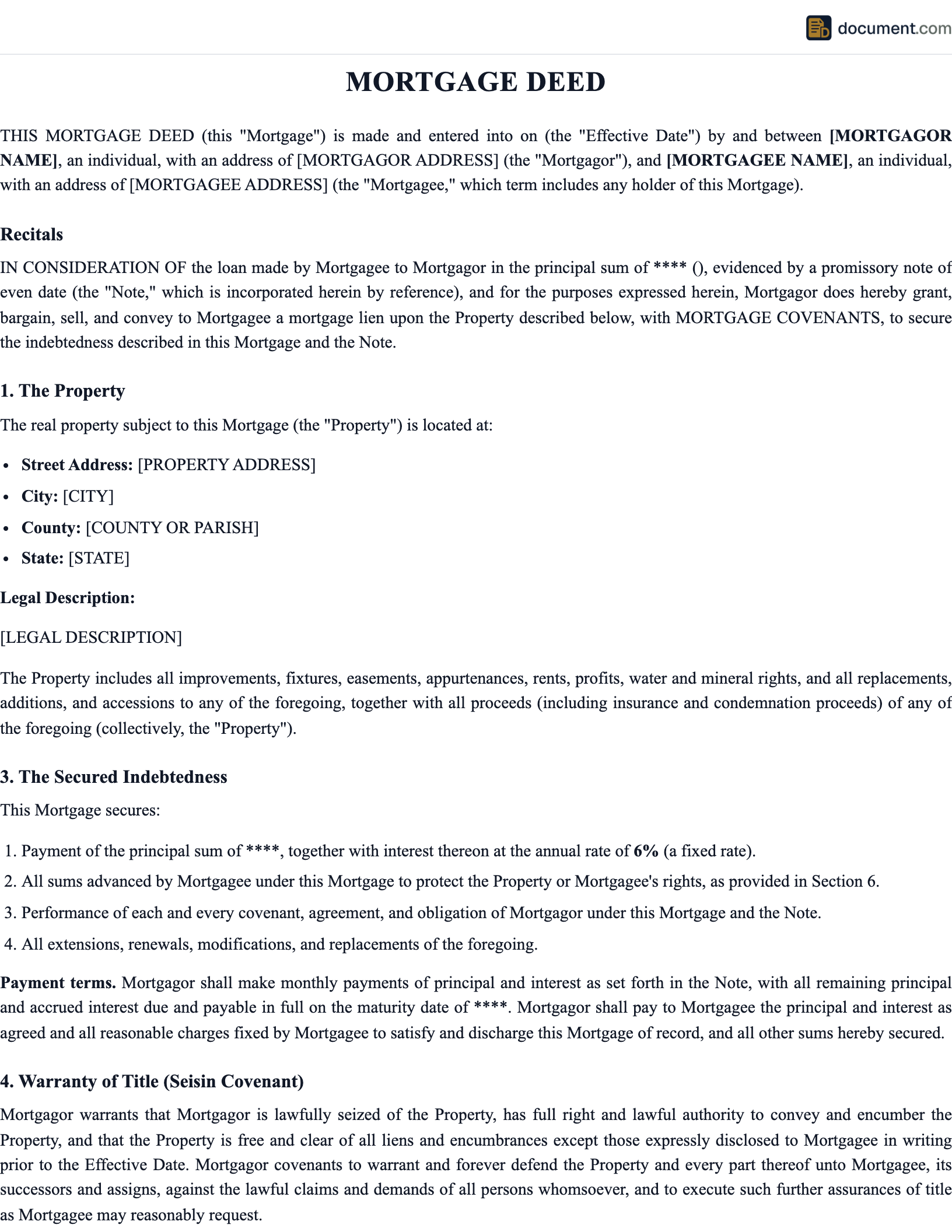
Sample Maine Mortgage Deed
Preview of our Maine-specific template. Your document will include all fields required for recording in any Maine county.
MORTGAGE DEED
STATE OF MAINE
Legal Document
PARTY INFORMATION
Name: [Full Legal Name]
Address: [Maine Address]
County: [County]
PROPERTY DESCRIPTION
County: [County] State: Maine
Legal Description: [Per Recorded Plat]
Parcel No.: [APN]
Maine Mortgage Deed FAQ
Common questions about filing in Maine, including requirements, fees, and tax implications.
Official Maine Resources
Official state resources for verifying requirements and finding your local recording office.
Important Considerations
Maine's dual foreclosure options give lenders and borrowers a different dynamic than in states with only one path. The availability of statutory non-judicial foreclosure under the 2009 power-of-sale statute means lenders can move faster on defaults without going to court, but borrowers retain the 90-day redemption right either way. Understanding which foreclosure process a lender is likely to use is relevant both at the time the mortgage is written and if a default situation arises.
Rural properties in Maine deserve extra attention at the title search stage. Maine has a significant amount of land that was subdivided, partitioned, or conveyed by deed descriptions that were prepared before modern survey standards. Gaps, overlaps, and disputed boundary lines are not uncommon in older Maine parcels. A thorough title search back through the chain of title, combined with a survey for rural properties, is the right approach before mortgaging rural Maine land.
Seasonal properties are prevalent in Maine, and mortgaging a camp, cottage, or recreational property can raise lender-specific issues. Some lenders place different underwriting requirements on seasonal properties or non-primary residences, including higher down payment requirements, different interest rates, or seasonal escrow arrangements. Borrowers should discuss the property's use and condition with their lender early in the process to avoid surprises at closing.
Maine Practice Note
Maine's 16 county registries each operate somewhat independently. e-recording availability, fee schedules, cover sheet requirements, and processing times vary across counties. Always confirm the current requirements with the specific Registry of Deeds for the county where your property is located before you submit any recording.
Related Documents
Depending on your situation, you may need additional documents alongside this one. Below are commonly related documents that are frequently used together in real estate transactions.
Important Considerations
Before proceeding with your document, there are several important factors to consider. Each real estate transaction is unique, and understanding the specific requirements and implications of your situation will help ensure a smooth and legally compliant process.
Real estate laws and regulations are subject to change, and local requirements may differ from state-level rules. It is always advisable to verify current requirements with your local recording office before submitting any documents for recording.
If your transaction involves complex circumstances such as multiple parties, commercial properties, trusts, estates, or interstate elements, consulting with a licensed real estate attorney is strongly recommended. An attorney can provide guidance specific to your situation and help you avoid potential legal issues.
Keep copies of all documents related to your real estate transaction in a safe place. Recorded documents become part of the public record, but having your own copies ensures you can reference the terms and conditions at any time. Digital copies stored securely are also recommended as a backup.
Professional Recommendation
While our templates are designed to be comprehensive and legally compliant, we recommend having your completed document reviewed by a licensed attorney before recording, especially for high-value transactions or complex situations. Many attorneys offer flat-fee document review services that provide peace of mind at a reasonable cost.
Related Documents
Depending on your situation, you may need additional documents alongside this one. Below are commonly related documents that are frequently used together in real estate transactions.
Create your Maine Mortgage Deed in under 5 minutes.
Answer a few questions and download a Maine-compliant document, ready for the state agency.