



Louisiana Mortgage Deed Overview
Louisiana stands apart from every other state in the country when it comes to real property law. As a civil law jurisdiction rooted in the French and Spanish legal traditions rather than English common law, Louisiana has its own civil code, its own recording system, and its own formal requirements for mortgage instruments that have no real counterpart elsewhere in the United States. Attorneys practicing Louisiana real estate law must be specifically trained in civilian concepts, and standard common-law mortgage documents used in other states will not work here.
A Louisiana mortgage must be executed as an authentic act, requiring the simultaneous physical presence of the mortgagor, the mortgagee or their agent, a Louisiana-commissioned notary, and two competent witnesses. The notary must paraph the pages. Mortgages are recorded in the parish Mortgage Office (separate from the Conveyance records), and Louisiana permits only judicial foreclosure. There is no non-judicial power-of-sale option, though the executory process available under the Louisiana Code of Civil Procedure can be faster than ordinary foreclosure proceedings.
$50
Recording fee
None
Transfer tax
Required
Notarization
2
Witnesses required
Louisiana Requirements
Louisiana's requirements for mortgage execution are more demanding than any other state's. The authentic act requirement means that the signing ceremony must bring together all parties, both witnesses, and the notary in the same room at the same time. Remote notarization as practiced in other states is not sufficient to create an authentic act in Louisiana. The notary paraphs the pages, the witnesses sign, and the instrument is then ready for recording in the parish Mortgage Office, not the Conveyance Office.
Louisiana Specific Note
Louisiana mortgages must be recorded in the Mortgage Office of the parish Clerk of Court, not in the Conveyance Office. Recording in the wrong office does not provide legally effective notice of the mortgage. Two competent witnesses (not parties to the transaction) and a Louisiana-licensed notary must all be physically present at the signing simultaneously. Recording fees vary by parish and by number of pages; confirm current fees with your parish Clerk of Court.
Document Requirements
- Notarization: Must be notarized by a Louisiana notary public or authorized notary
- Witnesses: Louisiana requires 2 additional witness(es)
- Legal Description: Complete legal description as it appears on the current deed of record
- Parcel Number: Assessor's parcel number or tax ID
- Return Address: Mailing address for returning the recorded document
- Formatting: Standard formatting with adequate margins, black ink, minimum 10-point font
How to File in Louisiana
Filing a mortgage in Louisiana is more involved than in common law states, primarily because of the authentic act requirement and the two-office recording system. Each step below reflects Louisiana civil law practice specifically.
Draft the Mortgage Instrument
Include the full legal description of the property as it appears in the conveyance records, the names and addresses of all parties, the amount and terms of the debt being secured, and the legal description of the property. Because Louisiana uses a civil code framework, the language and structure of a Louisiana mortgage differs materially from common law mortgage forms used in other states.
Execute the Authentic Act
All signing parties, two competent witnesses, and the Louisiana-commissioned notary must be physically present in the same location at the same time. The notary reads or presents the instrument, all parties and witnesses sign in each other's presence, and the notary completes the attestation and paraphs each page. There are no shortcuts to this process under Louisiana law.
File in the Mortgage Office
Take the original instrument to the Mortgage Office of the Clerk of Court in the parish where the property is located. Do not file it in the Conveyance Office. The Mortgage Office indexes the mortgage separately from property sales and conveyances. Filing in the wrong office is a critical error that can affect the mortgage's priority and enforceability.
Pay Recording Fees
Louisiana does not impose a statewide mortgage tax, so there is no tax calculated on the loan amount. The Clerk of Court charges a recording fee based on the number of pages. Fee schedules vary by parish, so confirm the current amount with the specific Clerk of Court before submitting.
Retain the Recorded Original
After recording, the Clerk will return the instrument with a stamp confirming the registry entry number and date. The mortgage is effective against third parties from the time it is filed in the Mortgage Office. Keep the recorded original in a secure location; in Louisiana, the notary also typically retains a copy of authentic acts in their notarial archives.
Louisiana Fees & Costs
Typical costs for filing in Louisiana. Actual fees may vary by county.
| Fee / Tax | Amount |
|---|---|
| Recording Fee | $50 |
| Transfer Tax | None |
| Notarization | $5 - $25 per signature |
| Certified Copy | $1 - $10 per page |
| Attorney Review (optional) | $150 - $500 |
Louisiana Tax Implications
Louisiana does not levy a statewide mortgage tax or documentary stamp tax based on the loan amount, which keeps recording costs relatively low. The primary costs are the notary's fee for drafting and executing the authentic act and the Clerk of Court's per-page recording fee. Notary fees in Louisiana vary considerably depending on the complexity of the transaction and the notary's practice, since Louisiana notaries have professional training comparable to civil law attorneys in other countries.
Louisiana property is subject to parish-level property taxes assessed by the parish assessor. Louisiana also has a homestead exemption that reduces the taxable assessed value of a primary residence by up to $75,000. The homestead exemption applies to the property tax assessment but does not affect the mortgage or its enforceability. Lenders typically require property tax escrow for mortgaged properties to ensure that taxes are paid before they become a superior lien on the property.
Louisiana's community property regime is another tax consideration that does not arise in common law states. Property acquired during a marriage in Louisiana is generally community property, and both spouses may have interests in the mortgaged property even if only one spouse is the titled owner. This can affect how the transaction is characterized for federal income tax purposes, particularly in the event of foreclosure, and is worth discussing with a Louisiana tax advisor on high-value transactions.
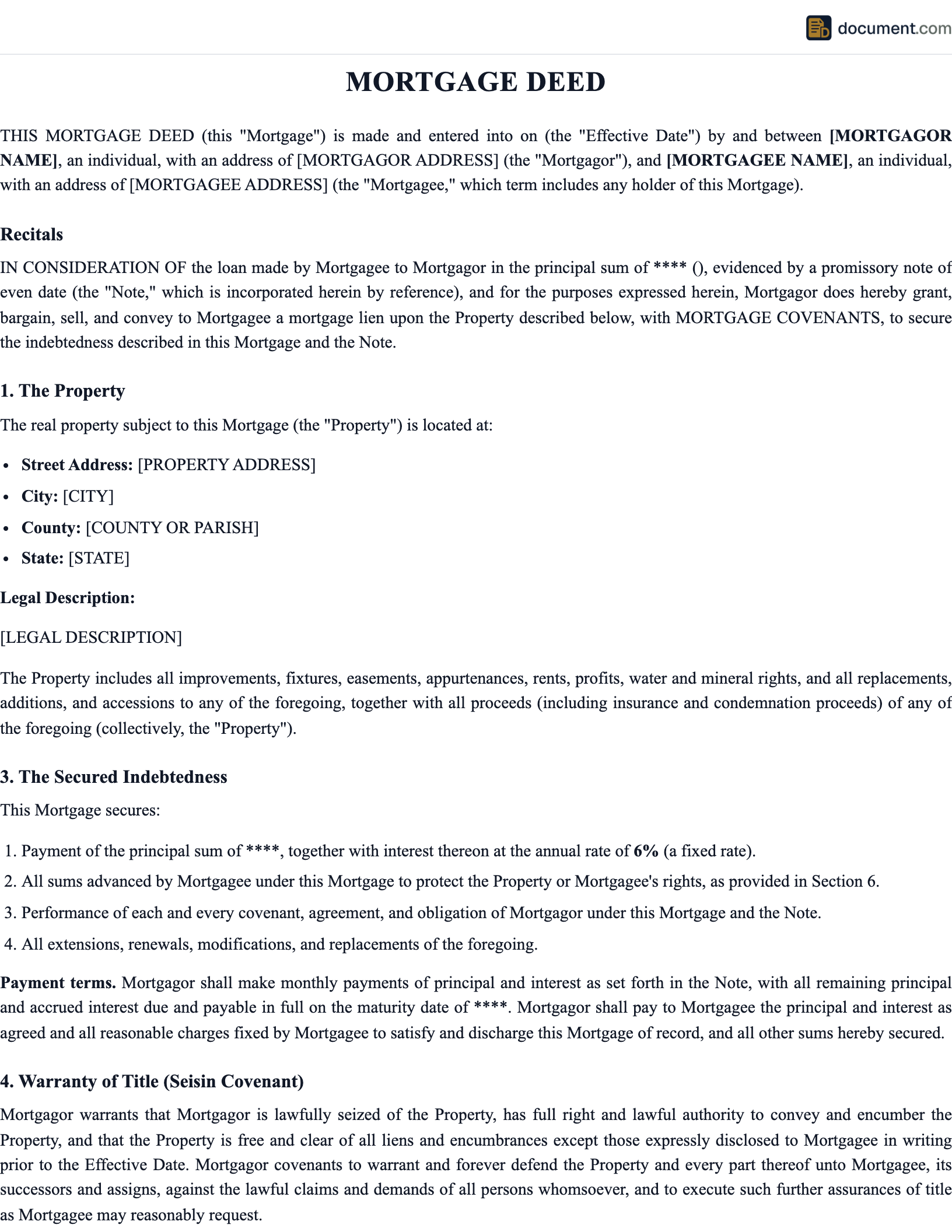
Sample Louisiana Mortgage Deed
Preview of our Louisiana-specific template. Your document will include all fields required for recording in any Louisiana county.
MORTGAGE DEED
STATE OF LOUISIANA
Legal Document
PARTY INFORMATION
Name: [Full Legal Name]
Address: [Louisiana Address]
County: [County]
PROPERTY DESCRIPTION
County: [County] State: Louisiana
Legal Description: [Per Recorded Plat]
Parcel No.: [APN]
Louisiana Mortgage Deed FAQ
Common questions about filing in Louisiana, including requirements, fees, and tax implications.
Official Louisiana Resources
Official state resources for verifying requirements and finding your local recording office.
Important Considerations
Louisiana's civil law system is not a minor variation on common law mortgage practice; it is a fundamentally different legal tradition. Forms and procedures that work perfectly well in Alabama or Texas will not produce a valid mortgage in Louisiana. This is not hyperbole. Courts have invalidated Louisiana mortgages prepared using common law forms or with defective authentic act ceremonies, leaving lenders without enforceable security interests in the property.
Community property rules deserve attention in every Louisiana mortgage transaction involving a married borrower. Under Louisiana's community property regime, debts incurred during the marriage may create claims against community property. A lender taking a mortgage on property that is community-owned generally needs both spouses to sign the mortgage, even if only one spouse is the borrower. Failure to address this correctly can limit the mortgage's enforceability.
The notary in Louisiana plays a role that goes beyond signing and stamping. Louisiana notaries are responsible for drafting authentic acts, advising parties, maintaining notarial archives, and certifying the document's authenticity. On a Louisiana mortgage, the notary is not just a witness verifier; they are an integral part of the legal instrument itself. Choosing a notary experienced in real estate mortgage transactions is particularly important when the transaction involves complex debt structures or property with title issues.
Louisiana Practice Note
Louisiana mortgage practice is one of the most specialized areas of real estate law in the country. Working with a Louisiana-licensed notary and, for significant transactions, a Louisiana real estate attorney is not just recommended; it is essential to ensure your mortgage instrument is validly executed and properly recorded in the Mortgage Office, not the Conveyance Office. The two offices serve entirely different legal functions in Louisiana's recording system.
Related Documents
Depending on your situation, you may need additional documents alongside this one. Below are commonly related documents that are frequently used together in real estate transactions.
Important Considerations
Before proceeding with your document, there are several important factors to consider. Each real estate transaction is unique, and understanding the specific requirements and implications of your situation will help ensure a smooth and legally compliant process.
Real estate laws and regulations are subject to change, and local requirements may differ from state-level rules. It is always advisable to verify current requirements with your local recording office before submitting any documents for recording.
If your transaction involves complex circumstances such as multiple parties, commercial properties, trusts, estates, or interstate elements, consulting with a licensed real estate attorney is strongly recommended. An attorney can provide guidance specific to your situation and help you avoid potential legal issues.
Keep copies of all documents related to your real estate transaction in a safe place. Recorded documents become part of the public record, but having your own copies ensures you can reference the terms and conditions at any time. Digital copies stored securely are also recommended as a backup.
Professional Recommendation
While our templates are designed to be comprehensive and legally compliant, we recommend having your completed document reviewed by a licensed attorney before recording, especially for high-value transactions or complex situations. Many attorneys offer flat-fee document review services that provide peace of mind at a reasonable cost.
Related Documents
Depending on your situation, you may need additional documents alongside this one. Below are commonly related documents that are frequently used together in real estate transactions.
Create your Louisiana Mortgage Deed in under 5 minutes.
Answer a few questions and download a Louisiana-compliant document, ready for the state agency.